

Refrigerant services company Hudson Technologies (NASDAQ: HDSN) reported Q1 CY2026 results exceeding the market’s revenue expectations, with sales up 8.7% year on year to $60.15 million. Guidance for next quarter’s revenue was better than expected at $74.5 million at the midpoint, 0.7% above analysts’ estimates. Its GAAP profit of $0.01 per share was 84% below analysts’ consensus estimates.
Is now the time to buy Hudson Technologies? Find out by accessing our full research report, it’s free.
Hudson Technologies (HDSN) Q1 CY2026 Highlights:
- Revenue: $60.15 million vs analyst estimates of $57.15 million (8.7% year-on-year growth, 5.2% beat)
- EPS (GAAP): $0.01 vs analyst expectations of $0.06 (84% miss)
- Adjusted Operating Income: $1.63 million vs analyst estimates of $3.00 million (2.7% margin, 45.5% miss)
- Revenue Guidance for Q2 CY2026 is $74.5 million at the midpoint, roughly in line with what analysts were expecting
- Operating Margin: 2.4%, down from 5.6% in the same quarter last year
- Free Cash Flow was -$13.88 million, down from $12.75 million in the same quarter last year
- Market Capitalization: $264.6 million
Ken Gaglione, President and Chief Executive Officer of Hudson Technologies commented, ”Our first quarter was one of operational and strategic progress, highlighted by enhancements to our management team, critical partnership development and our increased focus on operational excellence as we move into the core of our selling season.
Company Overview
Founded in 1991, Hudson Technologies (NASDAQ: HDSN) specializes in refrigerant services and solutions, providing refrigerant sales, reclamation, and recycling.
Revenue Growth
A company’s long-term performance is an indicator of its overall quality. Even a bad business can shine for one or two quarters, but a top-tier one grows for years. Thankfully, Hudson Technologies’s 11.6% annualized revenue growth over the last five years was impressive. Its growth beat the average industrials company and shows its offerings resonate with customers.
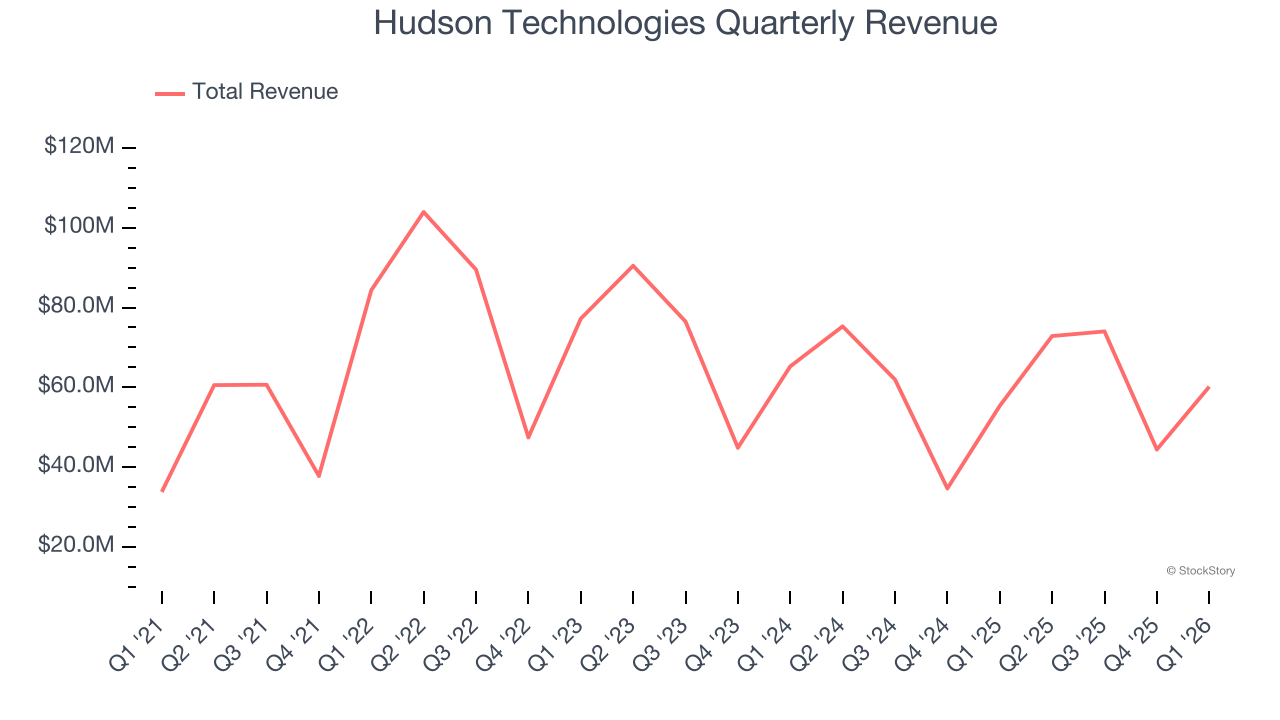
We at StockStory place the most emphasis on long-term growth, but within industrials, a half-decade historical view may miss cycles, industry trends, or a company capitalizing on catalysts such as a new contract win or a successful product line. Hudson Technologies’s recent performance marks a sharp pivot from its five-year trend as its revenue has shown annualized declines of 4.7% over the last two years. 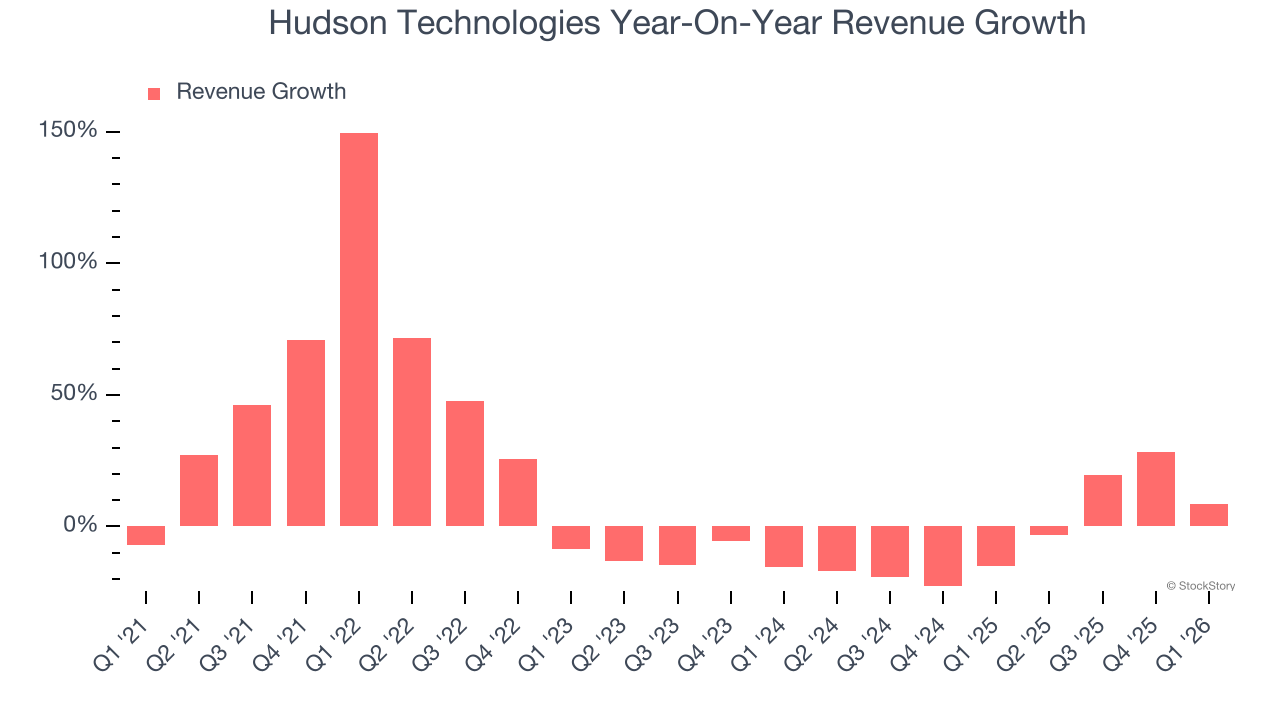
This quarter, Hudson Technologies reported year-on-year revenue growth of 8.7%, and its $60.15 million of revenue exceeded Wall Street’s estimates by 5.2%. Company management is currently guiding for a 2.3% year-on-year increase in sales next quarter.
Looking further ahead, sell-side analysts expect revenue to remain flat over the next 12 months. Although this projection implies its newer products and services will spur better top-line performance, it is still below average for the sector.
ONE MORE THING: The $21 AI Application Stock Wall Street Forgot. While Wall Street obsesses over who’s building AI, one company is already using it to print money. And nobody’s paying attention.
AI chip stocks trade at ridiculous valuations. This company processes a trillion consumer signals monthly using AI and trades at a third of the price. The gap won’t last. The institutions will figure it out. You need to see this first. Read the FREE Report Before They Notice.
Operating Margin
Operating margin is one of the best measures of profitability because it tells us how much money a company takes home after procuring and manufacturing its products, marketing and selling those products, and most importantly, keeping them relevant through research and development.
Hudson Technologies has been a well-oiled machine over the last five years. It demonstrated elite profitability for an industrials business, boasting an average operating margin of 23.1%. This result isn’t surprising as its high gross margin gives it a favorable starting point.
Looking at the trend in its profitability, Hudson Technologies’s operating margin decreased by 24.1 percentage points over the last five years. This raises questions about the company’s expense base because its revenue growth should have given it leverage on its fixed costs, resulting in better economies of scale and profitability.
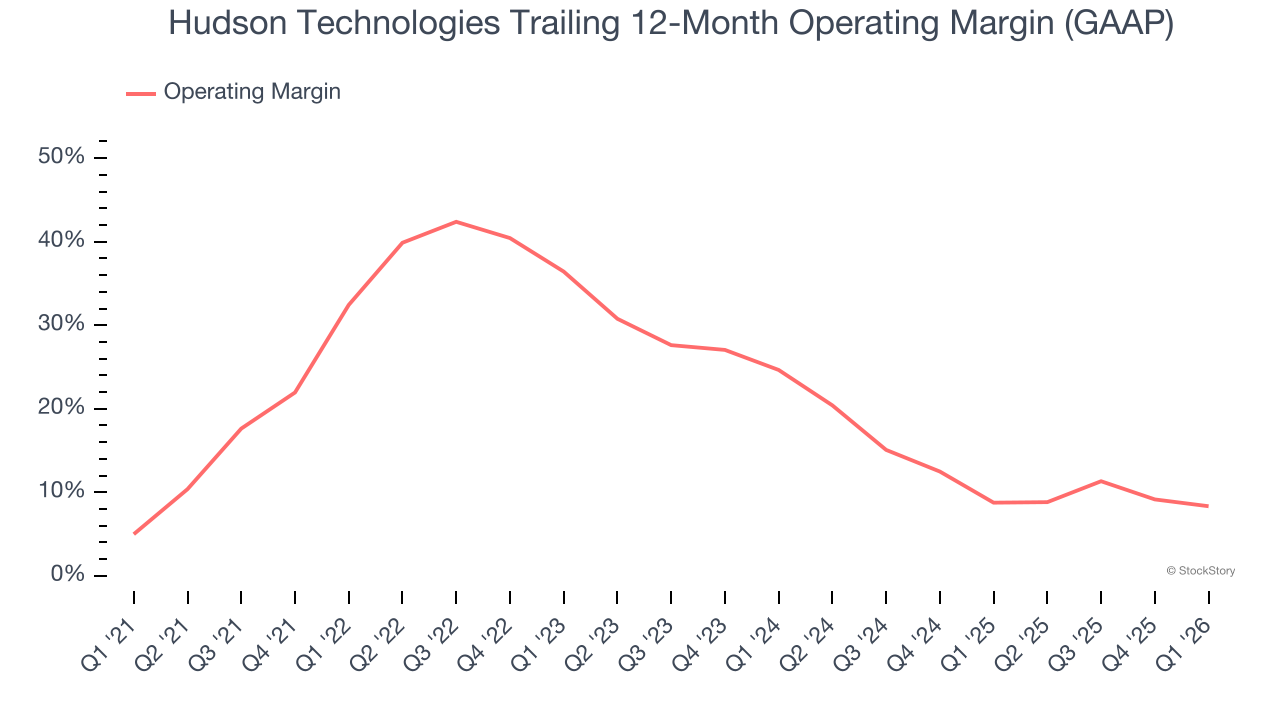
This quarter, Hudson Technologies generated an operating margin profit margin of 2.4%, down 3.1 percentage points year on year. Since Hudson Technologies’s operating margin decreased more than its gross margin, we can assume it was less efficient because expenses such as marketing, R&D, and administrative overhead increased.
Earnings Per Share
Revenue trends explain a company’s historical growth, but the long-term change in earnings per share (EPS) points to the profitability of that growth – for example, a company could inflate its sales through excessive spending on advertising and promotions.
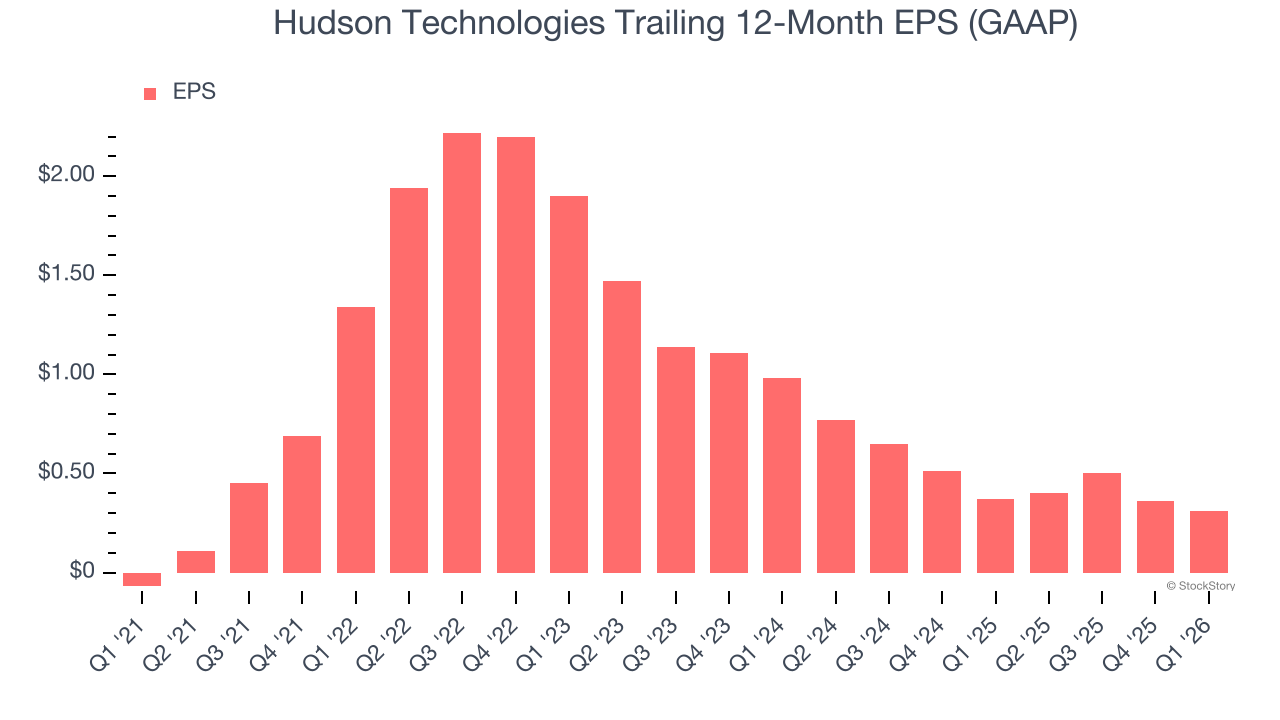
Hudson Technologies’s full-year EPS flipped from negative to positive over the last five years. This is encouraging and shows it’s at a critical moment in its life.
Like with revenue, we analyze EPS over a shorter period to see if we are missing a change in the business.
Sadly for Hudson Technologies, its EPS declined by more than its revenue over the last two years, dropping 43.8%. This tells us the company struggled to adjust to shrinking demand.
We can take a deeper look into Hudson Technologies’s earnings to better understand the drivers of its performance. Hudson Technologies’s operating margin has declined over the last two years. This was the most relevant factor (aside from the revenue impact) behind its lower earnings; interest expenses and taxes can also affect EPS but don’t tell us as much about a company’s fundamentals.
In Q1, Hudson Technologies reported EPS of $0.01, down from $0.06 in the same quarter last year. This print missed analysts’ estimates, but we care more about long-term EPS growth than short-term movements. We also like to analyze expected EPS growth based on Wall Street analysts’ consensus projections, but there is insufficient data.
Key Takeaways from Hudson Technologies’s Q1 Results
We were impressed by how significantly Hudson Technologies blew past analysts’ revenue expectations this quarter. On the other hand, its adjusted operating income missed and its EPS fell short of Wall Street’s estimates. Overall, this was a softer quarter. The stock traded down 3% to $6.35 immediately following the results.
Hudson Technologies underperformed this quarter, but does that create an opportunity to invest right now? The latest quarter does matter, but not nearly as much as longer-term fundamentals and valuation, when deciding if the stock is a buy. We cover that in our actionable full research report which you can read here (it’s free).