Cybersecurity AI platform provider SentinelOne (NYSE: S) met Wall Street’s revenue expectations in Q1 CY2026, with sales up 20.8% year on year to $276.7 million. On the other hand, next quarter’s revenue guidance of $290 million was less impressive, coming in 0.6% below analysts’ estimates. Its non-GAAP profit of $0.04 per share was $0.02 above analysts’ consensus estimates.
Is now the time to buy SentinelOne? Find out by accessing our full research report, it’s free.
SentinelOne (S) Q1 CY2026 Highlights:
- Revenue: $276.7 million vs analyst estimates of $277.2 million (20.8% year-on-year growth, in line)
- Adjusted EPS: $0.04 vs analyst estimates of $0.02 ($0.02 beat)
- Adjusted Operating Income: $10.55 million vs analyst estimates of $5.30 million (3.8% margin, 99.1% beat)
- The company dropped its revenue guidance for the full year to $1.2 million at the midpoint from $1.2 billion, a 99.9% decrease
- Management reiterated its full-year Adjusted EPS guidance of $0.35 at the midpoint
- Operating Margin: -28.8%, up from -38.2% in the same quarter last year
- Free Cash Flow was $30.72 million, up from -$2.31 million in the previous quarter
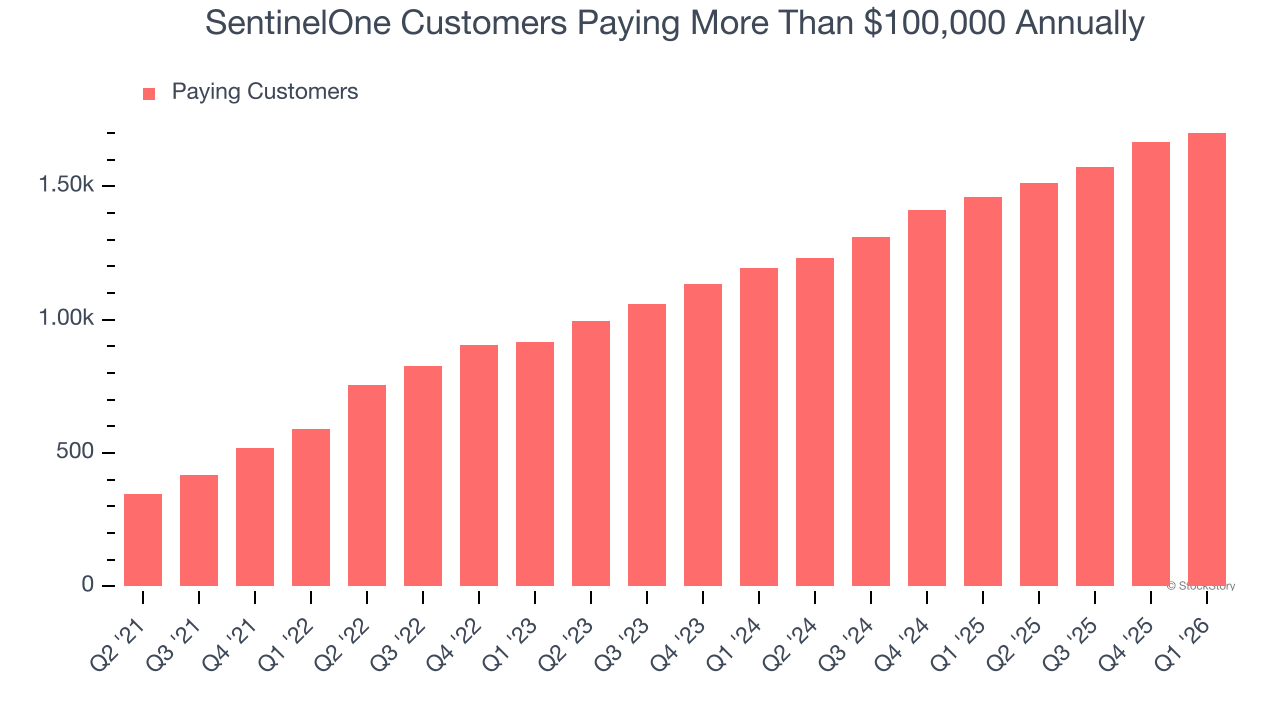
- Customers: 1,702 customers paying more than $100,000 annually
- Annual Recurring Revenue: $1.16 billion vs analyst estimates of $1.16 billion (22.7% year-on-year growth, in line)
- Billings: $229.8 million at quarter end, up 13.6% year on year
- Market Capitalization: $6.11 billion
“We had a solid start to the year, highlighted by record net new ARR growth and a landmark milestone as our emerging solutions reached half of our total company ARR,” said Tomer Weingarten, CEO of SentinelOne.
Company Overview
Built on the principle of "fighting machine with machine," SentinelOne (NYSE: S) provides an AI-powered cybersecurity platform that autonomously prevents, detects, and responds to threats across endpoints, cloud workloads, and identity systems.
Revenue Growth
A company’s long-term sales performance is one signal of its overall quality. Even a bad business can shine for one or two quarters, but a top-tier one grows for years. Luckily, SentinelOne’s sales grew at an incredible 56.3% compounded annual growth rate over the last five years. Its growth beat the average software company and shows its offerings resonate with customers, a helpful starting point for our analysis.
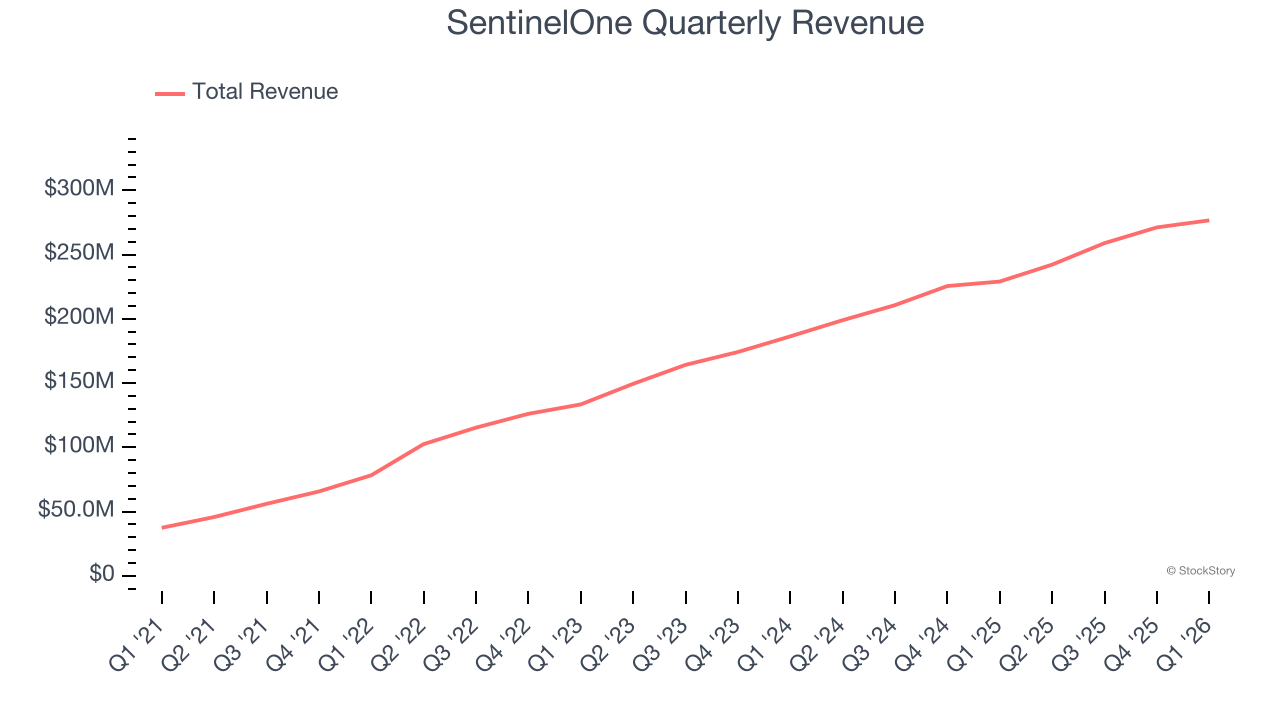
We at StockStory place the most emphasis on long-term growth, but within software, a half-decade historical view may miss recent innovations or disruptive industry trends. SentinelOne’s annualized revenue growth of 24.7% over the last two years is below its five-year trend, but we still think the results suggest healthy demand. 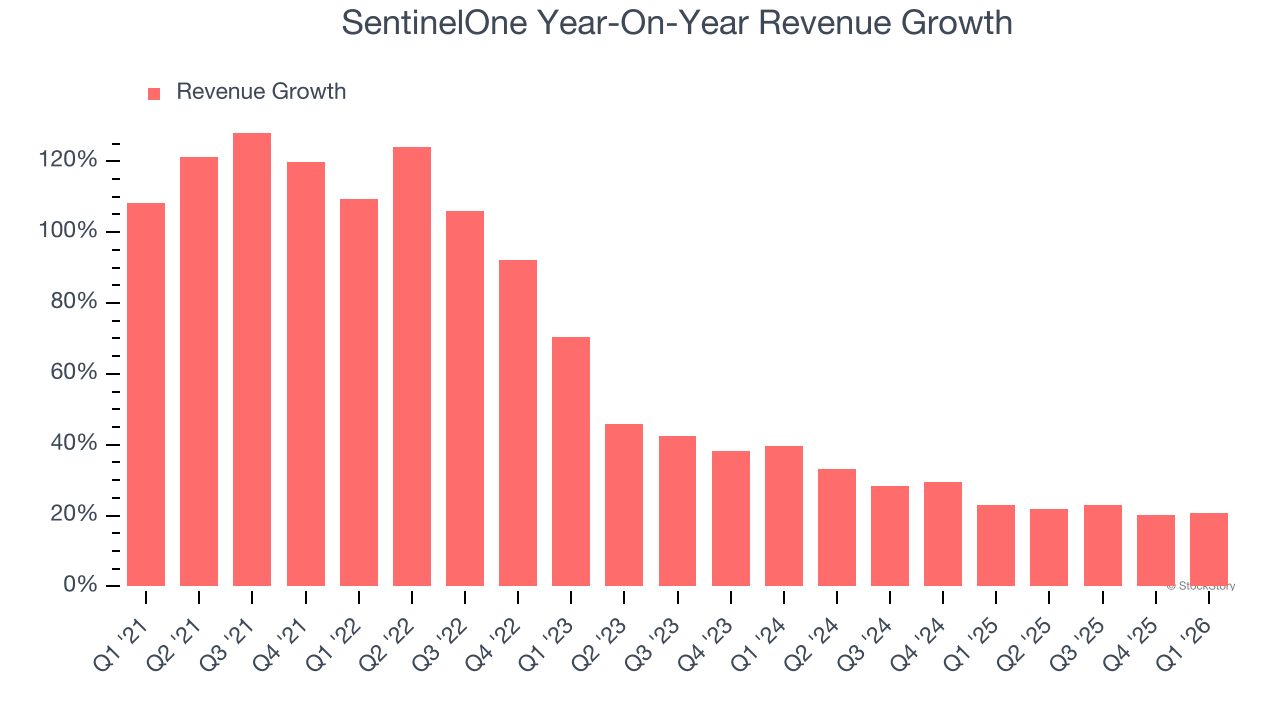
This quarter, SentinelOne’s year-on-year revenue growth of 20.8% was excellent, and its $276.7 million of revenue was in line with Wall Street’s estimates. Company management is currently guiding for a 19.7% year-on-year increase in sales next quarter.
Looking further ahead, sell-side analysts expect revenue to grow 19.5% over the next 12 months, a deceleration versus the last two years. Despite the slowdown, this projection is admirable and indicates the market sees success for its products and services.
ALSO WORTH WATCHING: Nvidia’s Quiet Partner. Nvidia’s chips cost a hundred grand. The connectors that make them work cost even more. One company makes them all.
Every AI server needs specialized infrastructure the chip companies don’t make. High-speed cables. Power connectors. Thermal sensors. This 90-year-old company built a monopoly on it. The AI boom just started. This stock is still flying under the radar. Claim The Stock Ticker Here for FREE.
Annual Recurring Revenue
While reported revenue for a software company can include low-margin items like implementation fees, annual recurring revenue (ARR) is a sum of the next 12 months of contracted revenue purely from software subscriptions, or the high-margin, predictable revenue streams that make SaaS businesses so valuable.
SentinelOne’s ARR punched in at $1.16 billion in Q1, and over the last four quarters, its growth was impressive as it averaged 22.8% year-on-year increases. This performance aligned with its total sales growth and shows that customers are willing to take multi-year bets on the company’s technology. Its growth also makes SentinelOne a more predictable business, a tailwind for its valuation as investors typically prefer businesses with recurring revenue. 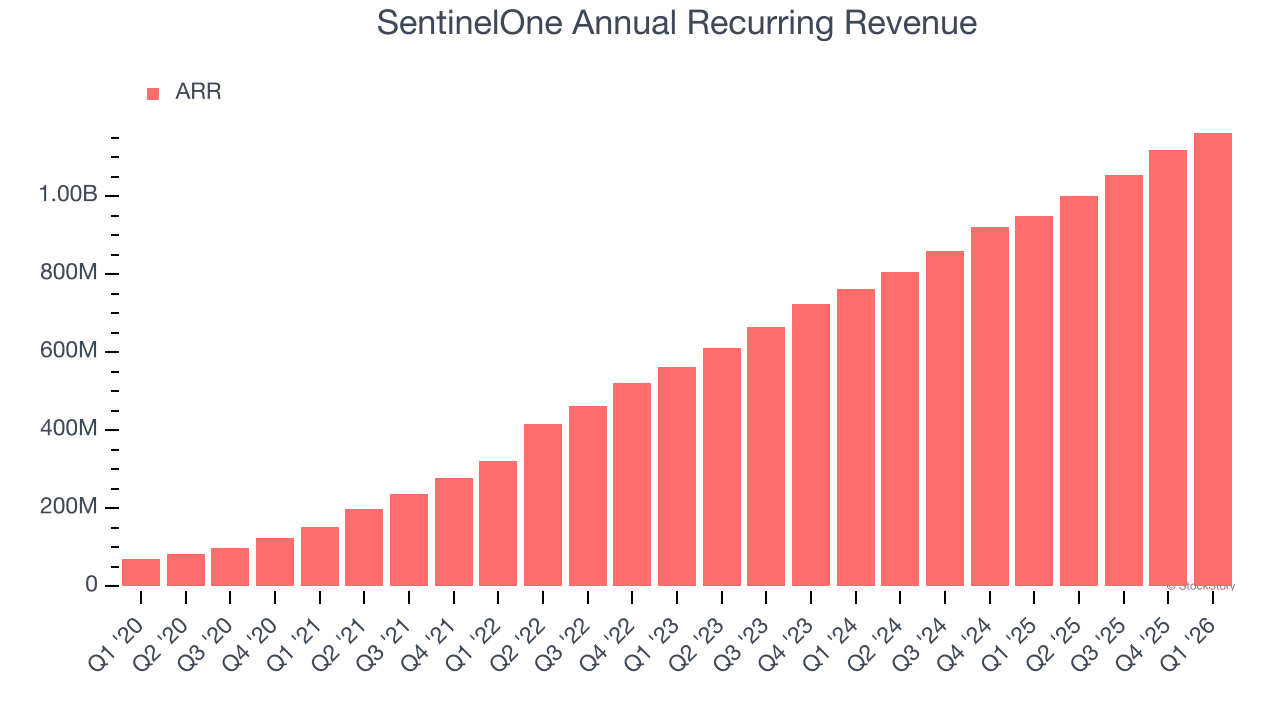
Enterprise Customer Base
This quarter, SentinelOne reported 1,702 enterprise customers paying more than $100,000 annually, an increase of 35 from the previous quarter. That’s a bit fewer contract wins than last quarter and a bit below what we’ve observed over the previous year, suggesting its sales momentum with new enterprise customers is slowing. It also implies that SentinelOne will likely need to upsell its existing large customers or move down market to maintain its top-line growth.
Key Takeaways from SentinelOne’s Q1 Results
We were impressed by SentinelOne’s optimistic full-year EPS guidance, which blew past analysts’ expectations. On the other hand, its full-year revenue guidance missed and its EPS guidance for next quarter fell short of Wall Street’s estimates. Overall, this was a softer quarter. The stock traded down 16.8% to $15.03 immediately after reporting.
SentinelOne underperformed this quarter, but does that create an opportunity to invest right now? We think that the latest quarter is only one piece of the longer-term business quality puzzle. Quality, when combined with valuation, can help determine if the stock is a buy. We cover that in our actionable full research report which you can read here (it’s free).