Telecommunications company Dycom (NYSE: DY) beat Wall Street’s revenue expectations in Q1 CY2026, with sales up 56.1% year on year to $1.96 billion. On top of that, next quarter’s revenue guidance ($1.98 billion at the midpoint) was surprisingly good and 10.8% above what analysts were expecting. Its non-GAAP profit of $4.42 per share was 62.5% above analysts’ consensus estimates.
Is now the time to buy Dycom? Find out by accessing our full research report, it’s free.
Dycom (DY) Q1 CY2026 Highlights:
- Revenue: $1.96 billion vs analyst estimates of $1.67 billion (56.1% year-on-year growth, 17.3% beat)
- Adjusted EPS: $4.42 vs analyst estimates of $2.72 (62.5% beat)
- Adjusted EBITDA: $262.5 million vs analyst estimates of $209.3 million (13.4% margin, 25.4% beat)
- Revenue Guidance for the full year is $7.52 billion at the midpoint, above analyst estimates of $7.07 billion
- Adjusted EPS guidance for Q2 CY2026 is $4.61 at the midpoint, above analyst estimates of $4.06
- EBITDA guidance for Q2 CY2026 is $293.5 million at the midpoint, above analyst estimates of $267 million
- Operating Margin: 13%, up from 6.8% in the same quarter last year
- Backlog: $11.91 billion at quarter end
- Market Capitalization: $12.62 billion
“Dycom delivered an outstanding start to the year that exceeded the high end of our expectations with strong revenue growth and margin expansion as well as record backlog,” said Dan Peyovich, Dycom’s President and Chief Executive Officer.
Company Overview
Working alongside some of the most popular mobile carriers in the world, Dycom (NYSE: DY) builds and maintains telecommunications infrastructure.
Revenue Growth
A company’s long-term sales performance can indicate its overall quality. Any business can experience short-term success, but top-performing ones enjoy sustained growth for years. Thankfully, Dycom’s 15% annualized revenue growth over the last five years was exceptional. Its growth surpassed the average industrials company and shows its offerings resonate with customers, a great starting point for our analysis.
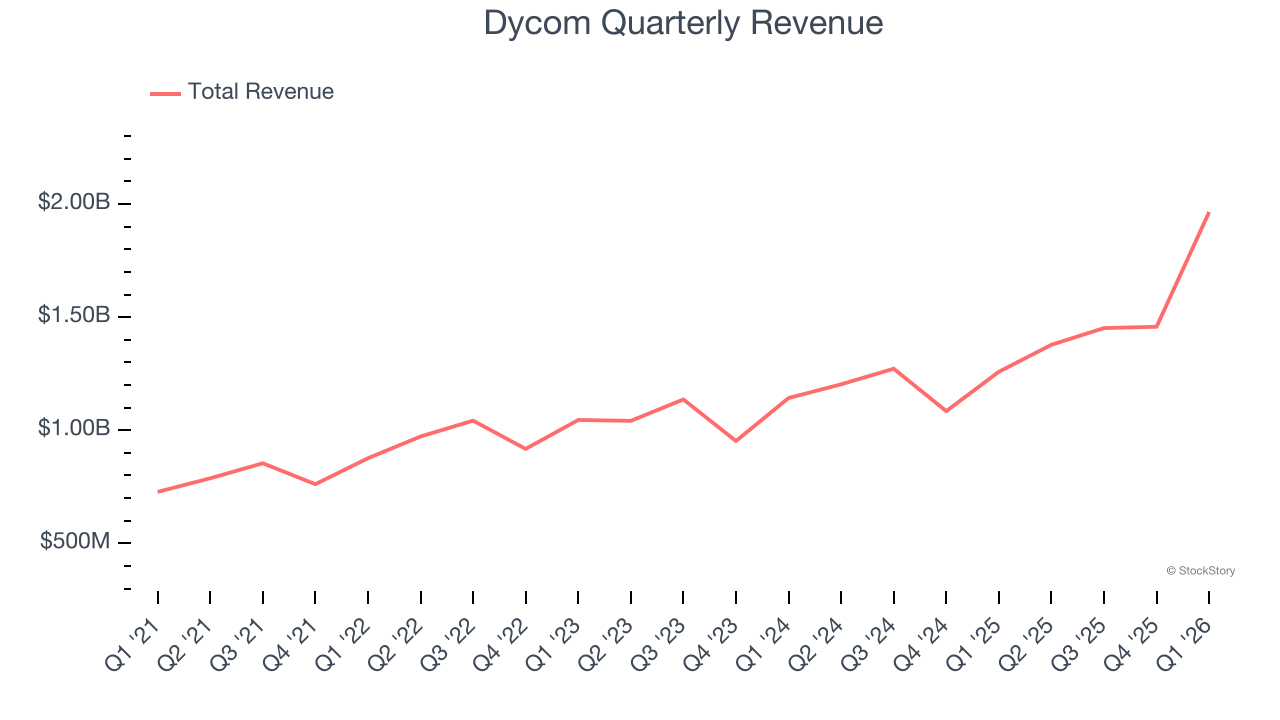
Long-term growth is the most important, but within industrials, a half-decade historical view may miss new industry trends or demand cycles. Dycom’s annualized revenue growth of 21% over the last two years is above its five-year trend, suggesting its demand was strong and recently accelerated. 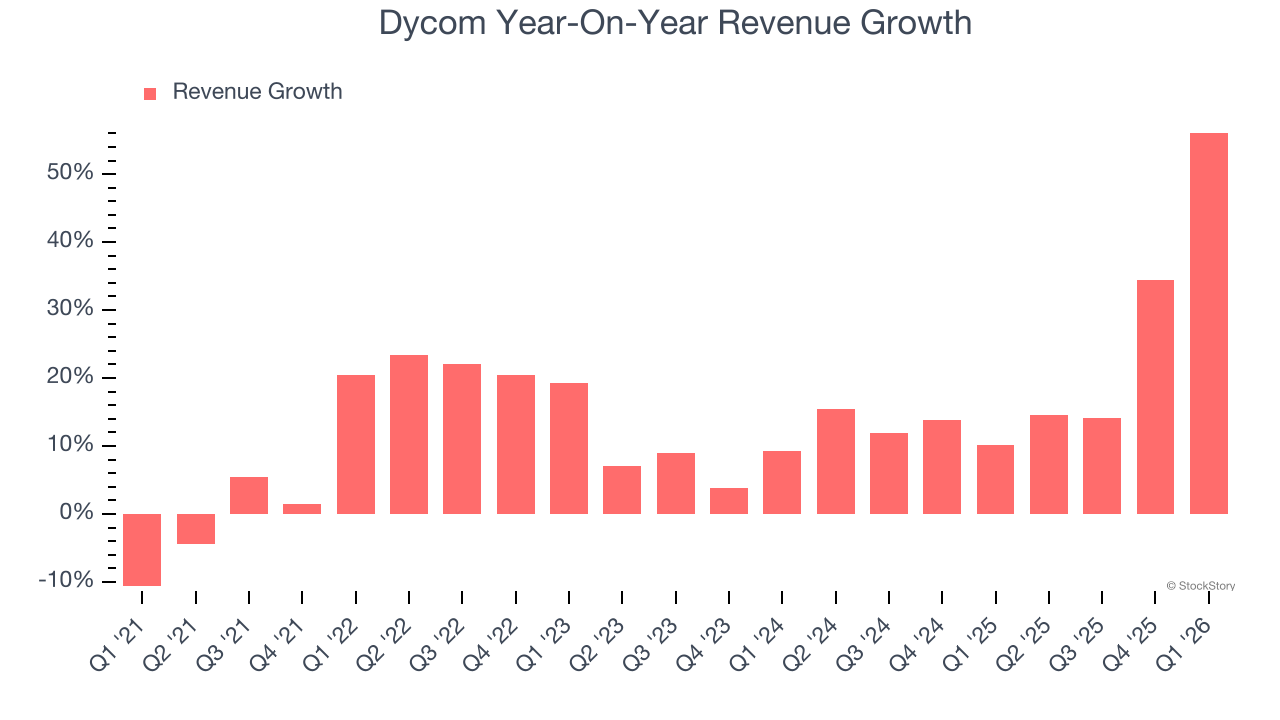
This quarter, Dycom reported magnificent year-on-year revenue growth of 56.1%, and its $1.96 billion of revenue beat Wall Street’s estimates by 17.3%. Company management is currently guiding for a 43.3% year-on-year increase in sales next quarter.
Looking further ahead, sell-side analysts expect revenue to grow 15.8% over the next 12 months, a deceleration versus the last two years. Despite the slowdown, this projection is healthy and indicates the market is baking in success for its products and services.
WHILE YOU’RE HERE: The Next Palantir? One satellite company captures images of every point on Earth. Every single day. The Pentagon wants it. Hedge funds are using it to beat earnings. You’ve probably never heard of it.
This is what the early days of Palantir looked like before it became a $437 billion giant. Same playbook. Different technology. If you missed Palantir, you need to see this. Claim The Stock Ticker for Free HERE.
Operating Margin
Operating margin is one of the best measures of profitability because it tells us how much money a company takes home after procuring and manufacturing its products, marketing and selling those products, and most importantly, keeping them relevant through research and development.
Dycom was profitable over the last five years but held back by its large cost base. Its average operating margin of 7.2% was weak for an industrials business. This result isn’t too surprising given its low gross margin as a starting point.
On the plus side, Dycom’s operating margin rose by 6.3 percentage points over the last five years, as its sales growth gave it immense operating leverage.
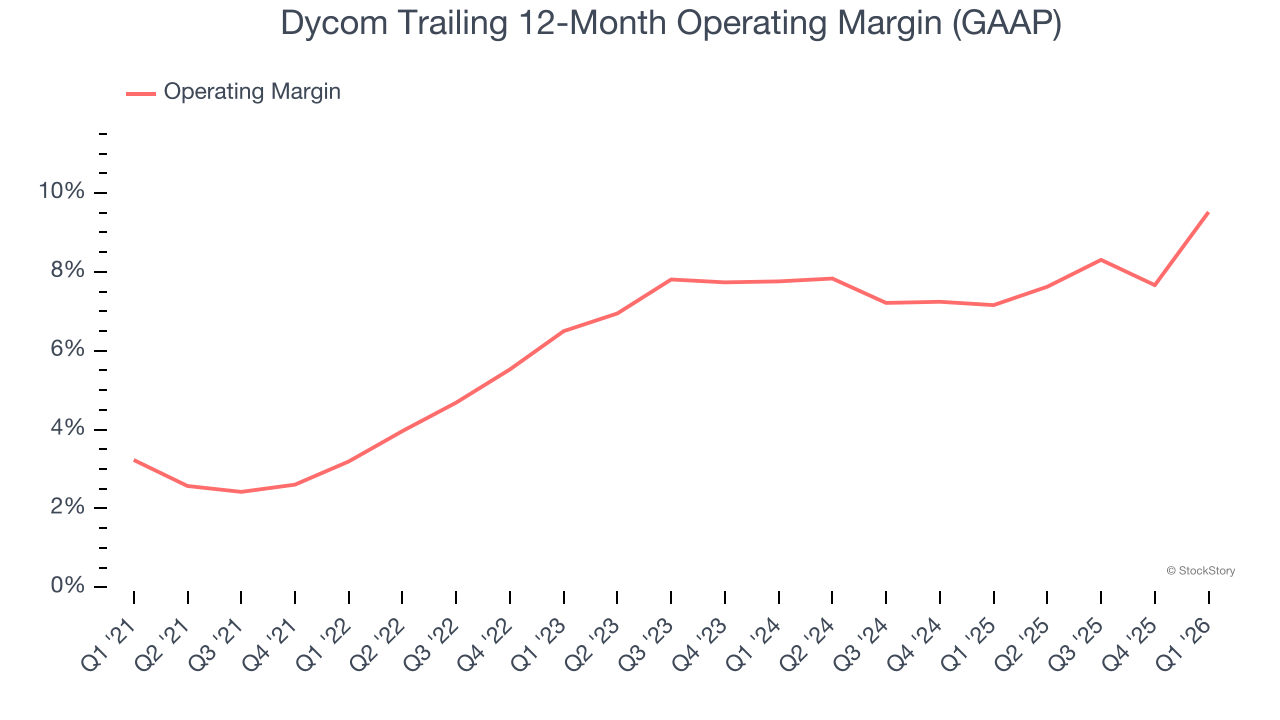
In Q1, Dycom generated an operating margin profit margin of 13%, up 6.2 percentage points year on year. The increase was solid, and because its operating margin rose more than its gross margin, we can infer it was more efficient with expenses such as marketing, R&D, and administrative overhead.
Earnings Per Share
We track the long-term change in earnings per share (EPS) for the same reason as long-term revenue growth. Compared to revenue, however, EPS highlights whether a company’s growth is profitable.
Dycom’s EPS grew at 44.5% compounded annual growth rate over the last five years, higher than its 15% annualized revenue growth. This tells us the company became more profitable on a per-share basis as it expanded.
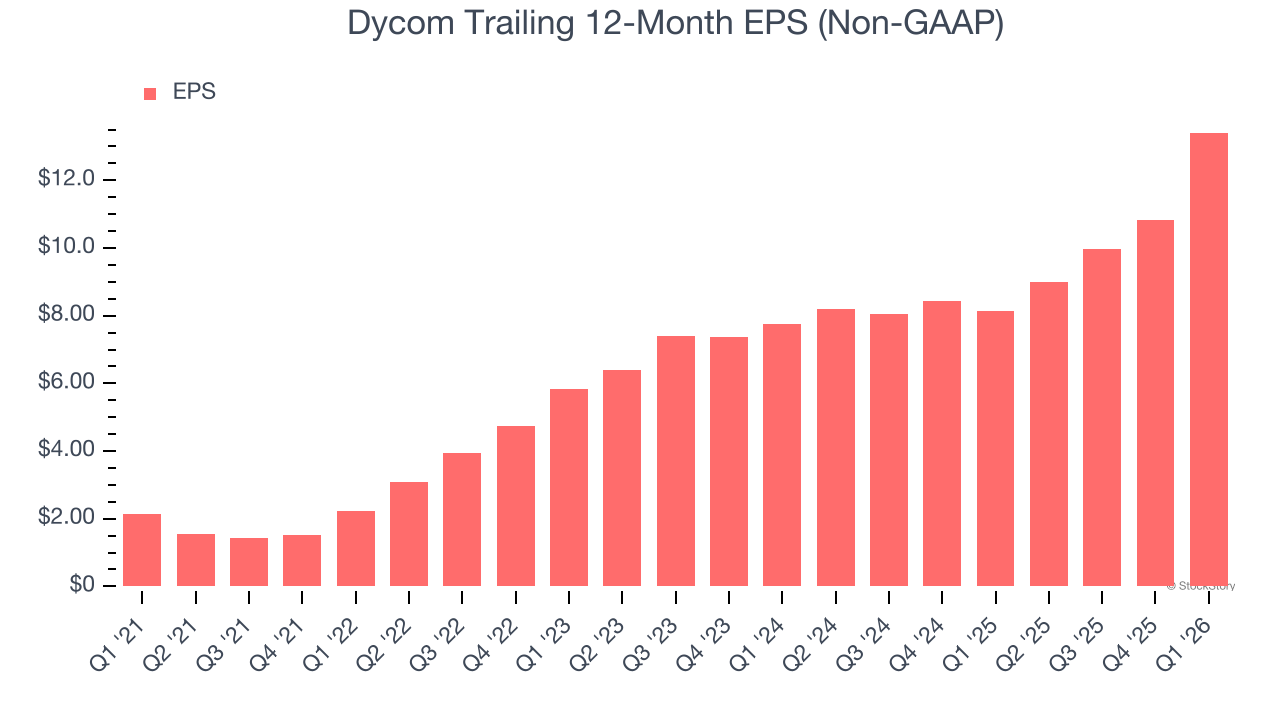
Diving into the nuances of Dycom’s earnings can give us a better understanding of its performance. As we mentioned earlier, Dycom’s operating margin expanded by 6.3 percentage points over the last five years. On top of that, its share count shrank by 2.9%. These are positive signs for shareholders because improving profitability and share buybacks turbocharge EPS growth relative to revenue growth. 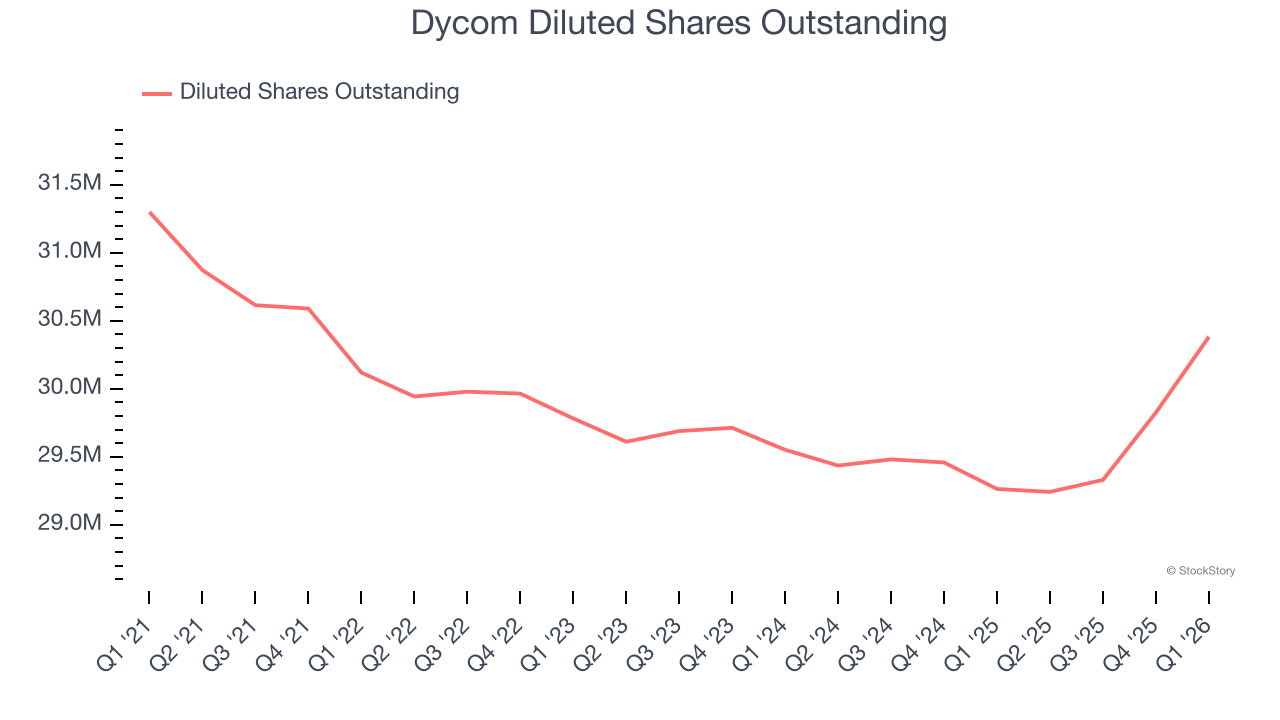
Like with revenue, we analyze EPS over a more recent period because it can provide insight into an emerging theme or development for the business.
For Dycom, its two-year annual EPS growth of 31.5% was lower than its five-year trend. We still think its growth was good and hope it can accelerate in the future.
In Q1, Dycom reported adjusted EPS of $4.42, up from $1.83 in the same quarter last year. This print easily cleared analysts’ estimates, and shareholders should be content with the results. Over the next 12 months, Wall Street expects Dycom’s full-year EPS of $13.41 to grow 10.4%.
Key Takeaways from Dycom’s Q1 Results
We were impressed by Dycom’s optimistic EBITDA guidance for next quarter, which blew past analysts’ expectations. We were also glad its revenue, EBITDA, and EPS outperformed Wall Street’s estimates by large magnitudes. Zooming out, we think this was a very good print with some key areas of upside. The stock traded up 23% to $516.41 immediately following the results.
Dycom had an encouraging quarter, but one earnings result doesn’t necessarily make the stock a buy. Let’s see if this is a good investment. When making that decision, it’s important to consider its valuation, business qualities, as well as what has happened in the latest quarter. We cover that in our actionable full research report which you can read here (it’s free).