

Engineered components manufacturer for critical industries ITT Inc. (NYSE: ITT) reported Q4 CY2025 results topping the market’s revenue expectations, with sales up 13.5% year on year to $1.05 billion. Its non-GAAP profit of $1.85 per share was 4% above analysts’ consensus estimates.
Is now the time to buy ITT? Find out by accessing our full research report, it’s free.
ITT (ITT) Q4 CY2025 Highlights:
- Revenue: $1.05 billion vs analyst estimates of $1.01 billion (13.5% year-on-year growth, 4.6% beat)
- Adjusted EPS: $1.85 vs analyst estimates of $1.78 (4% beat)
- Adjusted EBITDA: $250.2 million vs analyst estimates of $226.1 million (23.7% margin, 10.7% beat)
- Adjusted EPS guidance for Q1 CY2026 is $1.70 at the midpoint, above analyst estimates of $1.61
- Operating Margin: 17%, in line with the same quarter last year
- Free Cash Flow Margin: 17.8%, down from 20.1% in the same quarter last year
- Organic Revenue rose 8.6% year on year (beat)
- Market Capitalization: $15.93 billion
Company Overview
Playing a crucial role in the development of the first transatlantic television transmission in 1956, ITT (NYSE: ITT) provides motion and fluid handling equipment for various industries
Revenue Growth
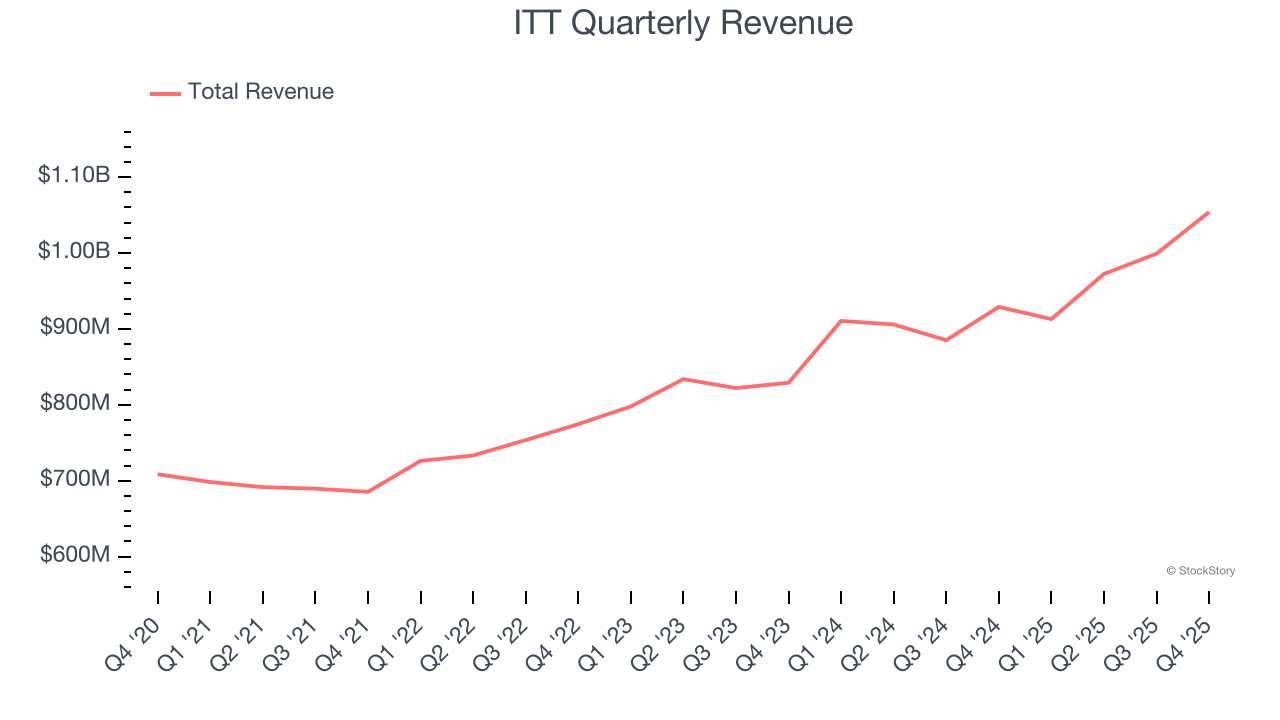
A company’s long-term performance is an indicator of its overall quality. Any business can put up a good quarter or two, but the best consistently grow over the long haul. Luckily, ITT’s sales grew at a solid 9.7% compounded annual growth rate over the last five years. Its growth beat the average industrials company and shows its offerings resonate with customers, a helpful starting point for our analysis.
Long-term growth is the most important, but within industrials, a half-decade historical view may miss new industry trends or demand cycles. ITT’s annualized revenue growth of 9.5% over the last two years aligns with its five-year trend, suggesting its demand was predictably strong. 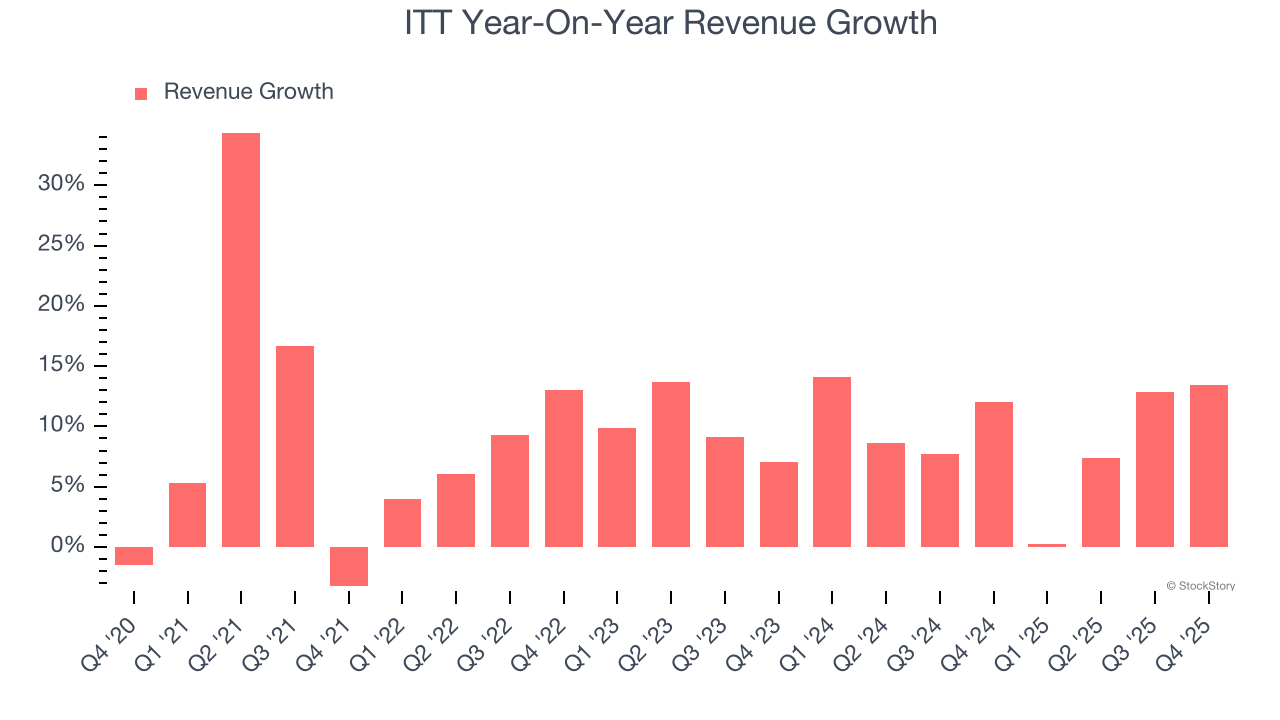
ITT also reports organic revenue, which strips out one-time events like acquisitions and currency fluctuations that don’t accurately reflect its fundamentals. Over the last two years, ITT’s organic revenue averaged 5.7% year-on-year growth. Because this number is lower than its two-year revenue growth, we can see that some mixture of acquisitions and foreign exchange rates boosted its headline results. 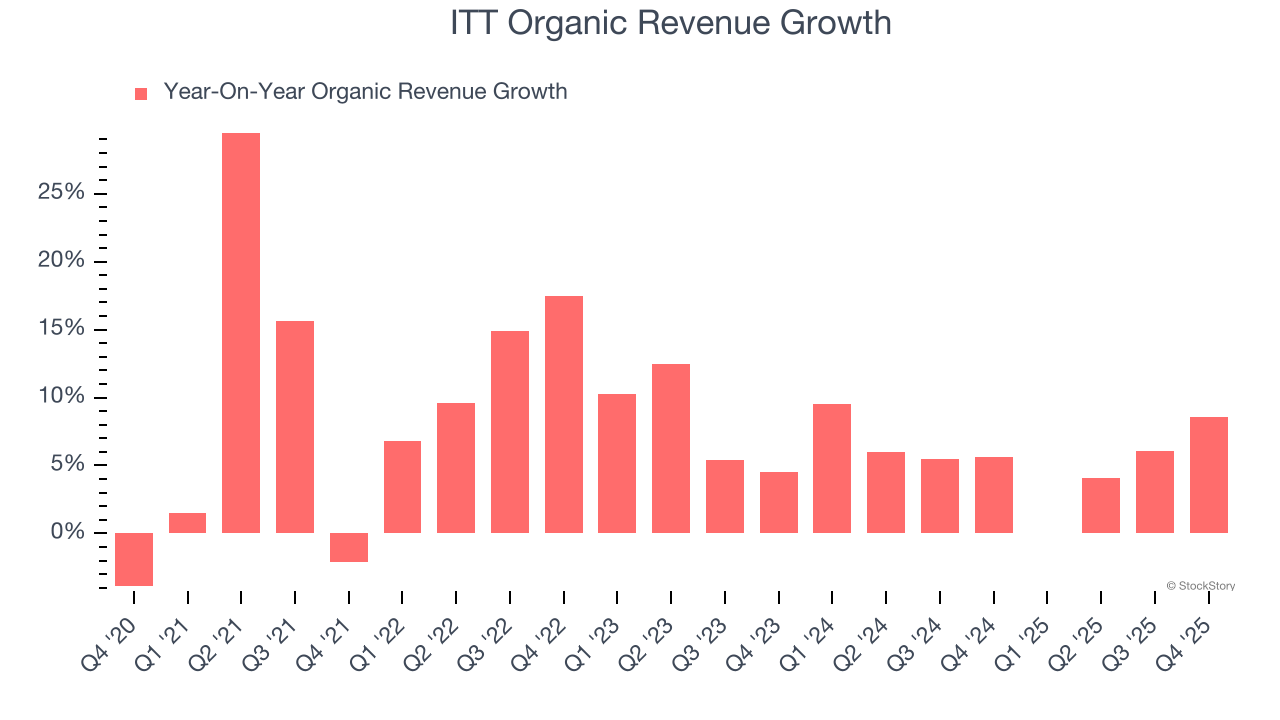
This quarter, ITT reported year-on-year revenue growth of 13.5%, and its $1.05 billion of revenue exceeded Wall Street’s estimates by 4.6%.
Looking ahead, sell-side analysts expect revenue to grow 7.1% over the next 12 months, a slight deceleration versus the last two years. This projection doesn't excite us and indicates its products and services will face some demand challenges. At least the company is tracking well in other measures of financial health.
The 1999 book Gorilla Game predicted Microsoft and Apple would dominate tech before it happened. Its thesis? Identify the platform winners early. Today, enterprise software companies embedding generative AI are becoming the new gorillas. a profitable, fast-growing enterprise software stock that is already riding the automation wave and looking to catch the generative AI next.
Operating Margin
ITT’s operating margin might fluctuated slightly over the last 12 months but has remained more or less the same, averaging 17.2% over the last five years. This profitability was elite for an industrials business thanks to its efficient cost structure and economies of scale. This is seen in its fast historical revenue growth and healthy gross margin, which is why we look at all three data points together.
Looking at the trend in its profitability, ITT’s operating margin might fluctuated slightly but has generally stayed the same over the last five years. This raises questions about the company’s expense base because its revenue growth should have given it leverage on its fixed costs, resulting in better economies of scale and profitability.
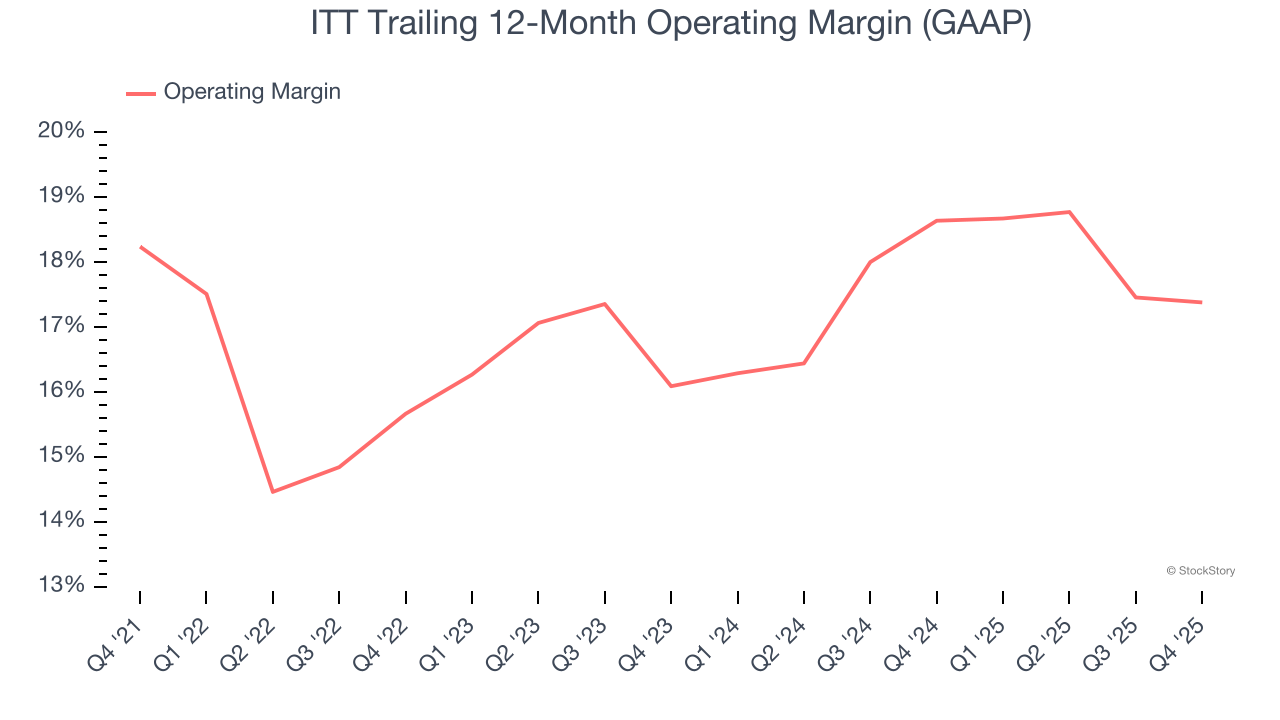
This quarter, ITT generated an operating margin profit margin of 17%, in line with the same quarter last year. This indicates the company’s cost structure has recently been stable.
Earnings Per Share
Revenue trends explain a company’s historical growth, but the long-term change in earnings per share (EPS) points to the profitability of that growth – for example, a company could inflate its sales through excessive spending on advertising and promotions.
ITT’s EPS grew at a spectacular 16% compounded annual growth rate over the last five years, higher than its 9.7% annualized revenue growth. However, this alone doesn’t tell us much about its business quality because its operating margin didn’t improve.
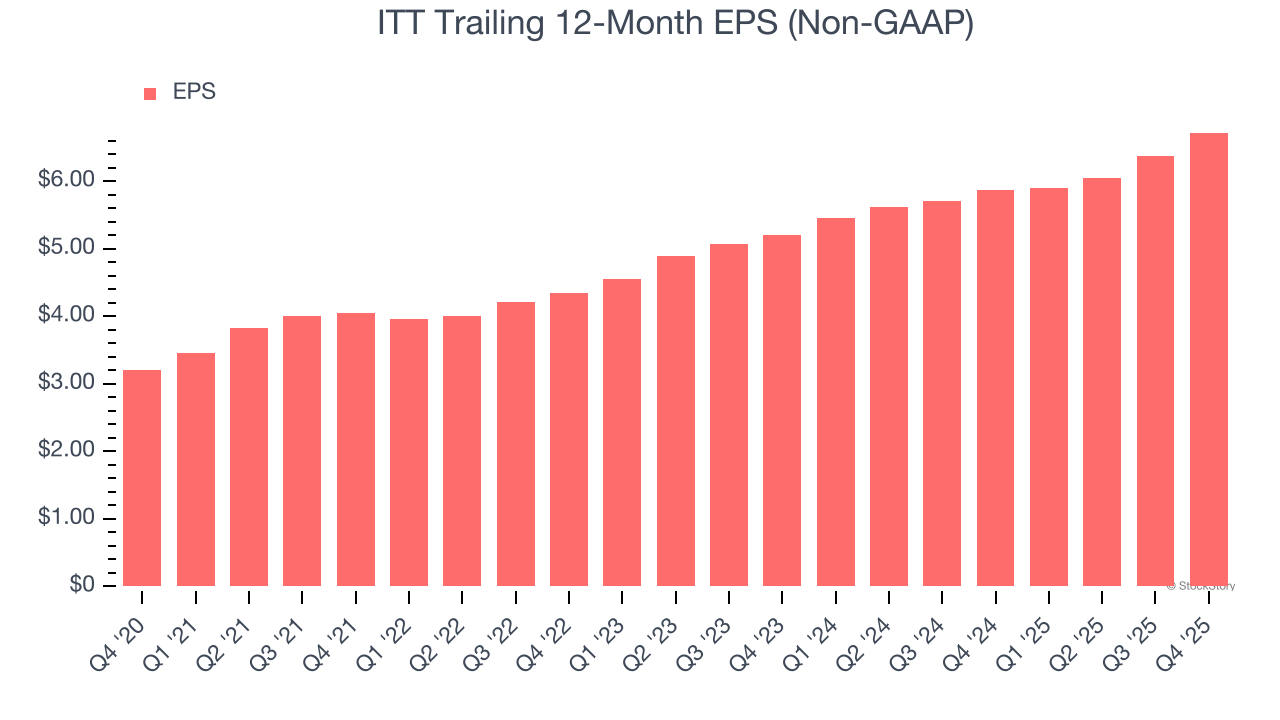
Diving into the nuances of ITT’s earnings can give us a better understanding of its performance. A five-year view shows that ITT has repurchased its stock, shrinking its share count by 7.1%. This tells us its EPS outperformed its revenue not because of increased operational efficiency but financial engineering, as buybacks boost per share earnings. 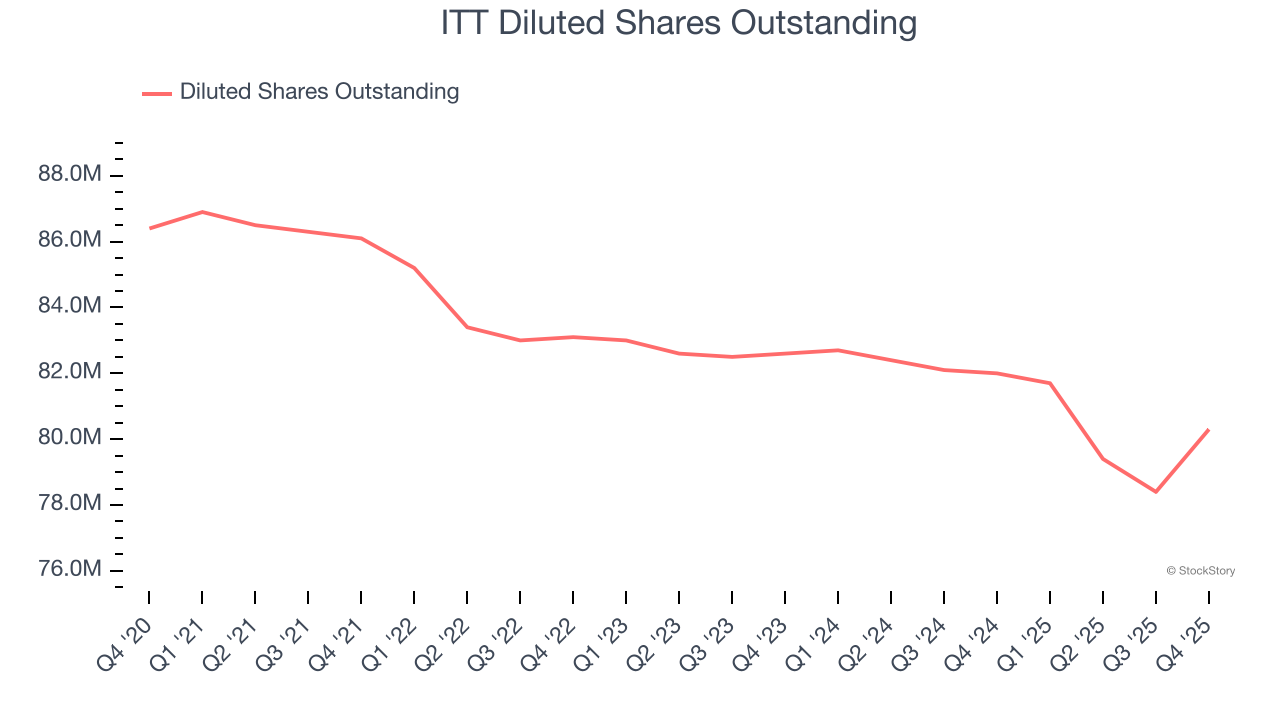
Like with revenue, we analyze EPS over a more recent period because it can provide insight into an emerging theme or development for the business.
For ITT, its two-year annual EPS growth of 13.6% was lower than its five-year trend. We still think its growth was good and hope it can accelerate in the future.
In Q4, ITT reported adjusted EPS of $1.85, up from $1.50 in the same quarter last year. This print beat analysts’ estimates by 4%. Over the next 12 months, Wall Street expects ITT’s full-year EPS of $6.72 to grow 7.8%.
Key Takeaways from ITT’s Q4 Results
We were impressed that both revenue and EPS in the quarter beat analysts’ EBITDA expectations this quarter. We were also excited its EPS guidance outperformed Wall Street’s estimates. Zooming out, we think this quarter featured some important positives. The stock remained flat at $185.15 immediately following the results.
ITT put up rock-solid earnings, but one quarter doesn’t necessarily make the stock a buy. Let’s see if this is a good investment. When making that decision, it’s important to consider its valuation, business qualities, as well as what has happened in the latest quarter. We cover that in our actionable full research report which you can read here (it’s free).