

Aerospace and defense company Rocket Lab (NASDAQ: RKLB) reported Q4 CY2025 results topping the market’s revenue expectations, with sales up 35.7% year on year to $179.7 million. On the other hand, next quarter’s revenue guidance of $192.5 million was less impressive, coming in 3.3% below analysts’ estimates. Its GAAP loss of $0.09 per share was in line with analysts’ consensus estimates.
Is now the time to buy Rocket Lab? Find out by accessing our full research report, it’s free.
Rocket Lab (RKLB) Q4 CY2025 Highlights:
- Revenue: $179.7 million vs analyst estimates of $177.2 million (35.7% year-on-year growth, 1.4% beat)
- EPS (GAAP): -$0.09 vs analyst estimates of -$0.10 (in line)
- Adjusted EBITDA: -$17.37 million (-9.7% margin, 25.1% year-on-year growth)
- Revenue Guidance for Q1 CY2026 is $192.5 million at the midpoint, below analyst estimates of $199 million
- EBITDA guidance for Q1 CY2026 is -$24 million at the midpoint, below analyst estimates of -$15.8 million
- Adjusted EBITDA Margin: -9.7%, up from -17.5% in the same quarter last year
- Free Cash Flow was -$114.2 million compared to -$23.94 million in the same quarter last year
- Market Capitalization: $37.5 billion
Rocket Lab founder and CEO, Sir Peter Beck, said: “2026 was a record-breaking year for Rocket Lab financially and operationally. We delivered record quarterly revenue of $180 million, which brought our full year revenue to a record $602 million, representing 38% growth year on year. We reached a new annual launch record, flying 21 missions across Electron and HASTE with a 100% success rate for the year, and also reached significant qualification milestones in the development of Neutron, our new medium-lift launch vehicle. At the same time we were awarded Rocket Lab’s largest single contract to date, an $816 million contract from the Space Development Agency to design and manufacture 18 satellites for the Tracking Layer Tranche 3 program under the Proliferated Warfighter Space Architecture. It was also the quarter in which two spacecraft we built for NASA and the University of California Berkeley were successfully launched toward Mars for the historic ESCAPADE mission, proving Rocket Lab can deliver decadal class science missions on rapid timelines for a fraction of the cost of traditional interplanetary programs. We ended the year with a record $1.85 billion in backlog, representing 73% year-on-year growth, a figure we look forward to building upon in 2026.”
Company Overview
Becoming the first private company in the Southern Hemisphere to reach space, Rocket Lab (NASDAQ: RKLB) offers rockets designed for launching small satellites.
Revenue Growth
A company’s long-term sales performance is one signal of its overall quality. Even a bad business can shine for one or two quarters, but a top-tier one grows for years. Over the last five years, Rocket Lab grew its sales at an incredible 76.5% compounded annual growth rate. Its growth beat the average industrials company and shows its offerings resonate with customers.
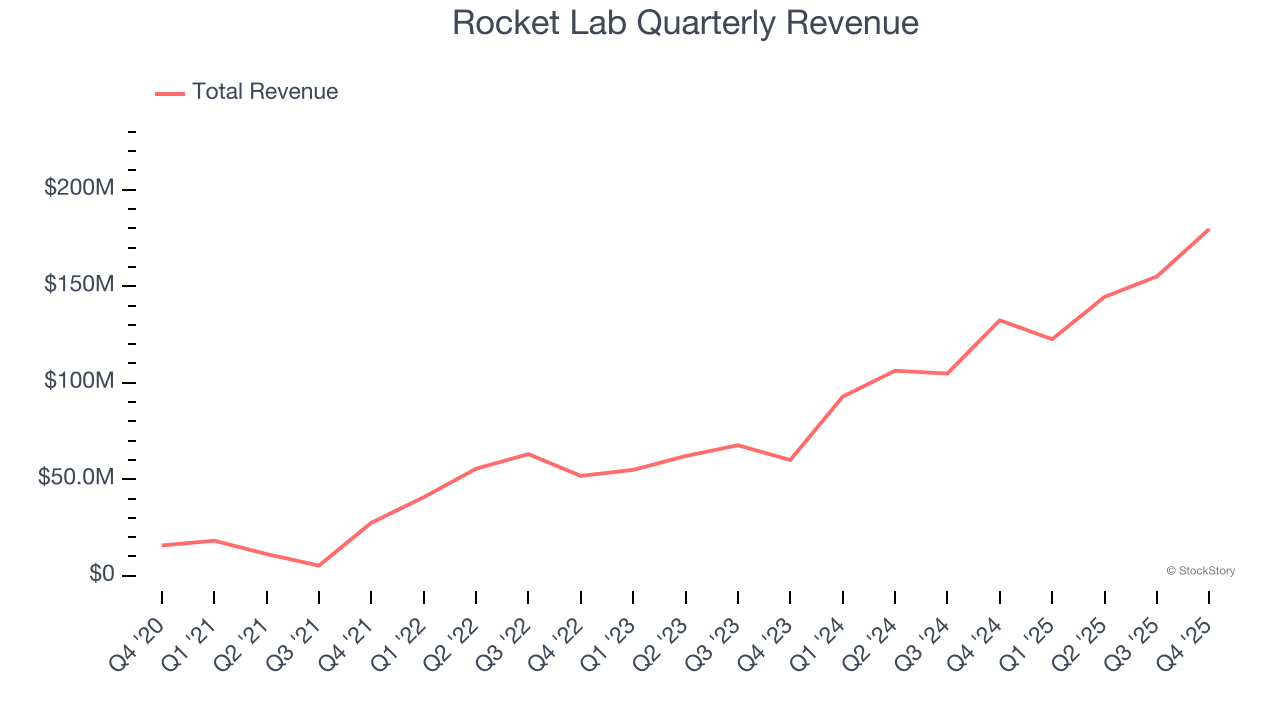
Long-term growth is the most important, but within industrials, a half-decade historical view may miss new industry trends or demand cycles. Rocket Lab’s annualized revenue growth of 56.9% over the last two years is below its five-year trend, but we still think the results suggest healthy demand. 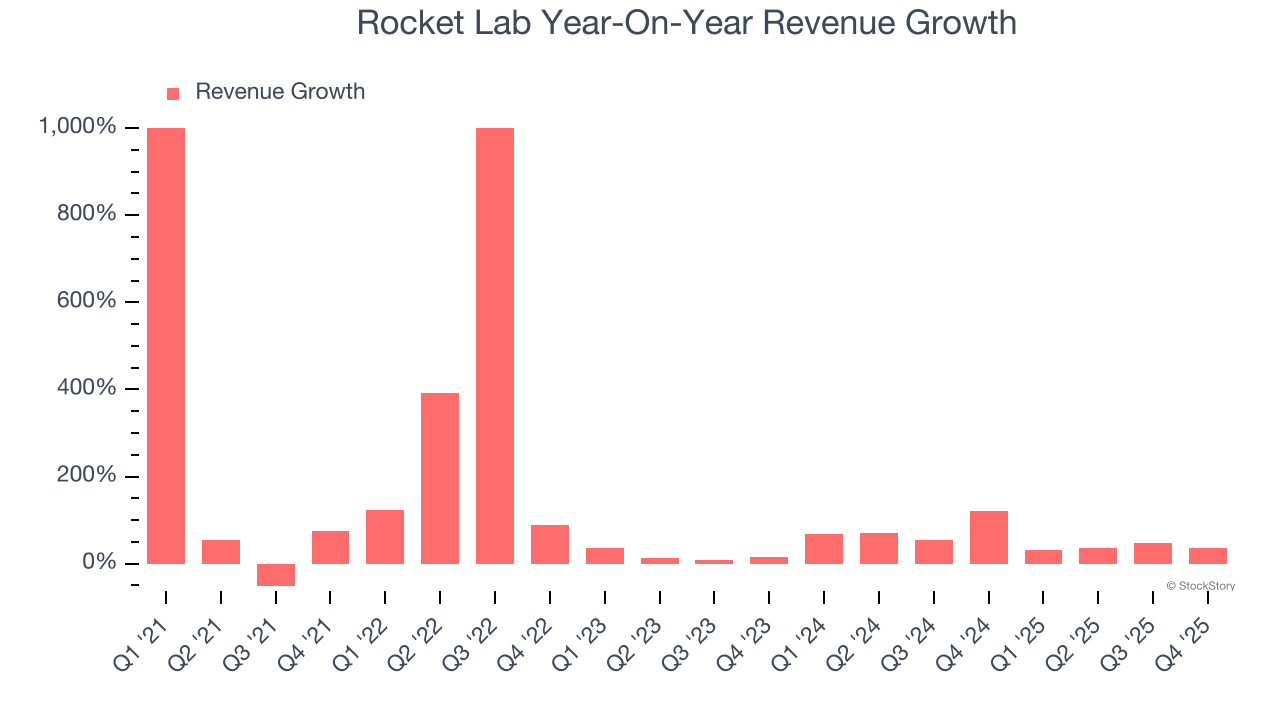
This quarter, Rocket Lab reported wonderful year-on-year revenue growth of 35.7%, and its $179.7 million of revenue exceeded Wall Street’s estimates by 1.4%. Company management is currently guiding for a 57.1% year-on-year increase in sales next quarter.
Looking further ahead, sell-side analysts expect revenue to grow 50.2% over the next 12 months, a deceleration versus the last two years. Despite the slowdown, this projection is noteworthy and implies the market sees success for its products and services.
The 1999 book Gorilla Game predicted Microsoft and Apple would dominate tech before it happened. Its thesis? Identify the platform winners early. Today, enterprise software companies embedding generative AI are becoming the new gorillas. a profitable, fast-growing enterprise software stock that is already riding the automation wave and looking to catch the generative AI next.
Operating Margin
Operating margin is an important measure of profitability as it shows the portion of revenue left after accounting for all core expenses – everything from the cost of goods sold to advertising and wages. It’s also useful for comparing profitability across companies with different levels of debt and tax rates because it excludes interest and taxes.
Rocket Lab’s high expenses have contributed to an average operating margin of negative 53.6% over the last five years. Unprofitable industrials companies require extra attention because they could get caught swimming naked when the tide goes out. It’s hard to trust that the business can endure a full cycle.
On the plus side, Rocket Lab’s operating margin rose over the last five years, as its sales growth gave it operating leverage. Still, it will take much more for the company to reach long-term profitability.
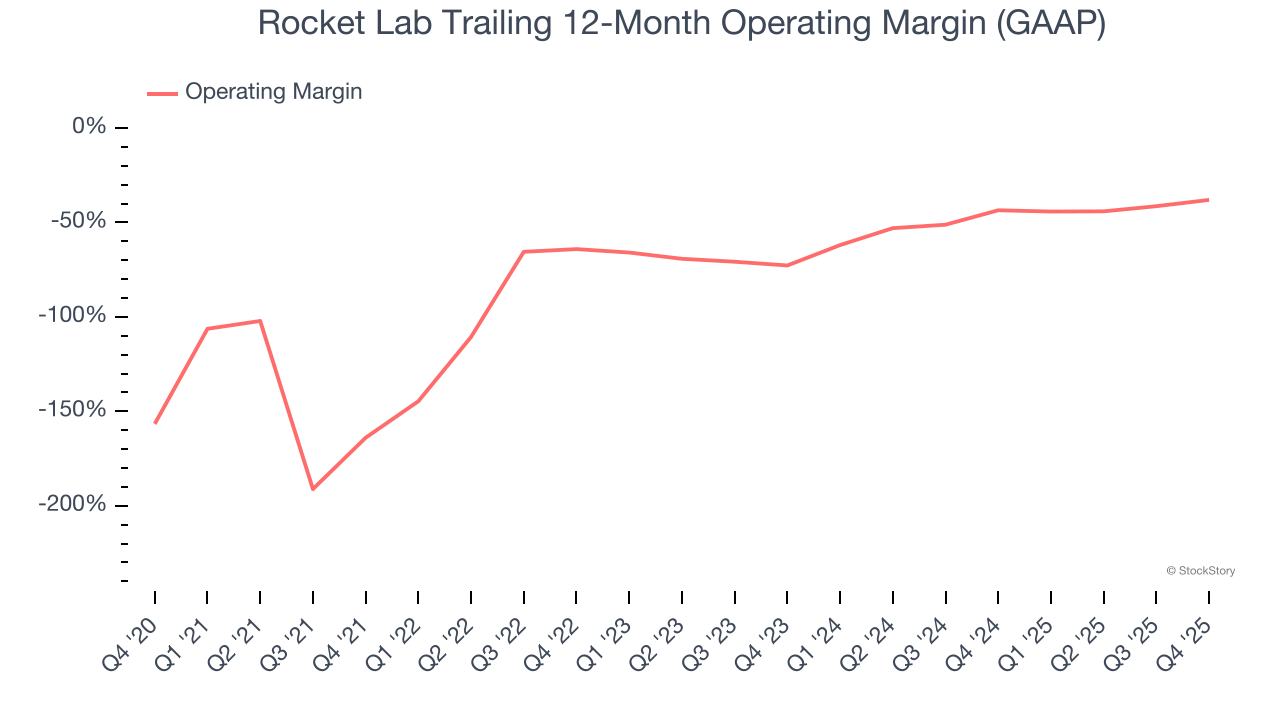
In Q4, Rocket Lab generated a negative 28.4% operating margin.
Earnings Per Share
We track the long-term change in earnings per share (EPS) for the same reason as long-term revenue growth. Compared to revenue, however, EPS highlights whether a company’s growth is profitable.
Although Rocket Lab’s full-year earnings are still negative, it reduced its losses and improved its EPS by 28.5% annually over the last five years. The next few quarters will be critical for assessing its long-term profitability. We hope to see an inflection point soon.
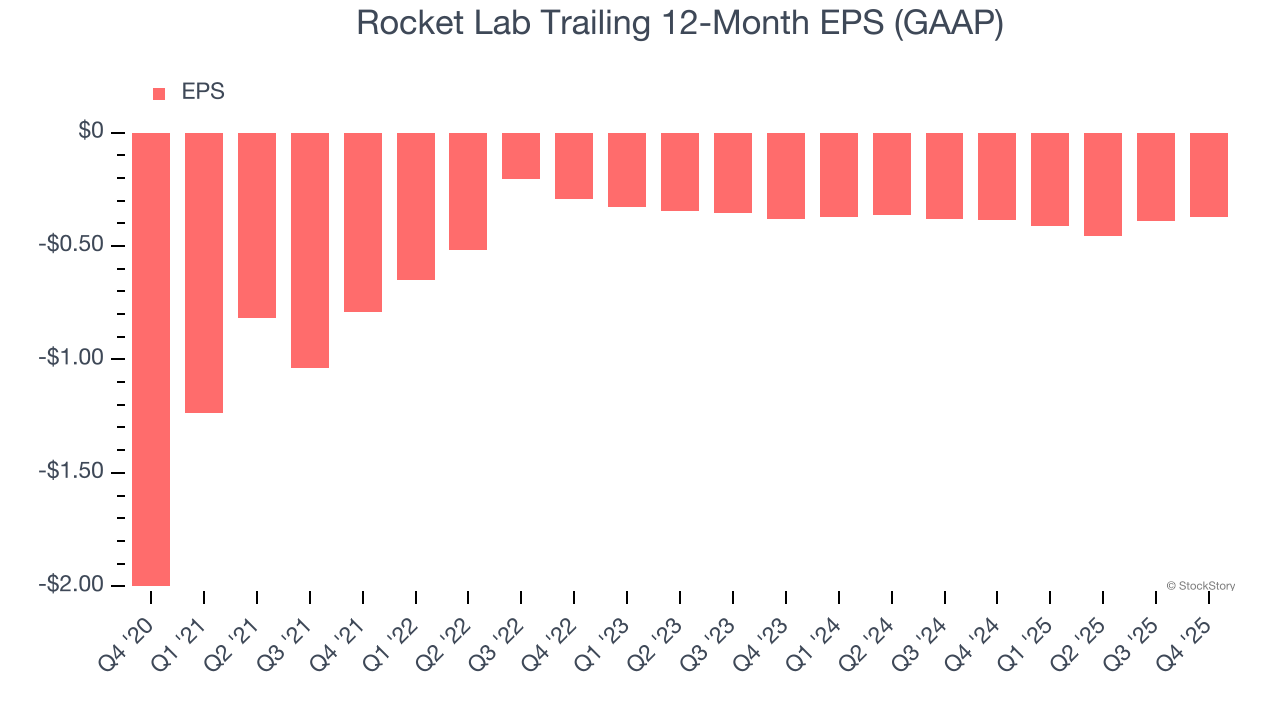
Like with revenue, we analyze EPS over a more recent period because it can provide insight into an emerging theme or development for the business.
For Rocket Lab, EPS didn’t budge over the last two years, a regression from its five-year trend. We hope it can revert to earnings growth in the coming years.
In Q4, Rocket Lab reported EPS of negative $0.09, up from negative $0.10 in the same quarter last year. This print beat analysts’ estimates by 8.2%. Over the next 12 months, Wall Street expects Rocket Lab to improve its earnings losses. Analysts forecast its full-year EPS of negative $0.37 will advance to negative $0.24.
Key Takeaways from Rocket Lab’s Q4 Results
We were impressed by how significantly Rocket Lab blew past analysts’ EBITDA expectations this quarter. We were also happy its revenue narrowly outperformed Wall Street’s estimates. On the other hand, its EBITDA guidance for next quarter missed and its revenue guidance for next quarter fell short of Wall Street’s estimates. Overall, this print was mixed but still had some key positives. Investors were likely hoping for more, and shares traded down 1.5% to $71.65 immediately after reporting.
So should you invest in Rocket Lab right now? If you’re making that decision, you should consider the bigger picture of valuation, business qualities, as well as the latest earnings. We cover that in our actionable full research report which you can read here (it’s free).