
Glass and windows manufacturer Tecnoglass (NYSE: TGLS) announced better-than-expected revenue in Q3 2026, with revenue up 19.2% year on year to $310.6 million. The company’s full-year revenue guidance of $1.12 billion at the midpoint came in 0.9% above analysts’ consensus estimates. Its non-GAAP profit of $0.61 per share was 4.1% above analysts’ consensus estimates.
For more on Tecnoglass, read our full research report for free.
Tecnoglass (TGLS) Q3 2026 highlights:
- Revenue $310.6 million vs S&P analysts’ consensus estimates of $284.3 million (19.2% year-on-year growth, 9.2% beat)
- Adjusted EPS $0.61 vs S&P analysts’ consensus estimates of $0.59 (4.1% beat)
- Adjusted EBITDA $47.66 million vs analysts’ consensus estimates of $49.97 million (15.3% margin, 4.6% miss)
- Revenue guidance The company lifted its revenue guidance for the full year to $1.12 billion at the midpoint from $1.1 billion, a 1.8% increase
- EBITDA guidance $215 million at the midpoint for the full year, below analysts’ consensus estimates of $221 million
- Operating margin 10.3%, down from 25.1% in the same quarter last year
- Free cash flow -$44.54 million, down from $21.23 million in the same quarter last year
- Market capitalization $1.90 billion
José Manuel Daes, Chief Executive Officer of Tecnoglass, commented, “We were pleased to deliver record revenues in the third quarter, up 19% year-over-year, led by 31% growth in our multi-family and commercial business. Single-family residential revenues grew 17% year-over-year excluding the previously disclosed pre-buy activity in the second quarter, reflecting continued market share gains as we expand outside of Florida. Third quarter margins were pressured by costs outside of our control, including elevated aluminum costs, ongoing tariffs and a Colombian Peso at its strongest level since 2018. Our higher volumes in the quarter drew on aluminum purchased at peak prices earlier in the year, and we have since secured aluminum at lower levels. Excluding an $8.4 million non-cash inventory revaluation tied to a rapid rise in the Peso, Adjusted EBITDA for the quarter was actually ahead of our internal expectations given a very strong top line performance. The benefits of our May pricing actions are beginning to flow through single-family residential invoicing, and our automation initiatives are taking hold, which position us well to deliver improved profitability. Together, these actions are making us a stronger and more efficient company, and we remain confident in our ability to unlock additional value for our shareholders.”
Revenue growth
A company’s long-term revenue performance can indicate its overall quality. Any business can have short-term success, but a top-tier one grows for years. Tecnoglass’s revenue grew at a strong 18.6% compounded annual growth rate over the last five years. Its growth beat the average industrials company and shows its offerings resonate with customers.
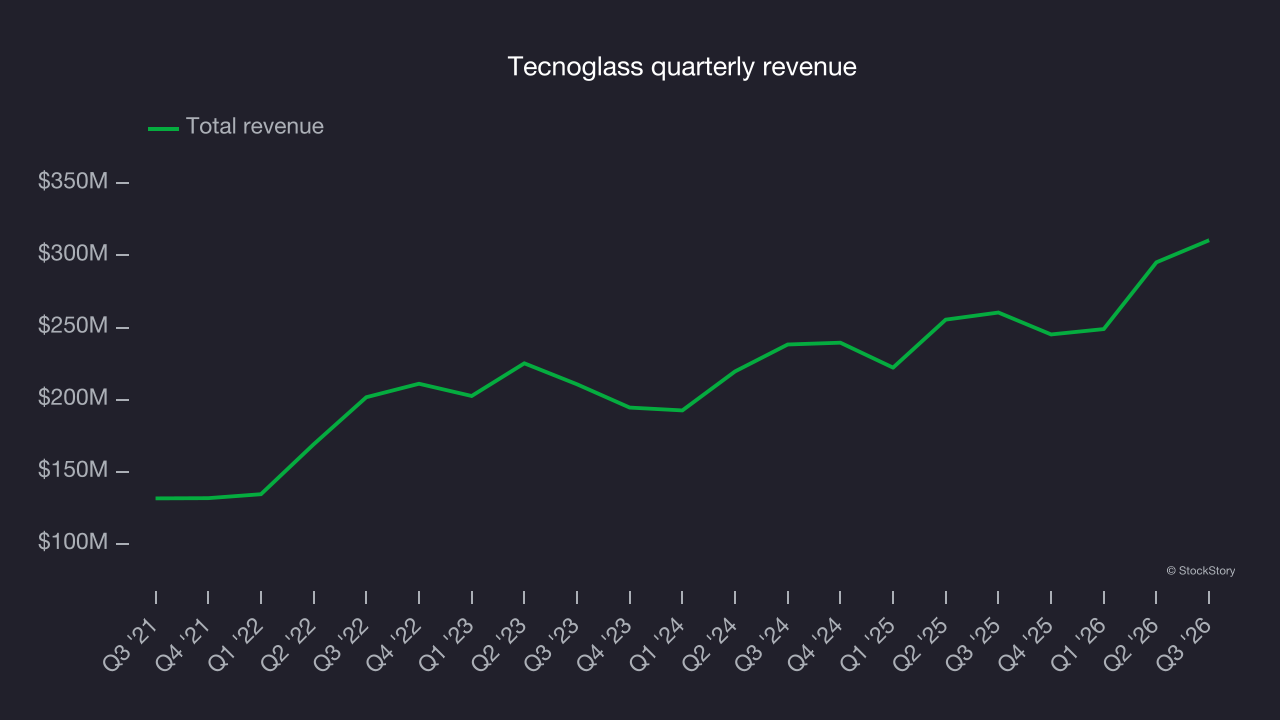
Long-term growth is the most important, but within industrials, a half-decade historical view may miss new industry trends or demand cycles. Tecnoglass’s annualized revenue growth of 14.1% over the last two years is below its five-year trend, but the results still suggest healthy demand. 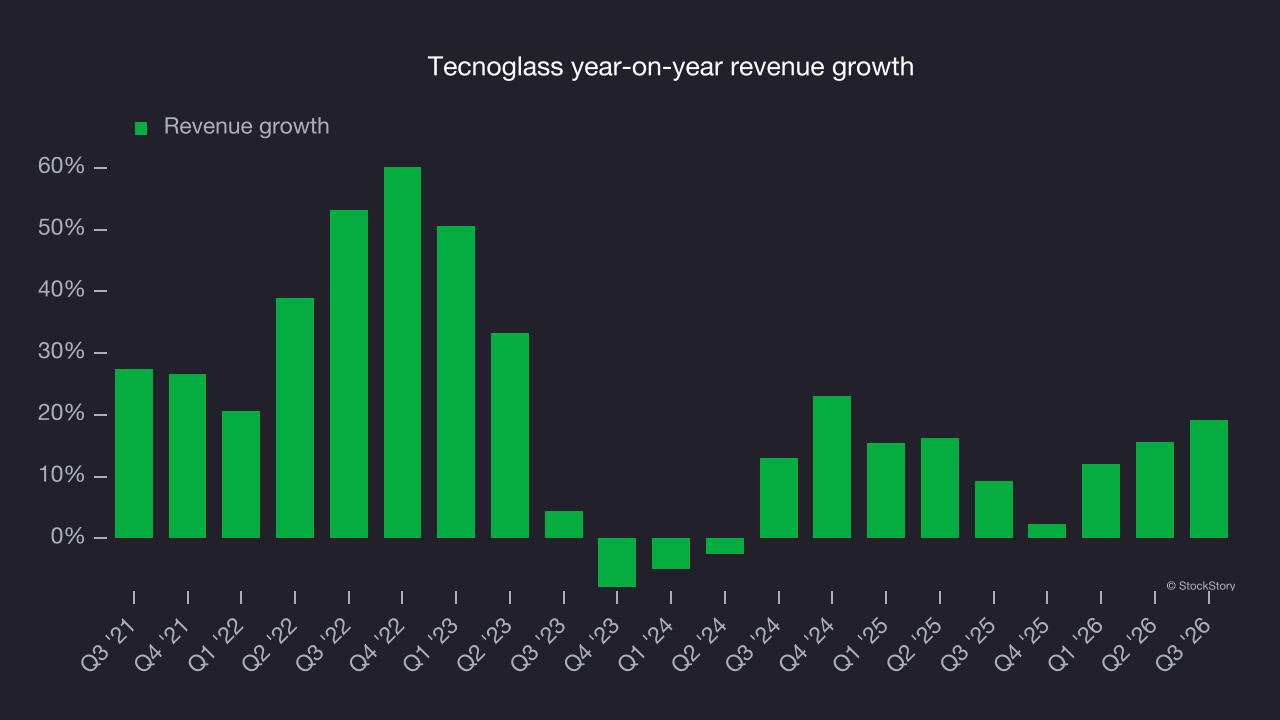
This quarter, Tecnoglass reported year-on-year revenue growth of 19.2%, and its $310.6 million of revenue exceeded Wall Street’s consensus estimates by 9.2%.
Looking ahead, sell-side analysts expect revenue to grow 9% over the next 12 months, according to S&P, a deceleration versus the last two years. Despite the slowdown, this projection remains solid and indicates the market sees success for its products and services.
Operating margin
Tecnoglass has performed well over the last five years. It demonstrated strong profitability for an industrials business, with an average operating margin of 25%. That outcome is unsurprising given its favorable gross margin baseline.
Tecnoglass’s operating margin decreased by 14.6 percentage points over the last five years. This raises questions about the company’s expense base because its revenue growth should have given it leverage on its fixed costs, resulting in better economies of scale and profitability.
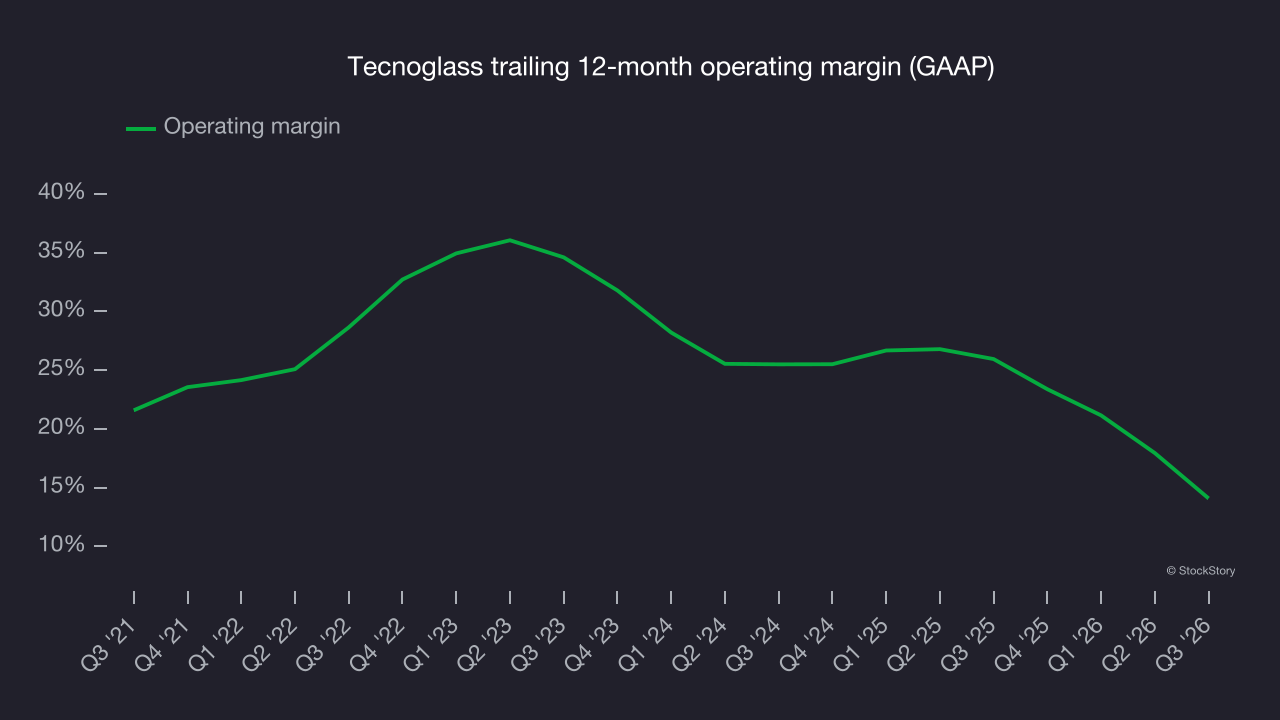
In Q3, Tecnoglass generated an operating margin of 10.3%, down 14.8 percentage points year on year. The larger decline in operating margin than in gross margin suggests it was less efficient because expenses such as marketing, research and development and administrative overhead increased.
Earnings per share
We track the long-term change in earnings per share (EPS) for the same reason as long-term revenue growth. Compared to revenue, however, EPS highlights whether a company’s growth is profitable.
Tecnoglass’s EPS grew at a strong 12.4% compounded annual growth rate over the last five years. However, this pace trailed its 18.6% annualized revenue growth, indicating the company became less profitable on a per-share basis as it expanded due to non-fundamental factors such as interest expenses and taxes.
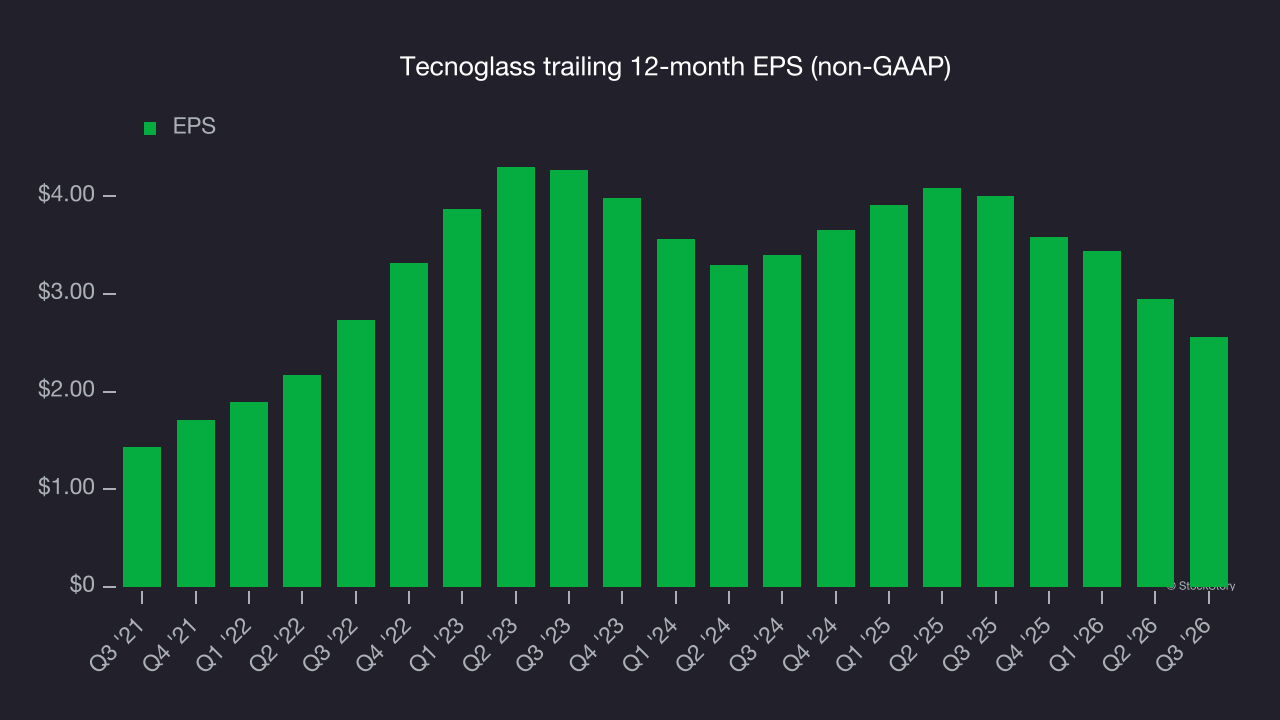
We can take a deeper look into Tecnoglass’s earnings quality to better understand the drivers of its performance. As we mentioned earlier, Tecnoglass’s operating margin declined by 14.6 percentage points over the last five years. This was the most relevant factor (aside from the revenue impact) behind its lower earnings; interest expenses and taxes can also affect EPS but don’t tell us as much about a company’s fundamentals.
Like with revenue, we analyze EPS over a shorter period to see if we are missing a change in the business.
Tecnoglass’s EPS declined at an annual rate of 13.2% over the last two years, reversing its seemingly healthy five-year trend.
In Q3, Tecnoglass reported adjusted EPS of $0.61, down from $1 in the same quarter last year. Despite falling year on year, this result beat analysts’ consensus estimates by 4.1%. Over the next 12 months, Wall Street expects Tecnoglass’s full-year EPS to grow 24.9% from $2.56 to $3.20, according to S&P.
Key takeaways from Tecnoglass’s Q3 results
Tecnoglass’s sizable revenue beat and full-year revenue guidance slightly above Wall Street’s consensus were bright spots in Q3. But EBITDA missed expectations, and full-year EBITDA guidance also fell short of Wall Street’s consensus estimates, leaving a quarter that could have been better. Shares remained flat at $42.80 immediately after the release.
The latest quarter matters when assessing Tecnoglass as an investment, but not nearly as much as longer-term fundamentals and valuation. Read the full research report here (it’s free).