

Healthcare services company Astrana Health met Wall Street’s revenue expectations in Q3 2026, with revenue up 7.1% year on year to $1.02 billion. On the other hand, next quarter’s revenue guidance of $989 million was less impressive, coming in 3.4% below analysts’ consensus estimates. Its non-GAAP profit of $0.71 per share was 19% below analysts’ consensus estimates.
For more on Astrana Health, read our free full research report.
Astrana Health (ASTH) Q3 2026 highlights:
- Revenue $1.02 billion vs S&P analysts’ consensus estimates of $1.02 billion (7.1% year-on-year growth, in line)
- Adjusted EPS $0.71 vs S&P analysts’ consensus estimates of $0.88 (19% miss)
- Adjusted EBITDA $77.21 million vs analysts’ consensus estimates of $74.32 million (7.5% margin, 3.9% beat)
- Revenue guidance $989 million at the midpoint for Q4 2026, below analysts’ consensus estimates of $1.02 billion
- EBITDA guidance $267.5 million at the midpoint for the full year, below analysts’ consensus estimates of $269.6 million
- Operating margin 3.9%, up from 2% in the same quarter last year
- Free cash flow margin 1.2%, similar to the same quarter last year
- Market capitalization $2.03 billion
Revenue growth
A company’s long-term performance is an indicator of its overall quality. Any business can experience short-term success, but top-performing ones sustain growth for years. Over the last five years, Astrana Health grew its revenue at a strong 38.9% compounded annual growth rate. Its growth beat the average healthcare company and shows its offerings resonate with customers.
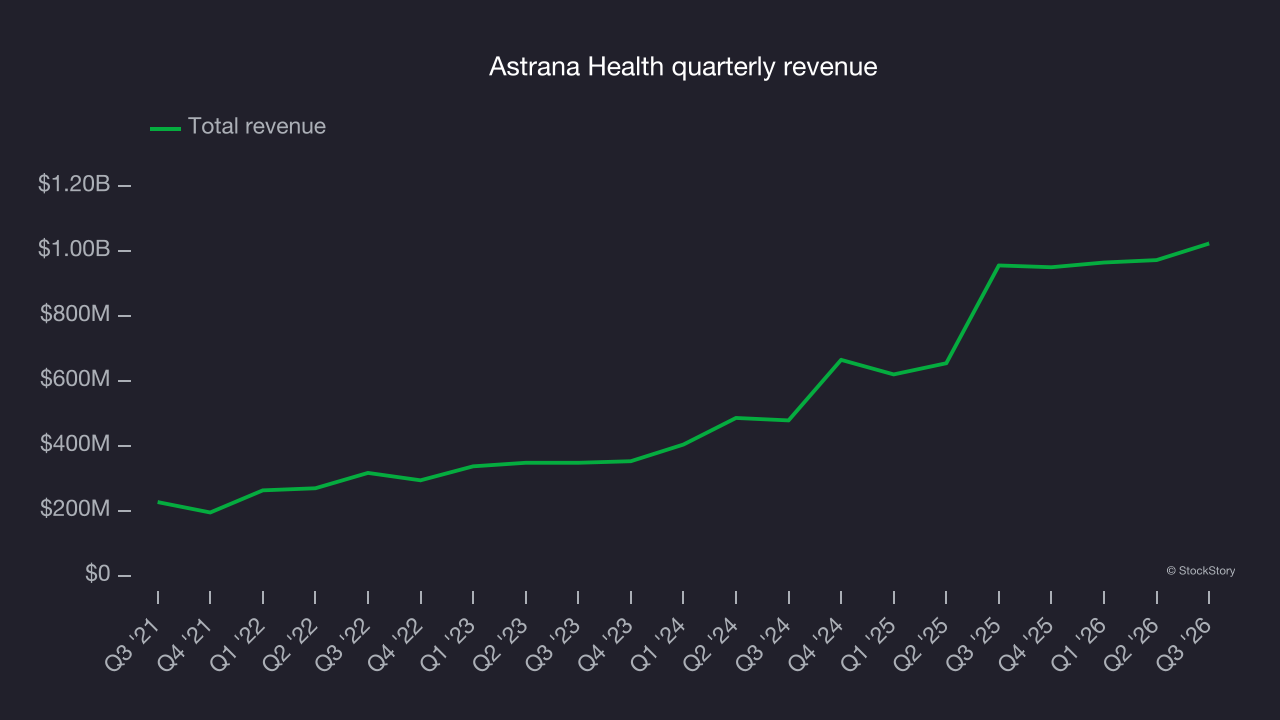
Long-term growth is the most important, but within healthcare, a half-decade historical view may miss new innovations or demand cycles. Astrana Health’s annualized revenue growth of 50.7% over the last two years is above its five-year trend, suggesting its demand was strong and recently accelerated. 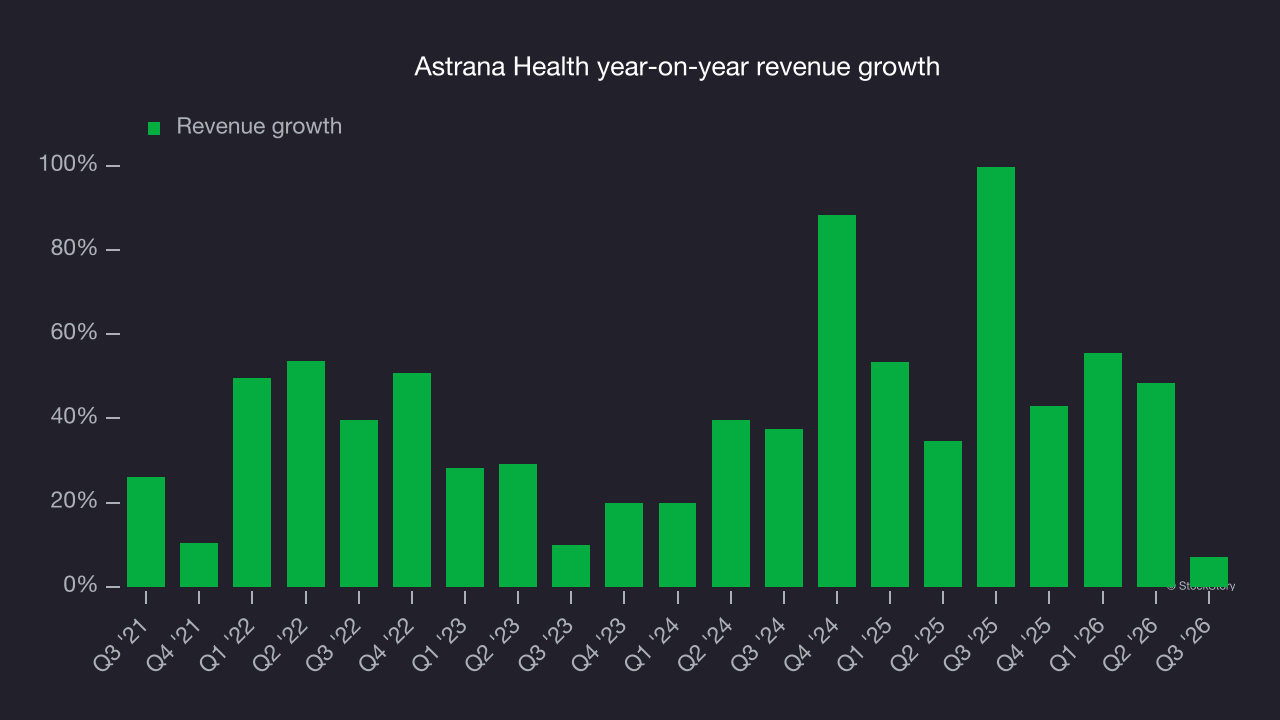
This quarter, Astrana Health grew its revenue by 7.1% year on year, and its $1.02 billion of revenue was in line with Wall Street’s consensus estimates. Company management is currently guiding for a 4% year-on-year increase in revenue next quarter.
Looking further ahead, sell-side analysts expect revenue to grow 9.7% over the next 12 months, according to S&P, a deceleration versus the last two years. Still, this projected growth is strong and indicates the market expects its products and services to succeed.
Adjusted operating margin
Adjusted operating margin is an important measure of profitability as it shows the portion of revenue left after accounting for all core expenses, from the cost of goods sold to advertising and wages. It’s also useful for comparing profitability across companies because it excludes non-recurring expenses, interest on debt and taxes.
Astrana Health was profitable over the last five years but held back by its large cost base. Its average adjusted operating margin of 6.5% was weak for a healthcare business.
Looking at the trend in its profitability, Astrana Health’s adjusted operating margin decreased by 5.4 percentage points over the last five years. The company’s two-year trajectory also shows it failed to return profitability to its peak as its margin fell by 2.1 percentage points. This was a poor performance, showing its expenses were rising and it couldn’t pass those costs on to its customers.
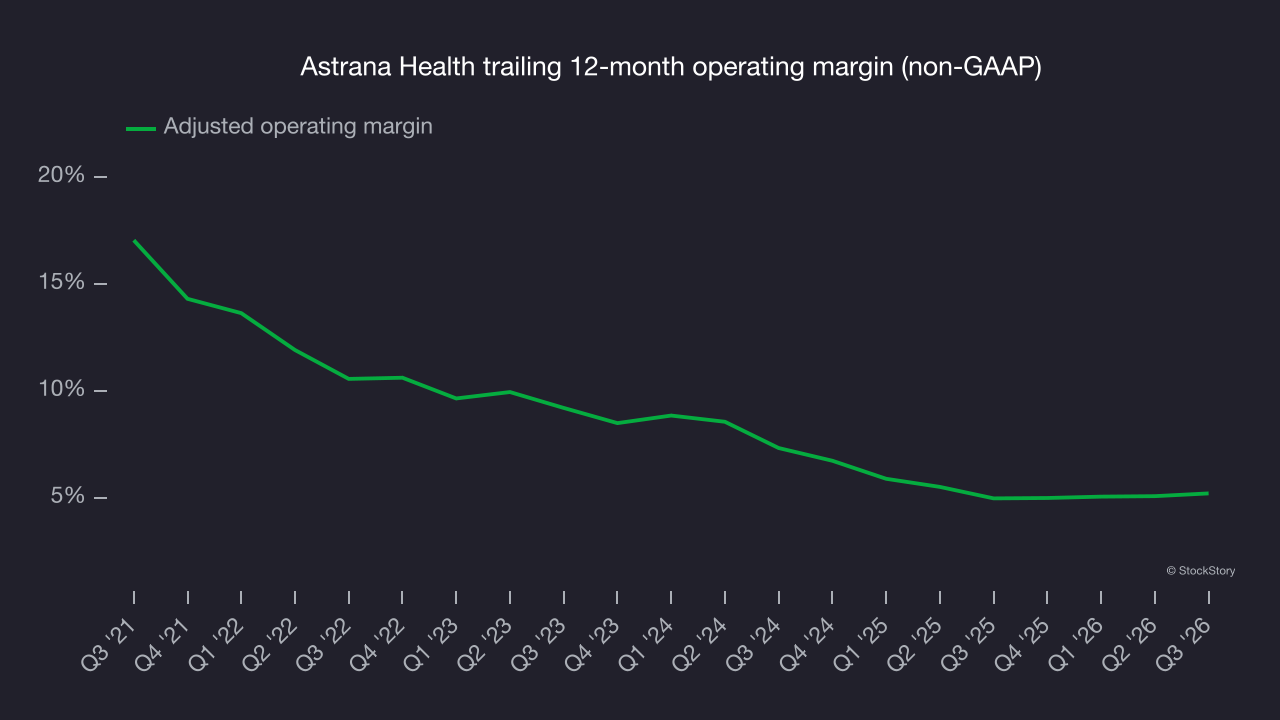
In Q3, Astrana Health generated an adjusted operating margin of 5.4%, in line with the same quarter last year. This indicates the company’s overall cost structure has been relatively stable.
Earnings per share
Revenue trends explain a company’s historical growth, but the long-term change in earnings per share (EPS) points to the profitability of that growth. For example, a company could inflate its revenue through excessive spending on advertising and promotions.
Astrana Health’s EPS grew at a solid 7.4% compounded annual growth rate over the last five years. However, this trailed its 38.9% annualized revenue growth, indicating the company became less profitable on a per-share basis as it expanded.
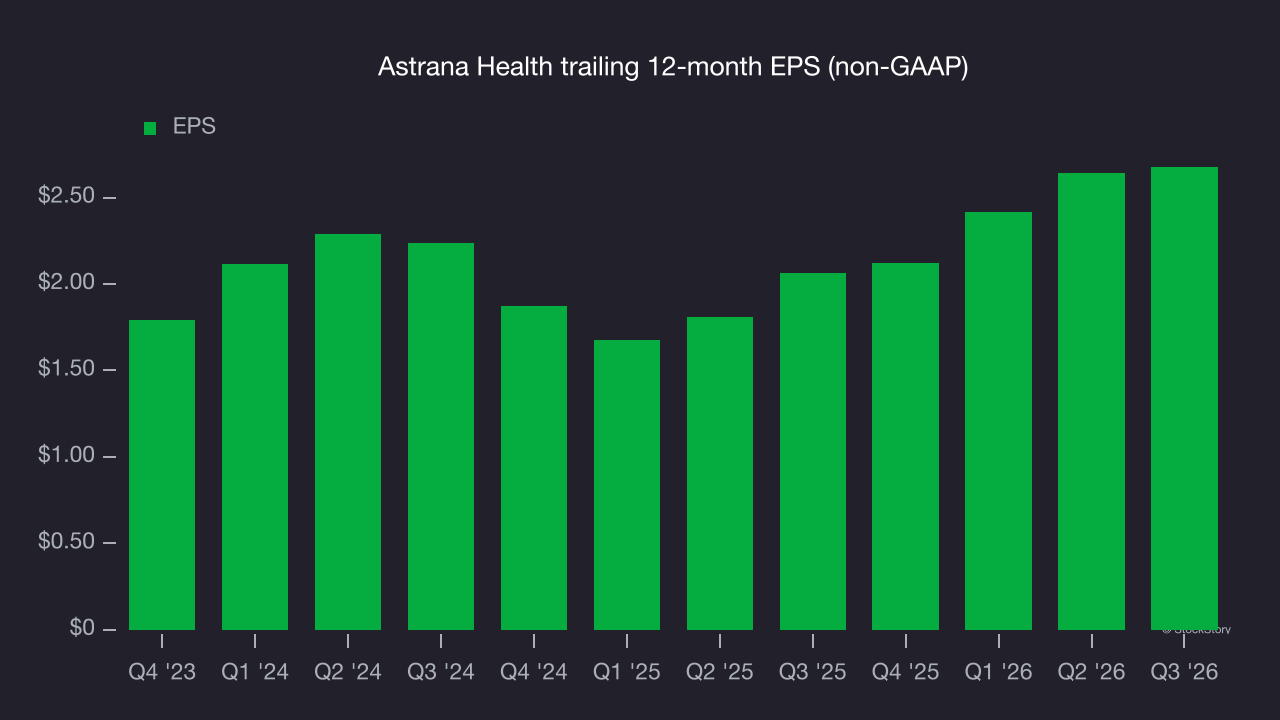
A closer look at Astrana Health’s earnings helps explain its performance. As mentioned earlier, Astrana Health’s adjusted operating margin was flat this quarter but declined by 5.4 percentage points over the last five years. Its share count also grew by 7.9%, meaning the company not only became less efficient with its operating expenses but also diluted its shareholders. 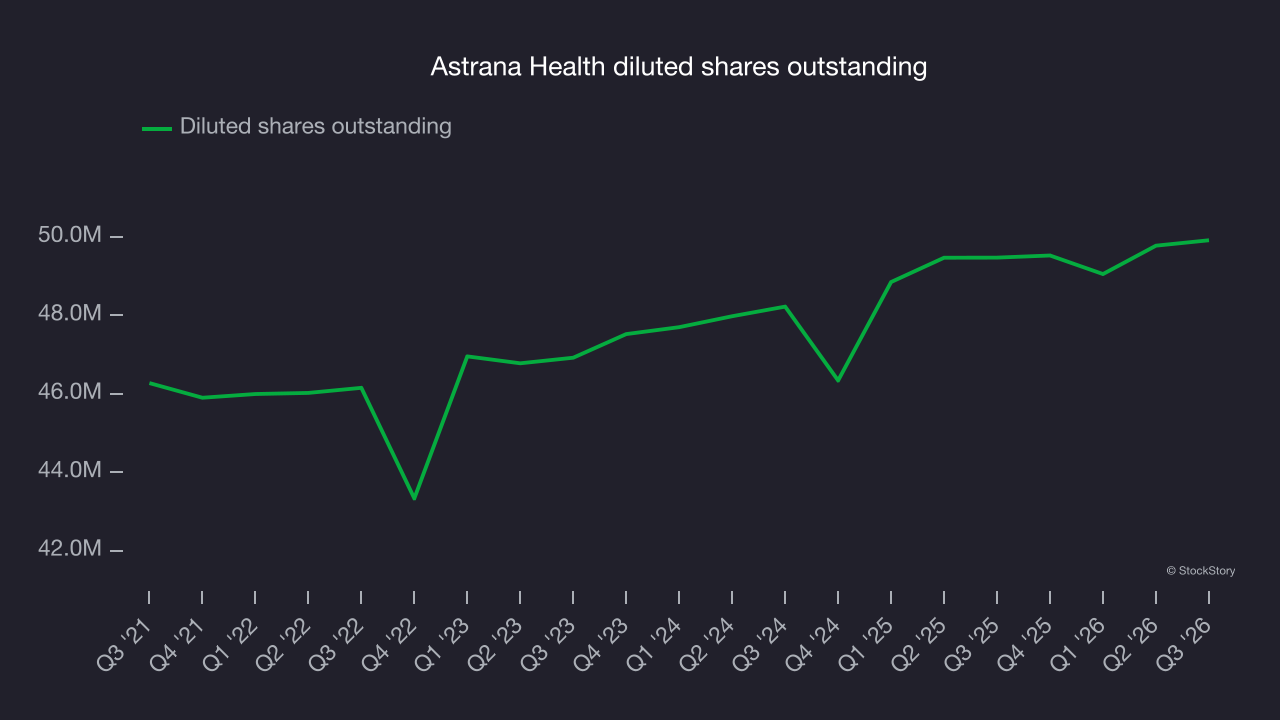
In Q3, Astrana Health reported adjusted EPS of $0.71, up from $0.67 in the same quarter last year. Despite growing year on year, adjusted EPS missed analysts’ consensus estimates, but long-term adjusted EPS growth matters more than short-term movements. Over the next 12 months, Wall Street expects Astrana Health’s full-year EPS to grow 32% from $2.67 to $3.53, according to S&P.
Key takeaways from Astrana Health’s Q3 results
Astrana Health had a softer quarter with few positives: EPS fell short of Wall Street’s consensus estimates, and revenue guidance for next quarter also missed expectations. Shares fell 2.7% to $38 immediately after the report.
Astrana Health may have had a tough quarter, but assessing its investment potential requires a broader view. Consider its valuation, business quality and latest quarterly results. For more on Astrana Health, read our free full research report here.