

E-commerce florist and gift retailer 1-800-FLOWERS (NASDAQ: FLWS) missed Wall Street’s revenue expectations in calendar Q3 2026 (fiscal Q1 2027), with revenue falling 20.4% year on year to $171.4 million. Its non-GAAP loss of $0.78 per share was 36% below analysts’ consensus estimates.
For more on 1-800-FLOWERS, read our free full research report.
1-800-FLOWERS (FLWS) Q3 CY2026 highlights:
- Revenue $171.4 million vs S&P analysts’ consensus estimates of $196.5 million (20.4% year-on-year decline, 12.8% miss)
- Adjusted EPS -$0.78 vs S&P analysts’ consensus estimates of -$0.57 (36% miss)
- Adjusted EBITDA -$31.91 million (-18.6% margin, 3.2% year-on-year growth)
- EBITDA guidance $12.5 million at the midpoint for the full year, below analysts’ consensus estimates of $14.1 million
- Operating margin -27.1%, down from -22.4% in the same quarter last year
- Free cash flow -$129.8 million compared to -$145.6 million in the same quarter last year
- Market capitalization $181.6 million
“We entered fiscal 2027 with a clear priority on strengthening our primary websites, 1-800-Flowers.com and Harry & David, which represent the greatest opportunity to improve our overall performance,” said Adolfo Villagomez, Chief Executive Officer. “During the fiscal first quarter, we began to see signs of progress across our primary websites, with improving net order demand trends and a moderation in the pace of year-over-year declines. While we are still in the early stages of our transformation, these developments are encouraging and suggest that our initiatives are beginning to take hold.”
Revenue growth
A company’s long-term performance is an indicator of its overall quality. Even a bad business can perform well for one or two quarters, but a top-tier one grows for years. Over the last five years, 1-800-FLOWERS’s demand was weak and its revenue declined by 7.4% per year. This fell short of our standards and points to poor business quality.
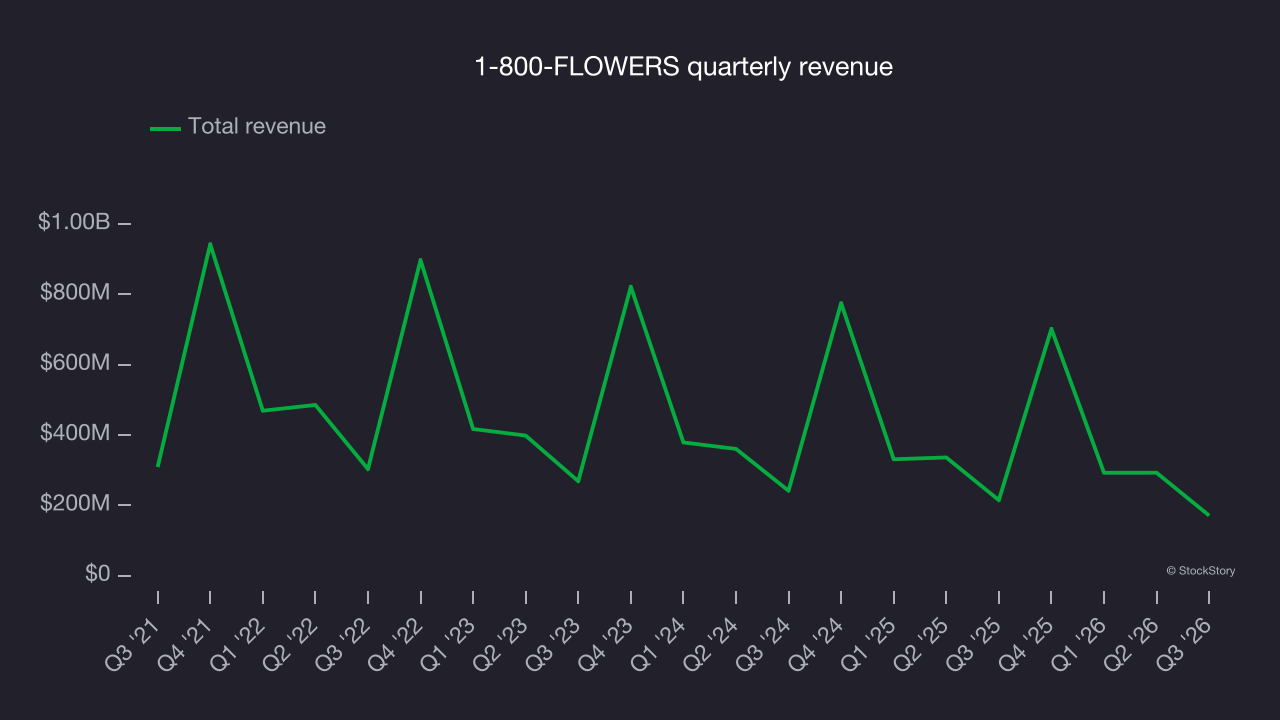
Long-term growth is the most important, but within consumer discretionary, product cycles are short and revenue can be hit-driven due to rapidly changing trends and consumer preferences. 1-800-FLOWERS’s recent performance shows its demand remained suppressed as its revenue has declined by 10.1% annually over the last two years. 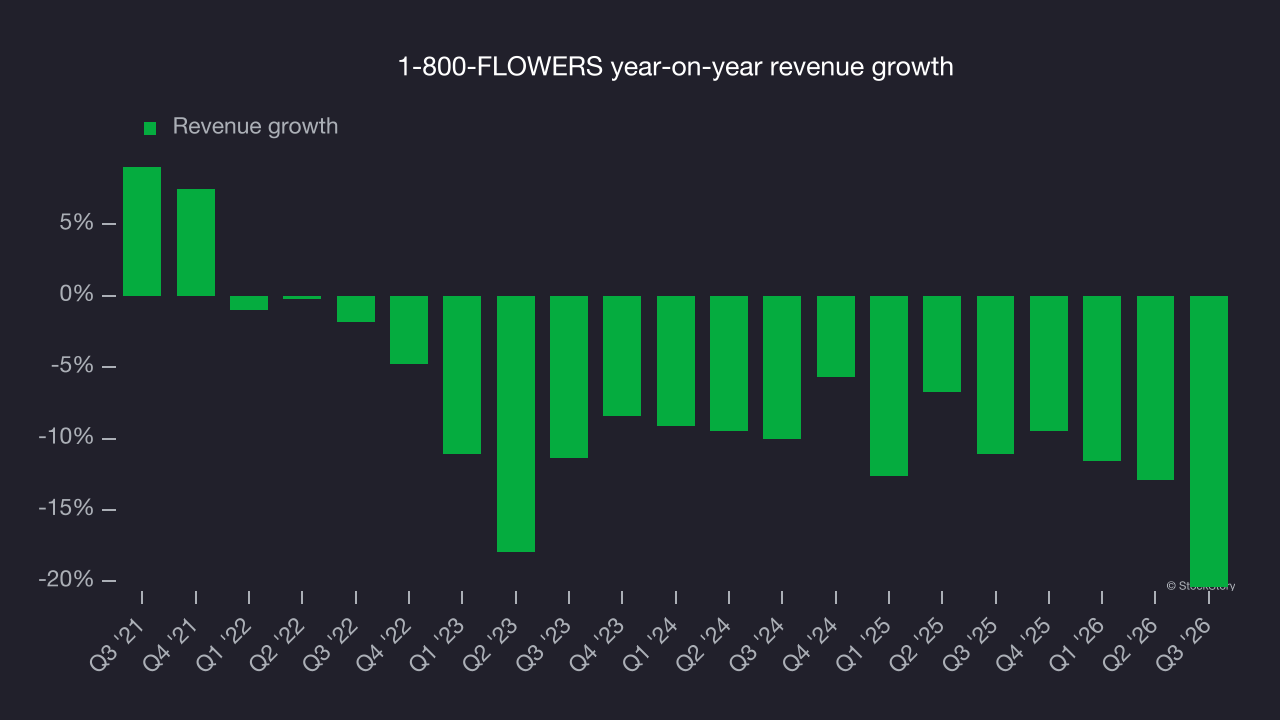
This quarter, 1-800-FLOWERS missed Wall Street’s consensus estimates and reported an uninspiring 20.4% year-on-year revenue decline, generating $171.4 million in revenue.
Looking ahead, sell-side analysts expect revenue to decline by 7.3% over the next 12 months, according to S&P. While this projection is better than its two-year trend, the company’s demand struggles remain a concern.
Operating margin
Operating margin is a key measure of profitability. Think of it as net income, the bottom line, excluding the impact of taxes and interest on debt, which are less connected to business fundamentals.
1-800-FLOWERS’s operating margin has generally stayed the same over the last 12 months, averaging negative 3.6% over the last two years. Unprofitable consumer discretionary companies that fail to narrow their losses or grow revenue rapidly deserve extra scrutiny. For the time being, it’s unclear if 1-800-FLOWERS’s business model is sustainable.
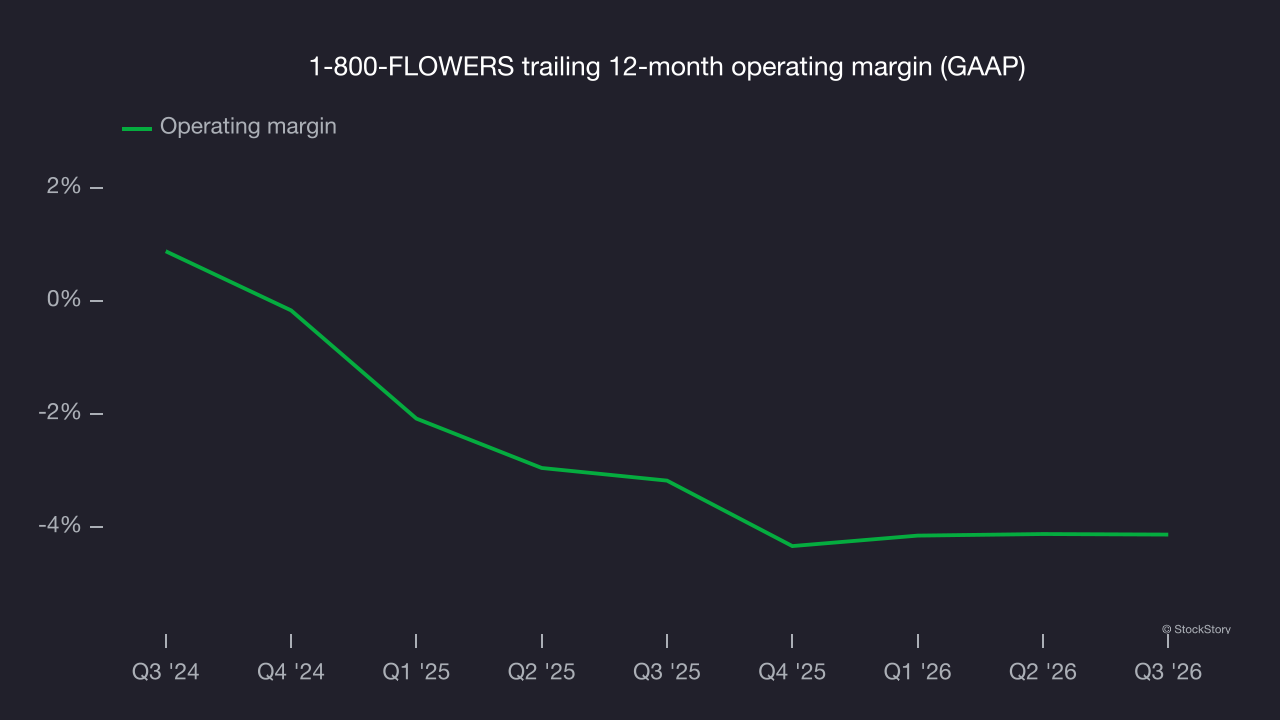
1-800-FLOWERS’s operating margin was negative 27.1% this quarter. The company’s consistent lack of profits raises concerns.
Earnings per share
Long-term earnings per share, or EPS, trends matter for the same reason as long-term revenue growth. Compared to revenue, however, EPS highlights whether a company’s growth is profitable.
1-800-FLOWERS’ EPS declined by 21.6% annually over the last five years, more than its revenue. This indicates the company struggled because its fixed cost base made it difficult to adjust to shrinking demand.
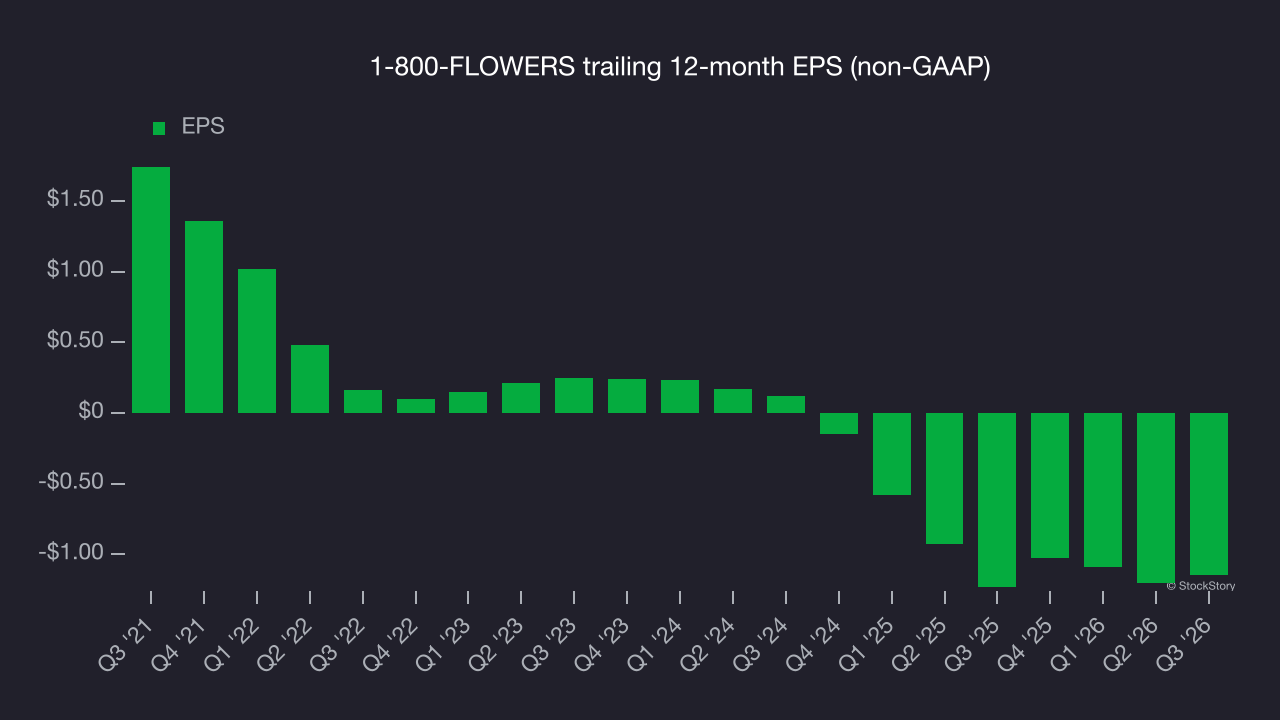
In Q3, 1-800-FLOWERS reported adjusted EPS of negative $0.78, up from negative $0.83 in the same quarter last year. Despite improving year on year, the result missed analysts’ consensus estimates. Over the next 12 months, Wall Street expects 1-800-FLOWERS to narrow its losses. Analysts forecast its full-year EPS will improve from negative $1.15 to negative $0.59, according to S&P.
Key takeaways from 1-800-FLOWERS’s Q3 results
1-800-FLOWERS offered few positives this quarter: Revenue fell short of Wall Street’s consensus estimates, and full-year EBITDA guidance also missed. Those shortfalls made for a weaker quarter. Shares remained flat at $2.87 immediately after the release.
The latest quarter is only one piece of the longer-term business quality picture. Quality, when combined with valuation, can help determine if the stock is a buy. For more on these factors, read the full research report here (it’s free).