
Document technology company Xerox (NASDAQ: XRX) met Wall Street’s revenue expectations in Q3 2026, but revenue fell by 4.7% year on year to $1.87 billion. The company’s outlook for the full year was close to analysts’ consensus estimates with revenue guided to $7.6 billion at the midpoint. Its non-GAAP profit of $0.02 per share was significantly above analysts’ consensus estimates.
For more on Xerox, read our full research report, it’s free.
Xerox (XRX) Q3 2026 highlights:
- Revenue $1.87 billion vs S&P analysts’ consensus estimates of $1.86 billion (4.7% year-on-year decline, in line)
- Adjusted EPS $0.02 vs S&P analysts’ consensus estimates of -$0.12 (significant beat)
- Revenue guidance The company reconfirmed its revenue guidance for the full year of $7.6 billion
- Operating margin -53.9%, down from -15.2% in the same quarter last year
- Free cash flow margin 0.4%, down from 6.7% in the same quarter last year
- Market capitalization $366.4 million
“This quarter, Print equipment revenue grew and adjusted operating margin doubled as we continued to execute against our three priorities: stabilize revenue, increase profitability and reduce leverage,” said Louie Pastor, chief executive officer at Xerox. “We are seeing results in the areas where we have focused our execution, but the headwinds affecting our outlook have intensified, creating greater near-term pressure than we expected. As a result, we are lowering our full-year adjusted operating income and free cash flow guidance. We’re responding with actions and cost measures to mitigate these pressures, improve profitability, and preserve cash, including the suspension of our common and preferred dividends, while maintaining our focus on reducing debt.”
Revenue growth
A company’s long-term revenue performance can indicate its overall quality. Even a poor business can perform well for one or two quarters, but a top-tier one grows for years.
With $7.66 billion in revenue over the past 12 months, Xerox is one of the larger companies in the business services industry and benefits from a well-known brand that influences purchasing decisions. However, its scale is a double-edged sword because it’s challenging to maintain high growth rates after capturing a large portion of the addressable market. To accelerate revenue growth, Xerox likely needs to optimize its pricing or focus on new offerings and international expansion.
Xerox’s 1.3% annualized revenue growth over the last five years was sluggish. This shows it failed to generate meaningful demand growth.
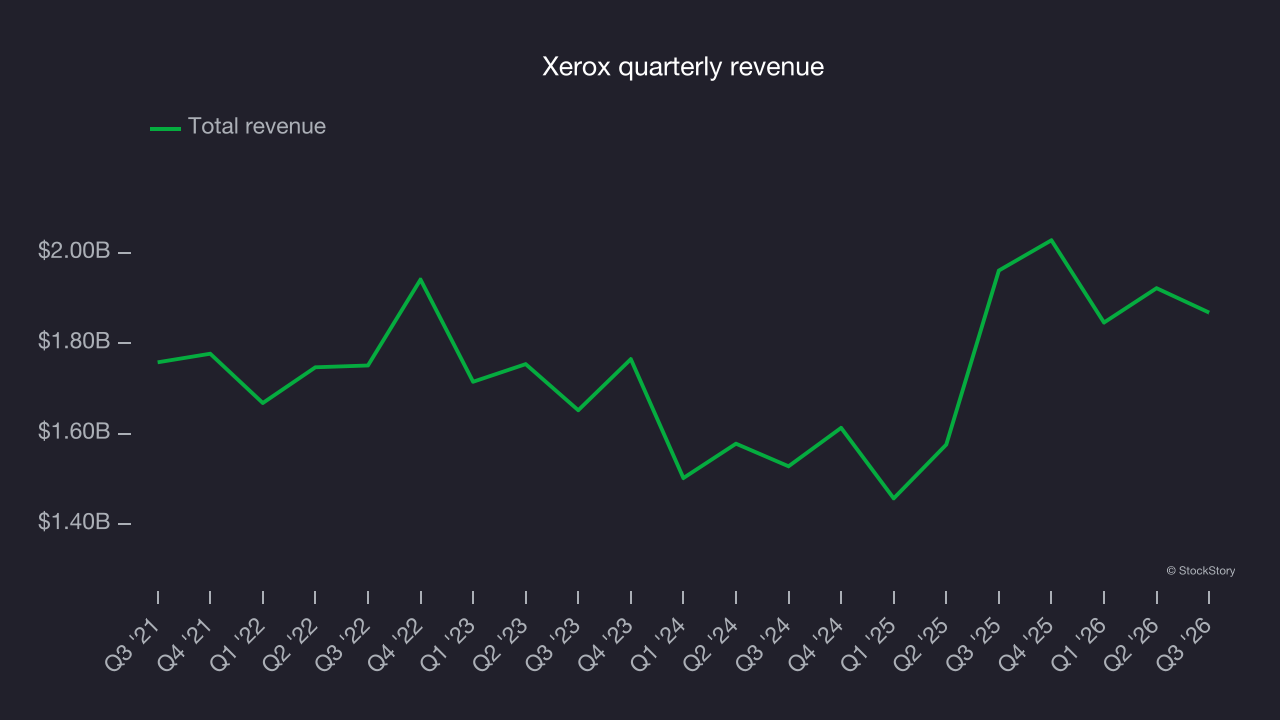
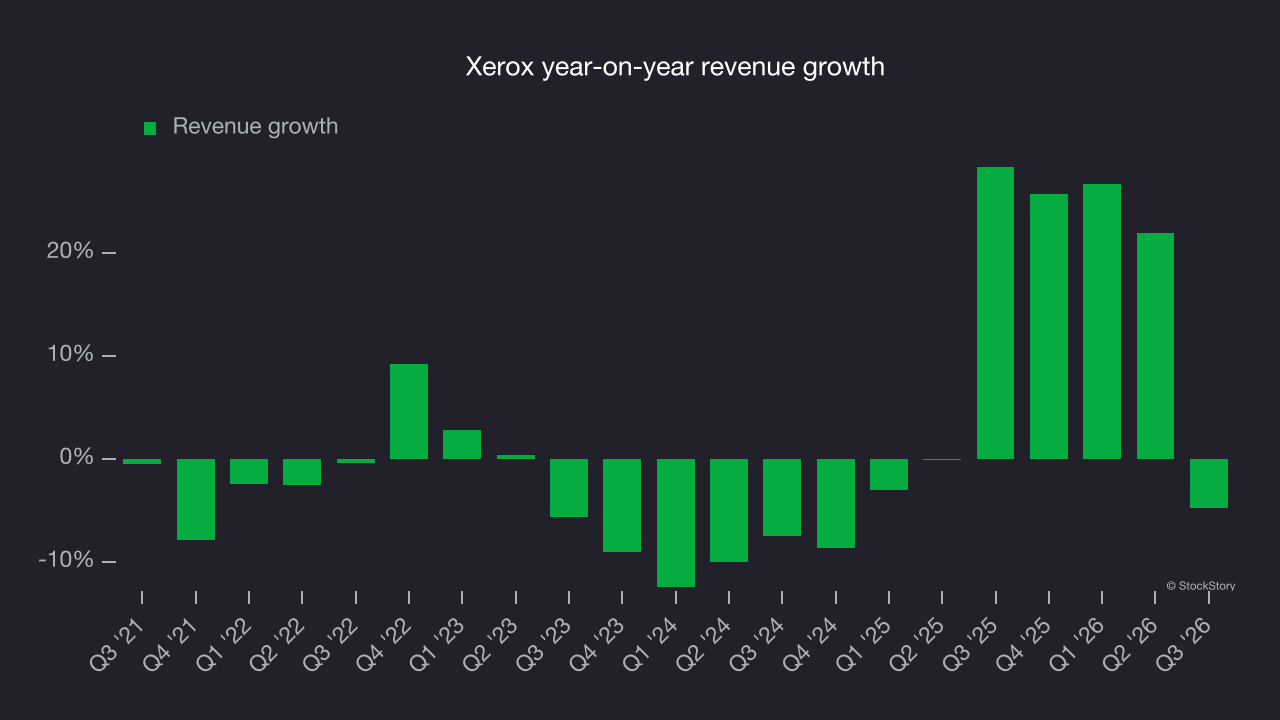
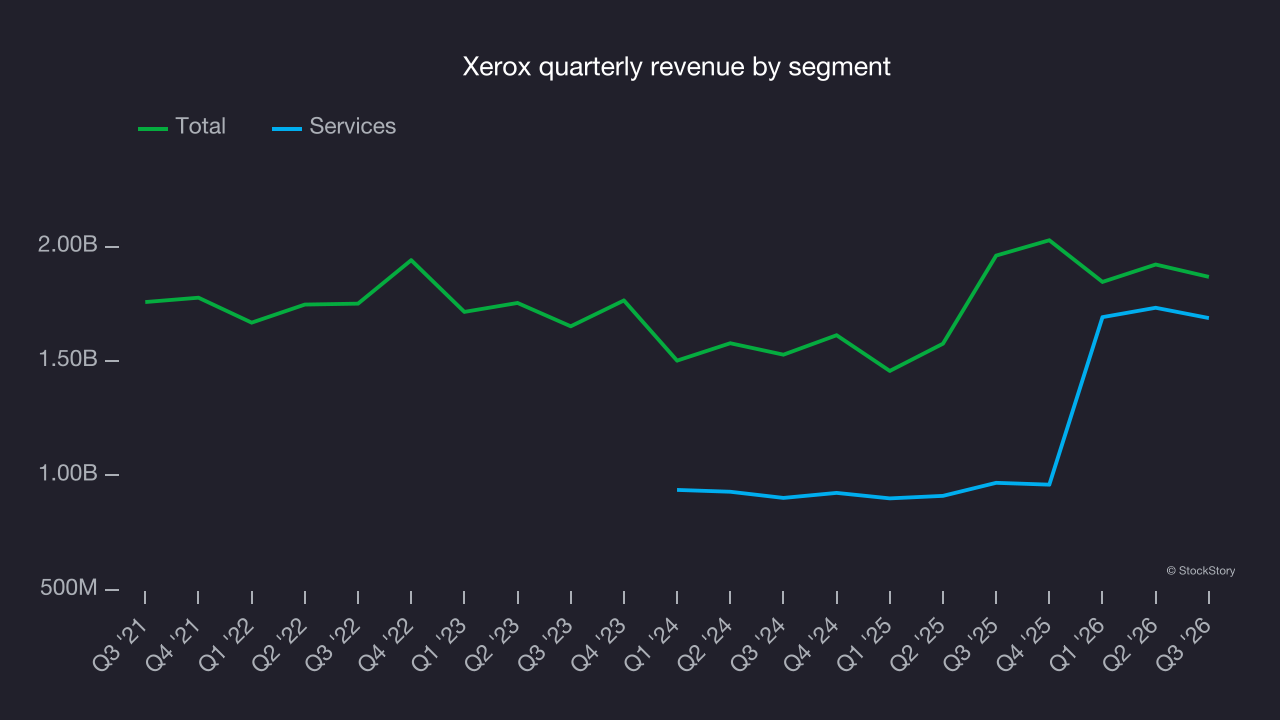
This quarter, Xerox reported an uninspiring 4.7% year-on-year revenue decline to $1.87 billion, in line with Wall Street’s consensus estimates.
Looking ahead, sell-side analysts expect revenue to decline by 2.1% over the next 12 months, according to S&P, a deceleration versus the last two years. This underwhelming projection indicates its products and services will face some demand challenges.
Adjusted operating margin
Xerox was profitable over the last five years but held back by its large cost base. Its average adjusted operating margin of 1.7% was weak for a business services company.
Looking at the trend in its profitability, Xerox’s adjusted operating margin decreased by 10.7 percentage points over the last five years. This raises questions about the company’s expense base because its revenue growth should have given it leverage on its fixed costs, resulting in better economies of scale and profitability. Xerox’s poor performance shows that costs were rising and it couldn’t pass them on to its customers.
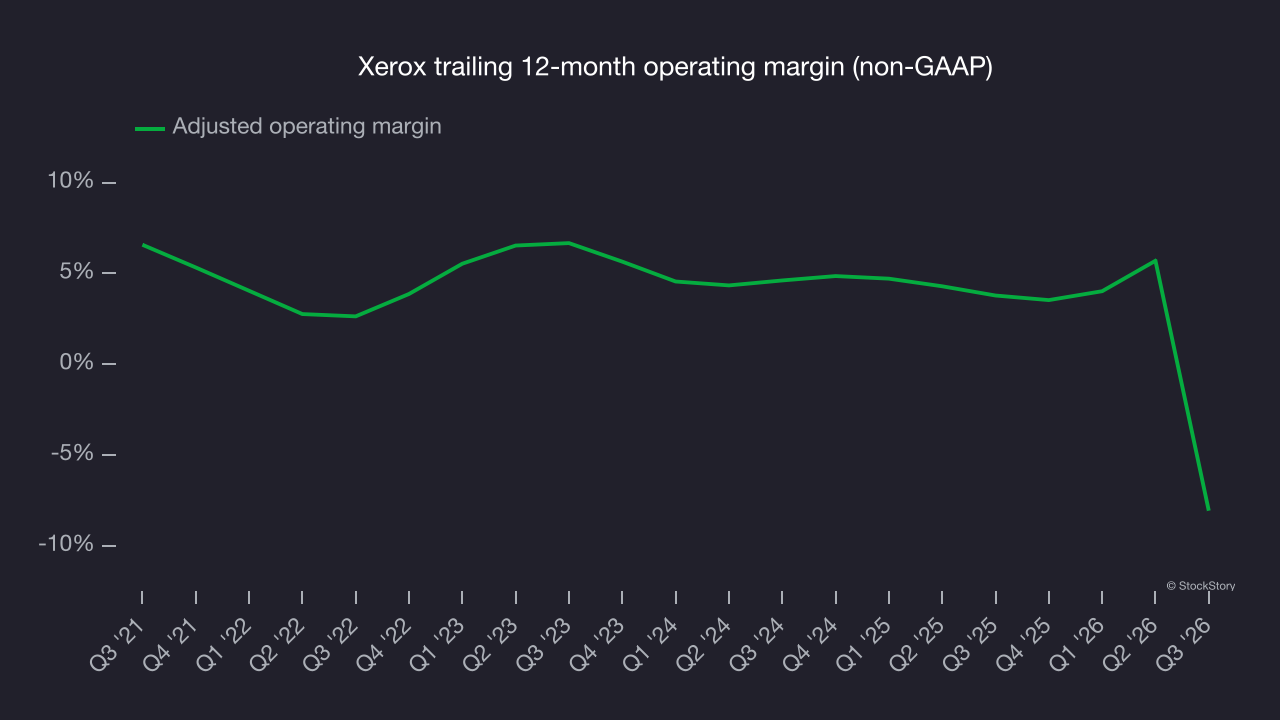
This quarter, Xerox reported an adjusted operating margin of negative 53.9%, down 38.6 percentage points year on year. This contraction shows it was less efficient because its expenses increased relative to its revenue.
Earnings per share
Revenue trends explain a company’s historical growth, but the long-term change in earnings per share (EPS) points to the profitability of that growth. For example, a company could inflate its revenue through excessive spending on advertising and promotions.
Xerox’s EPS declined by 15.7% annually over the last five years while its revenue grew by 1.3%. This indicates the company became less profitable on a per-share basis as it expanded due to non-fundamental factors such as interest expenses and taxes.
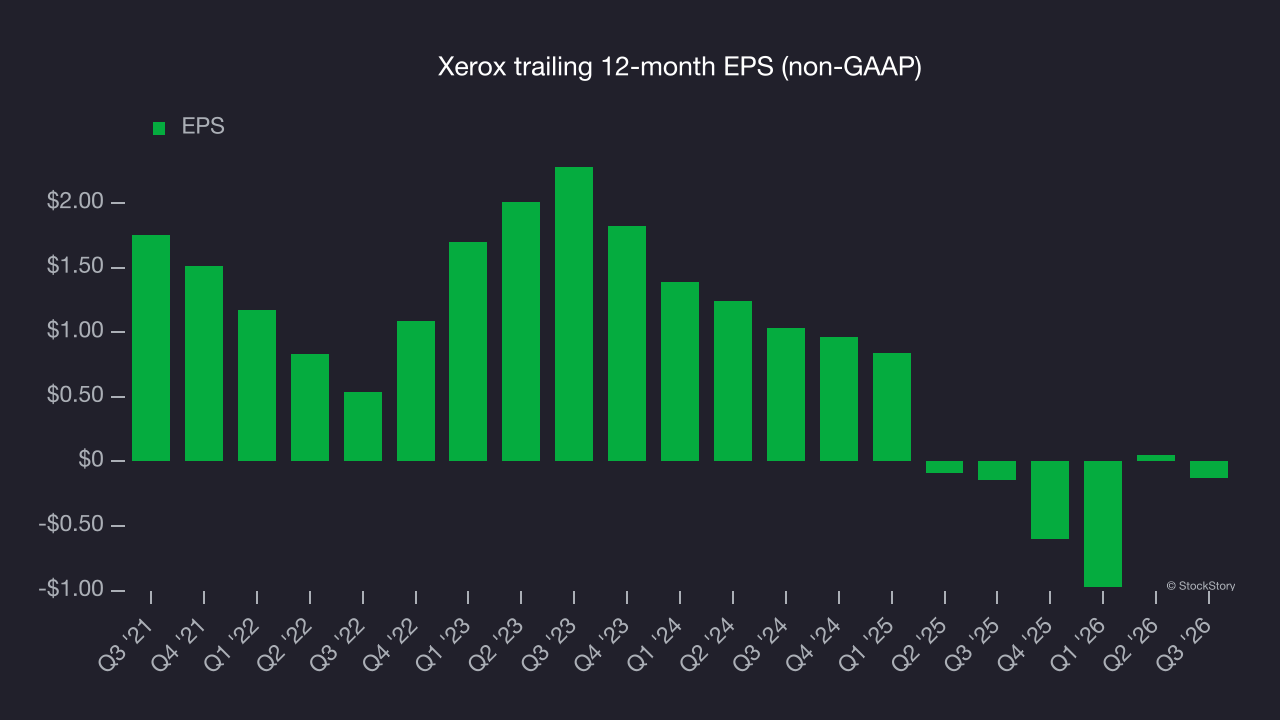
We can take a deeper look into Xerox’s earnings to better understand the drivers of its performance. As we mentioned earlier, Xerox’s adjusted operating margin declined by 10.7 percentage points over the last five years. This was the most relevant factor (aside from the revenue impact) behind its lower earnings; interest expenses and taxes can also affect EPS but don’t tell us as much about a company’s fundamentals.
Like with revenue, we analyze EPS over a more recent period because it can provide insight into an emerging theme or development for the business.
For Xerox, its two-year annual EPS declines of 45.8% show it’s continued to underperform. The results were poor across both periods.
In Q3, Xerox reported adjusted EPS of $0.02, down from $0.20 in the same quarter last year. Despite falling year on year, EPS easily topped analysts’ consensus estimates. Wall Street expects earnings to improve over the next 12 months. Analysts forecast Xerox’s full-year EPS will turn positive, rising from negative $0.13 to positive $0.52, according to S&P.
Key takeaways from Xerox’s Q3 results
Xerox’s EPS beat analysts’ consensus estimates, helping make this a decent quarter with some key metrics above expectations. But investors were likely hoping for more: Shares plunged 14.2% to $2.41 immediately after the results.
To assess whether Xerox is a buy at its current price, consider its valuation, business quality and latest quarterly results. For more on Xerox, read the full research report here (it’s free).