

Cloud computing and online retailer Amazon (NASDAQ: AMZN) met Wall Street’s revenue expectations in Q3 2026, with revenue rising 12.1% year on year to $201.9 billion. The company expects next quarter’s revenue to be around $243.5 billion, close to analysts’ consensus estimates. Its GAAP profit of $1.89 per share was 3.5% below analysts’ consensus estimates.
For more on Amazon, read our free full research report.
Amazon (AMZN) Q3 2026 highlights:
- Revenue $201.9 billion vs S&P analysts’ consensus estimates of $202.3 billion (in line)
- AWS revenue beat but Advertising revenue missed
- EPS (GAAP) $1.89 vs analysts’ consensus estimates of $1.96 (3.5% miss)
- Operating margin 13.9%, up from 9.7% in the same quarter last year
- Free cash flow margin -17.3%, down from 0.7% in the same quarter last year
- Market capitalization $2.75 trillion
“Our AWS investment in functionality and infrastructure is working, with over 39% year-over-year revenue growth in Q3 ($184 billion revenue run rate) and projected revenue growth rates of over 40% both in 2027 and in 2028,” said Andy Jassy, President and CEO, Amazon. “Our broader selection and speedier delivery are helping us capture more retail market segment share with improving margins, and our newer businesses, ranging from Grocery to Pharmacy to Amazon Leo to Zoox are progressing encouragingly. There has never been a trillion dollar revenue business, and we may have two of them in the next 5-10 years.”
Revenue growth
Amazon shows that even companies of its scale can grow quickly. The company’s revenue base of $458 billion five years ago has increased to $797.5 billion in the last year, translating into an impressive 11.7% annualized growth rate.
Over the same period, Amazon’s big tech peers Alphabet, Microsoft and Apple posted annualized growth rates of 14.5%, 14.5% and 5.2%, respectively. This is an important consideration because investors often use the comparisons as a starting point for their valuations. Relative to these benchmarks, Amazon’s price appears fair.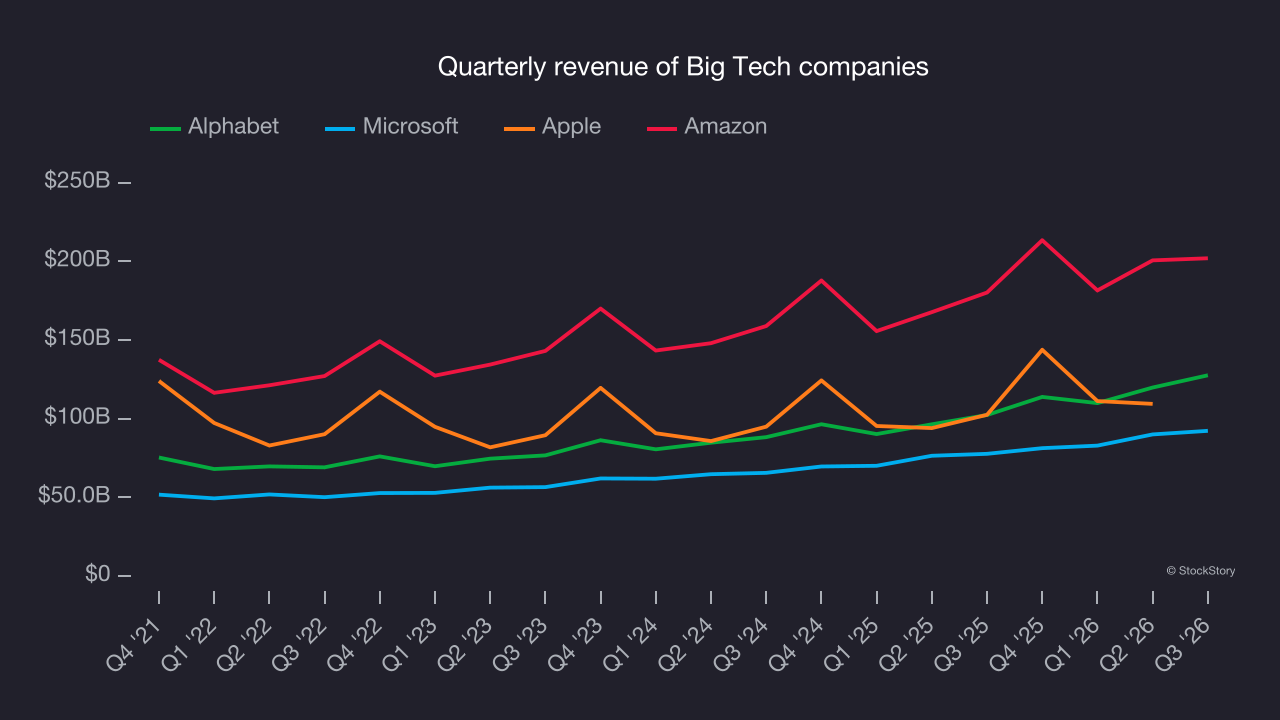
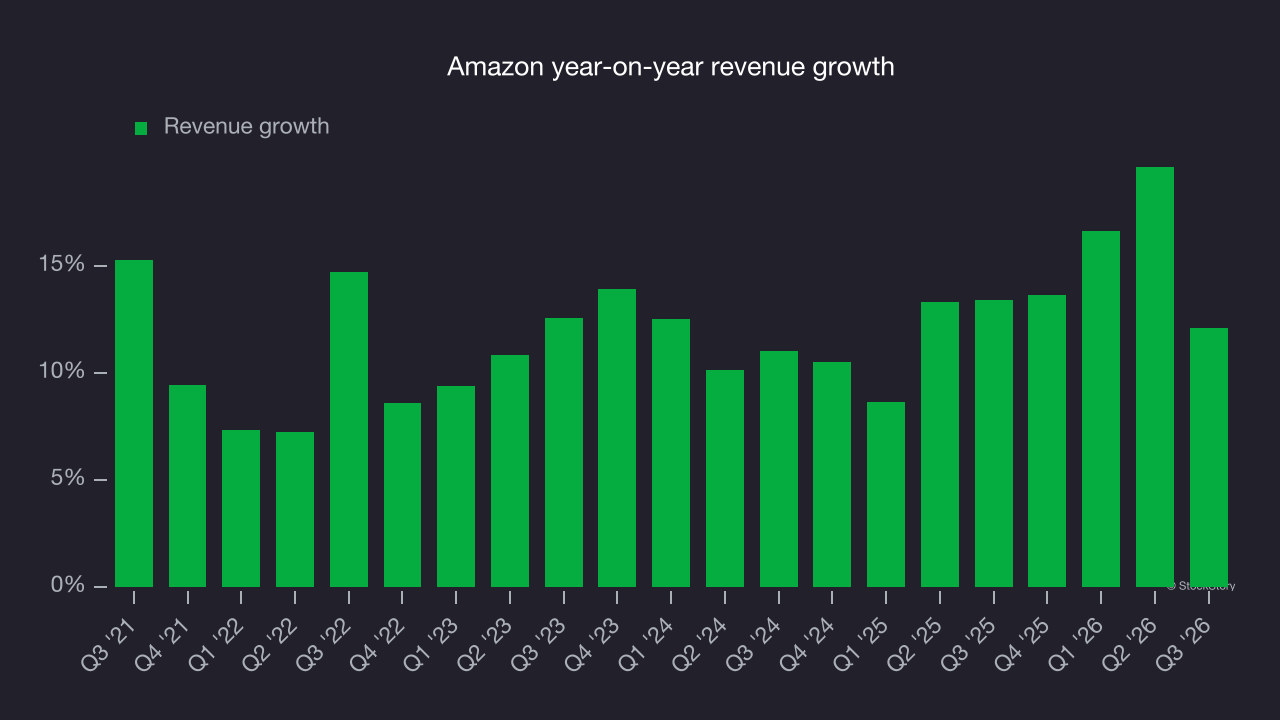
This quarter, Amazon’s year-on-year revenue growth was 12.1%, and its $201.9 billion of revenue was in line with Wall Street’s consensus estimates. Company management is currently guiding for a 14.1% year-on-year increase in revenue next quarter. This projection is strong for a company of its scale and indicates that the market sees some success for its newer products.
Profitability: the key debate
Many investors understand that Amazon’s e-commerce business caps its gross margin, which averaged 48.3% over the last five years. The company lags behind its pure-play tech peers because it sells many commoditized goods online where it must acquire and hold physical inventory.
What the market debates, however, is where Amazon’s long-term operating profitability could ultimately settle. Its five-year margin of 8.9% was mediocre, but it rose by 10.5 percentage points thanks to leverage on the fixed costs in its consumer-facing businesses and the highly profitable AWS segment becoming a larger portion of its revenue. The question is whether Amazon’s momentum can continue and result in a percentage margin in the mid-to-high teens over time.
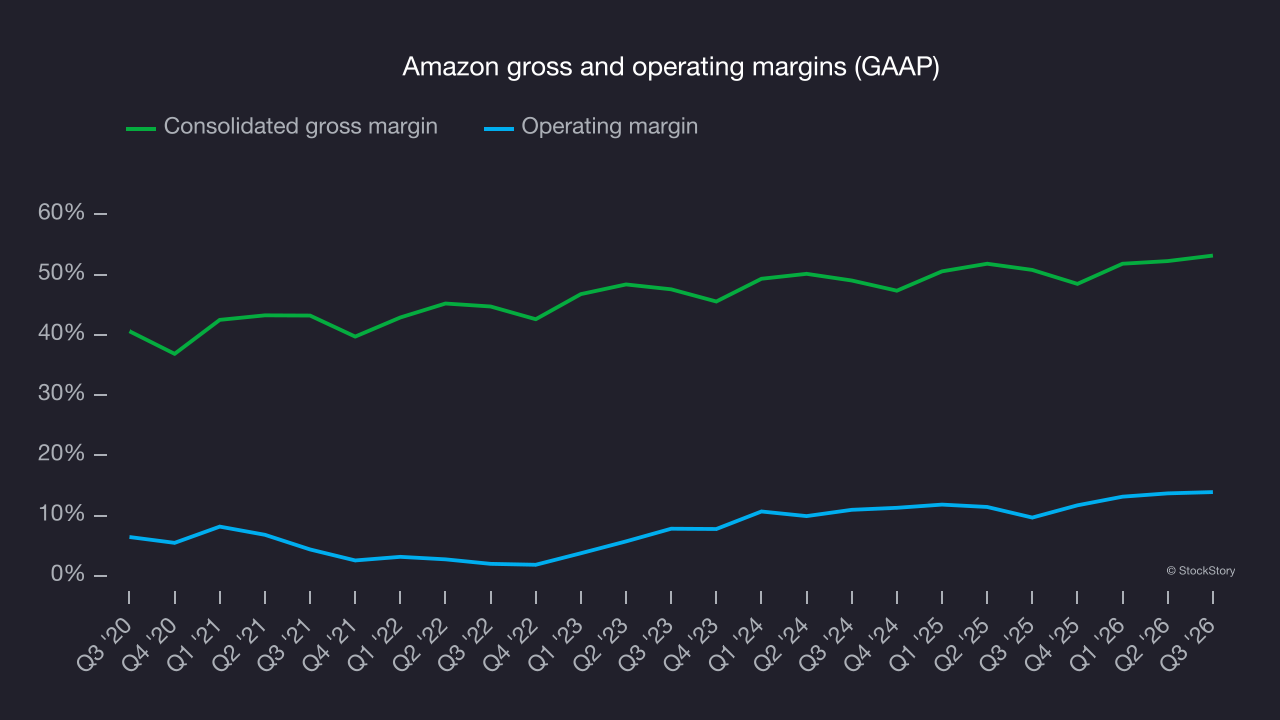
The company’s North America segment is key to this answer. Over the years, Amazon has made significant investments to attract large numbers of customers into its ecosystem and retain them. Some areas of focus in this effort included its delivery network and video streaming content.
Bulls argue that Amazon can afford to ease investment spending and begin reaping the benefits of its investments over the last two-plus decades. Its trailing 12-month operating margin of 13.1%, combined with its performance over the last few years, suggests Amazon’s long-term profitability could go much higher, potentially lifting earnings and the stock price.
Key takeaways from Amazon’s Q3 results
Amazon’s Q3 results offered few positives: EPS missed Wall Street’s consensus estimates and revenue came in as expected. It was a weaker quarter overall, and shares tumbled 6.5% to $228.29 immediately after the report.
Amazon fell short this quarter. The latest quarter matters, but longer-term fundamentals and valuation are more important when deciding whether the stock is a buy. For more on Amazon, read our full research report here (it’s free).