

Akamai currently trades at $96.60 per share and has shown little upside over the past six months, posting a small loss of 3.2%. The stock also fell short of the S&P 500’s 8.2% gain during that period.
Is there a buying opportunity in Akamai, or does it present a risk to your portfolio? See what our analysts have to say in our full research report, it’s free.
Why do we think Akamai will underperform?
We don’t have much confidence in Akamai. Here are three reasons we avoid AKAM, plus one stock we’d rather own.
1. Weak billings point to soft demand
Billings is a non-GAAP metric that is often called “cash revenue” because it shows how much money the company has collected from customers in a certain period. This is different from revenue, which must be recognized in pieces over the length of a contract.
Akamai’s billings came in at $1.10 billion in Q2, and over the last four quarters, its year-on-year growth averaged 5.7%. This performance was underwhelming and suggests that increasing competition is causing challenges in acquiring/retaining customers. 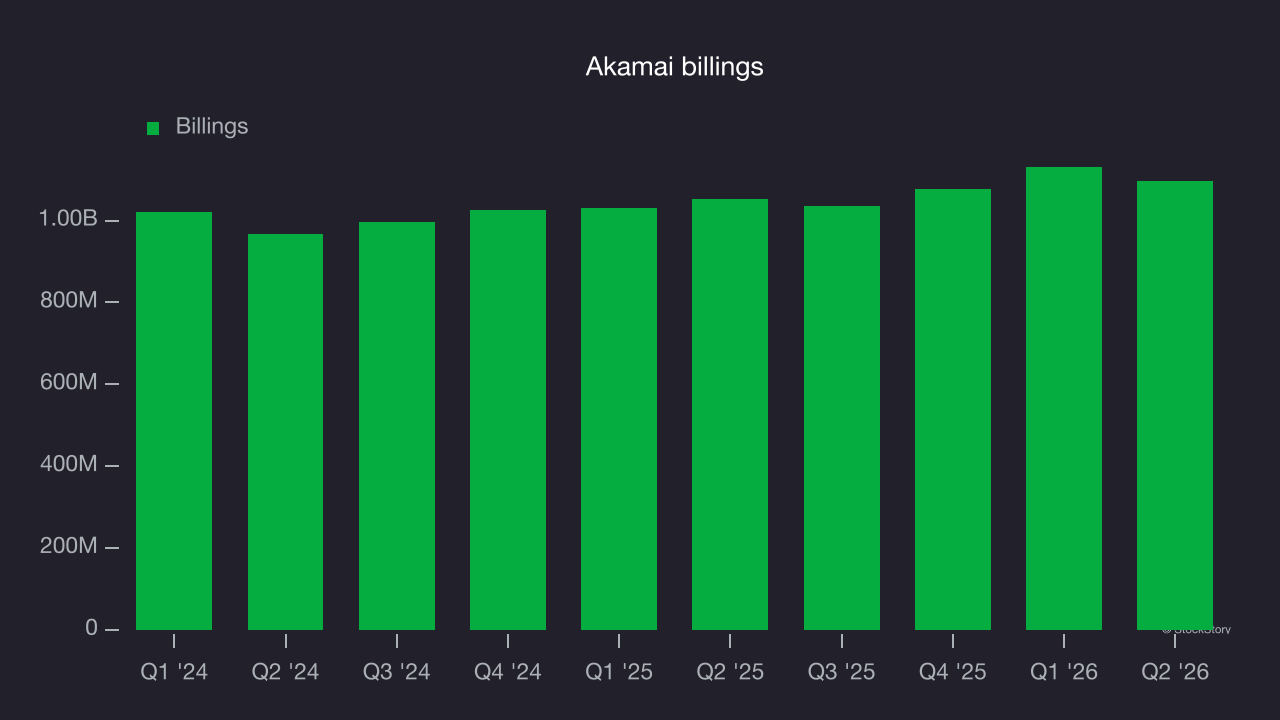
2. Low gross margin reveals weak structural profitability
For software companies like Akamai, gross profit tells us how much money remains after paying for the base cost of products and services (typically servers, licenses, and certain personnel). These costs are usually low as a percentage of revenue, explaining why software is more lucrative than other sectors.
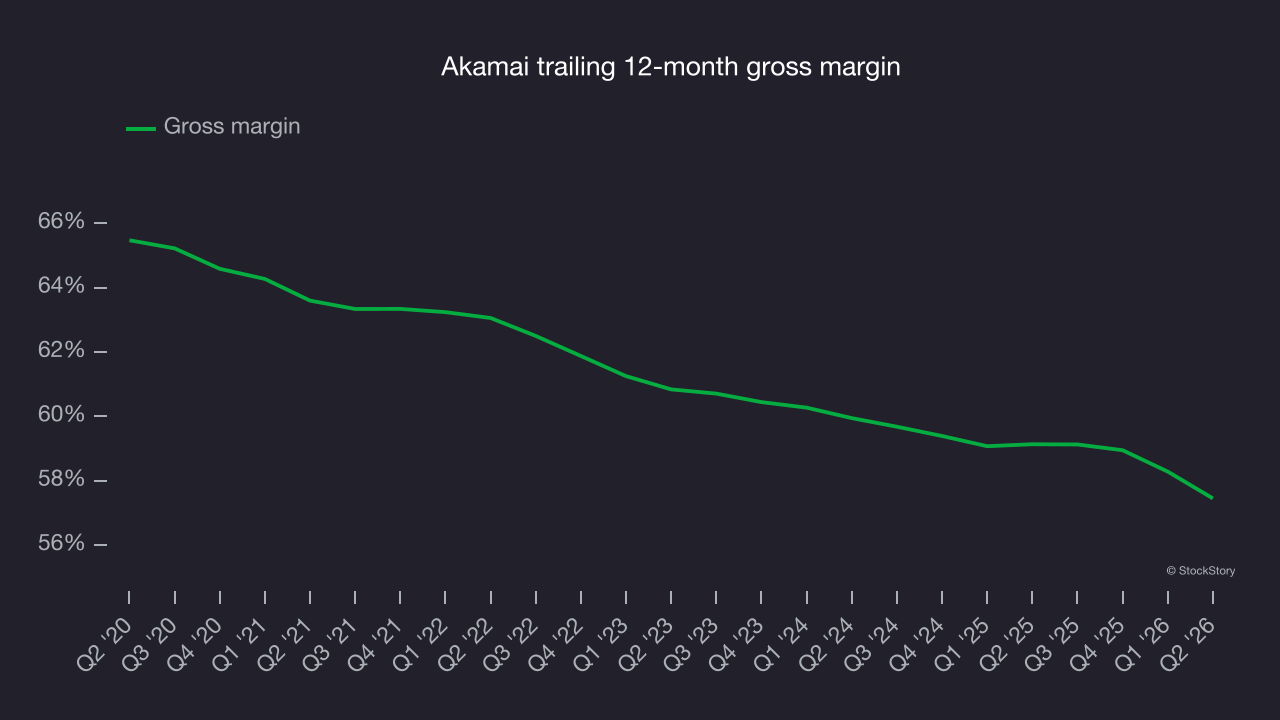
Akamai’s gross margin is substantially worse than most software businesses, signaling it has relatively high infrastructure costs compared to asset-lite businesses like ServiceNow. As you can see below, it averaged a 57.5% gross margin over the last year. That means Akamai paid its providers a lot of money ($42.55 for every $100 in revenue) to run its business.
The market not only cares about gross margin levels but also how they change over time because expansion creates firepower for profitability and free cash generation. Akamai has seen gross margins decline by 2.5 percentage points over the last 2 years, which is among the worst in the software space.
3. Cash flow margin set to decline
If you’ve followed StockStory for a while, you know we emphasize free cash flow. Why, you ask? We believe that in the end, cash is king, and you can’t use accounting profits to pay the bills.
Over the next year, analysts predict Akamai will flip from cash-producing to cash-burning. Their consensus estimates, according to S&P, imply its free cash flow margin of 14.6% for the last 12 months will decrease to negative 87.4%.
Final judgment
We see the value of companies addressing major business pain points, but in the case of Akamai, we’re out. With its shares underperforming the market lately, the stock trades at 3.2× forward price-to-sales (or $96.60 per share). At this valuation, there’s a lot of good news priced in - we think there are better stocks to buy right now. Let us point you toward the Amazon and PayPal of Latin America.
Stocks we would buy instead of Akamai
ONE MORE THING: Top 5 Growth Stocks. The biggest stock winners almost always had one thing in common before they ran. Revenue growing like crazy. Meta. CrowdStrike. Broadcom. Our AI flagged all three. They returned 315%, 314%, and 455%, respectively.
Find out which 5 stocks it’s flagging this month — FREE. Get Our Top 5 Growth Stocks for Free HERE.
Stocks that have made our list include now familiar names such as Nvidia (+1,460% between June 2020 and June 2025) as well as under-the-radar businesses like the once-micro-cap company Kadant (+214% between June 2020 and June 2025). Find your next big winner with StockStory today.