
Online casino and sports betting company Rush Street Interactive (NYSE: RSI) missed Wall Street’s revenue expectations in Q3 2026, but revenue rose 38.8% year on year to $385.9 million. On the other hand, the company’s outlook for the full year was close to analysts’ consensus estimates with revenue guided to $1.58 billion at the midpoint. Its non-GAAP profit of $0.15 per share was 12.1% above analysts’ consensus estimates.
For more on Rush Street Interactive, read our full research report, available free.
Rush Street Interactive (RSI) Q3 2026 highlights:
- Revenue $385.9 million vs S&P analysts’ consensus estimates of $388.6 million (38.8% year-on-year growth, 0.7% miss)
- Adjusted EPS $0.15 vs S&P analysts’ consensus estimates of $0.13 (12.1% beat)
- Adjusted EBITDA $62.22 million vs analysts’ consensus estimates of $54.67 million (16.1% margin, 13.8% beat)
- Revenue guidance The company reconfirmed its revenue guidance for the full year of $1.58 billion at the midpoint
- EBITDA guidance $255 million at the midpoint for the full year, in line with analysts’ consensus estimates
- Operating margin 11.1%, up from 7% in the same quarter last year
- Market capitalization $1.78 billion
“We enter the fourth quarter with a strong balance sheet, a scalable profitability model, continued marketing efficiency, and the flexibility to be opportunistic on how we invest in long-term growth.”
Revenue growth
Reviewing a company’s long-term revenue performance reveals insights into its quality. Even a poor business can perform well for one or two quarters, but a high-quality one grows for years. Over the last five years, Rush Street Interactive grew its revenue at a 26.4% compounded annual growth rate. Though this growth is acceptable on an absolute basis, revenue growth alone is not enough for the consumer discretionary sector, which can display significant earnings volatility. This means the bar for the sector is particularly high, reflecting the non-essential and hit-driven nature of the products and services offered. Additionally, the five-year CAGR starts around Covid, when revenue was depressed before rebounding.
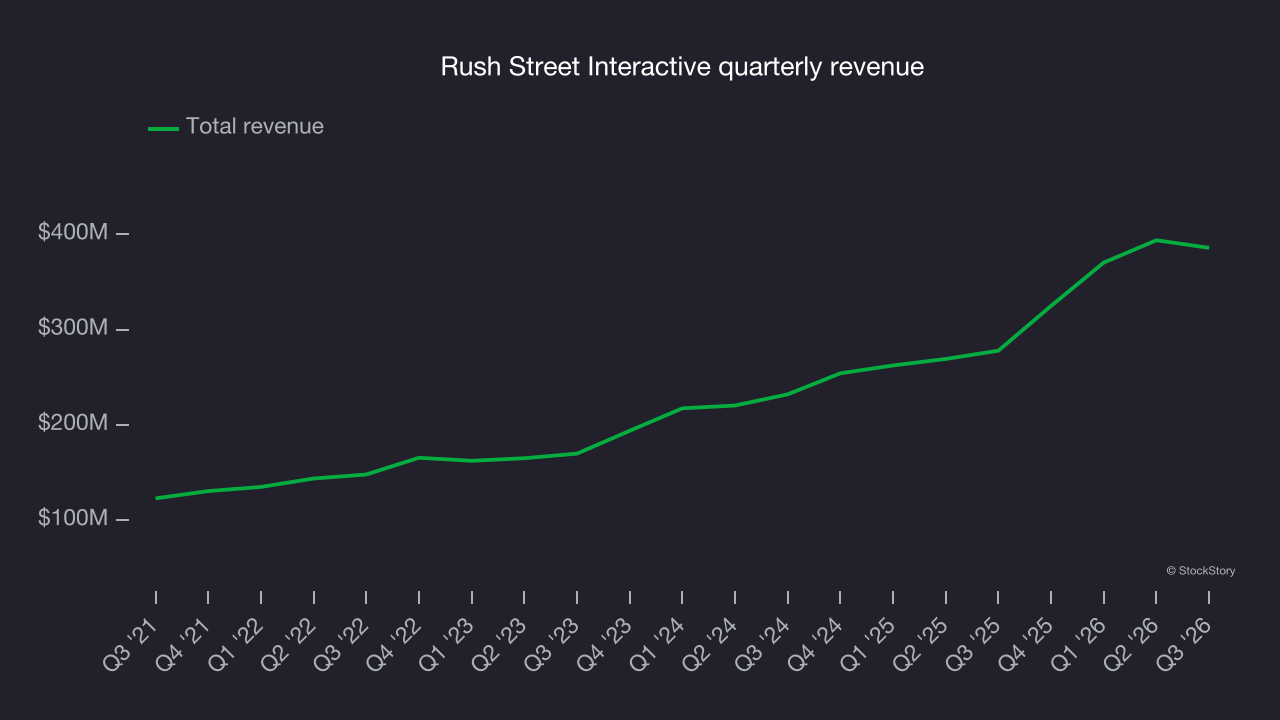
Long-term growth is the most important, but within consumer discretionary, product cycles are short and revenue can be hit-driven due to rapidly changing trends and consumer preferences. Rush Street Interactive’s annualized revenue growth of 30.7% over the last two years is above its five-year trend, which is encouraging. 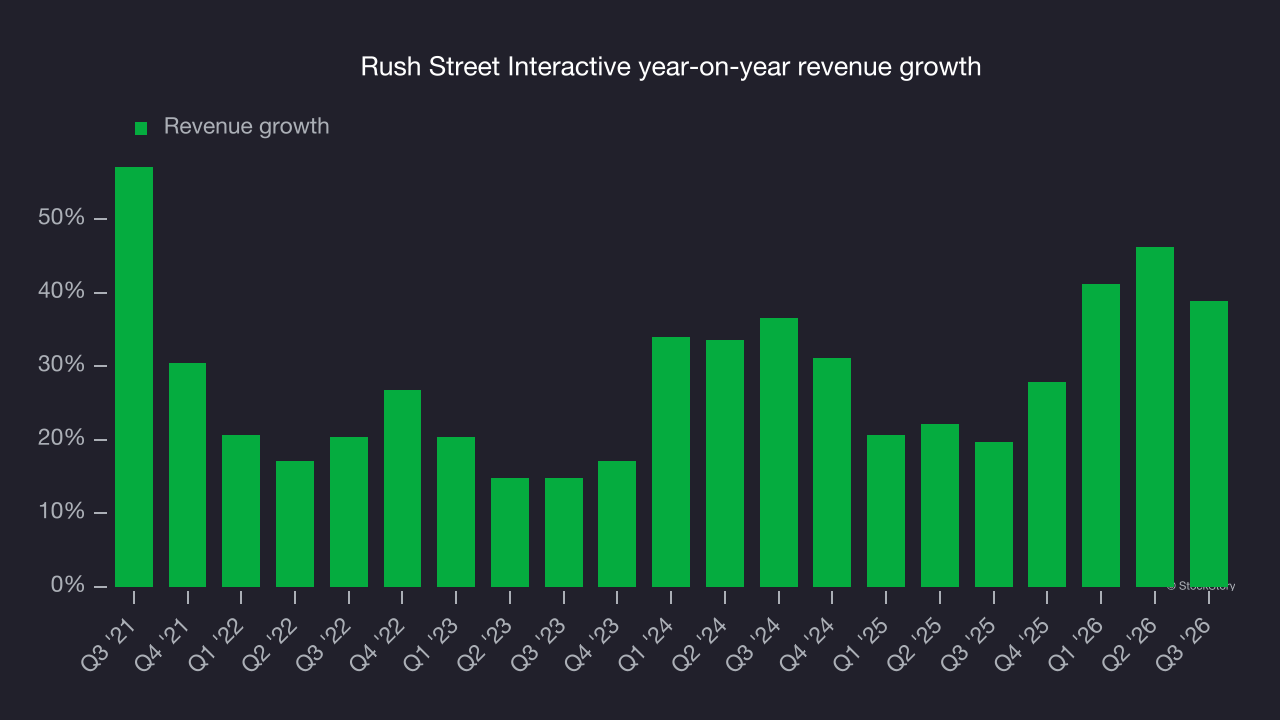
This quarter, Rush Street Interactive reported strong year-on-year revenue growth of 38.8%, but its $385.9 million in revenue fell short of Wall Street’s consensus estimates.
Looking ahead, sell-side analysts expect revenue to grow 20% over the next 12 months, according to S&P, a deceleration versus the last two years. Despite the slowdown, this projection remains strong and implies the market sees success for its products and services.
Operating margin
Operating margin is an important measure of profitability as it shows the portion of revenue left after accounting for all core expenses, everything from the cost of goods sold to advertising and wages. It’s also useful for comparing profitability across companies with different levels of debt and tax rates because it excludes interest and taxes.
Rush Street Interactive’s operating margin has risen over the last 12 months and averaged 9.1% over the last two years. The company’s improved efficiency is a positive, but its suboptimal cost structure means profitability remains inadequate for a consumer discretionary business.
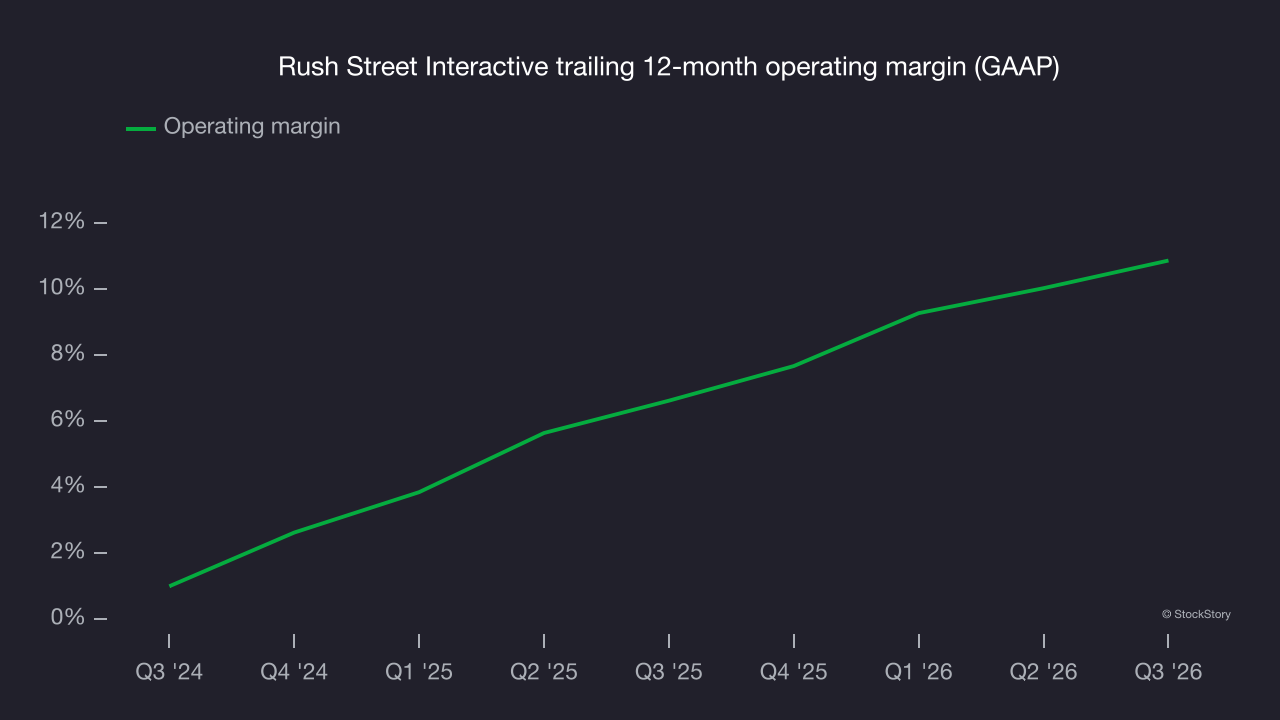
This quarter, Rush Street Interactive generated an operating margin of 11.1%, up 4 percentage points year on year. This increase was a positive development and shows it was more efficient.
Earnings per share
We track the long-term change in earnings per share (EPS) for the same reason as long-term revenue growth. Compared to revenue, however, EPS highlights whether a company’s growth is profitable.
Rush Street Interactive’s full-year EPS flipped from negative to positive over the last five years. That is a positive sign and marks a critical stage in its development.
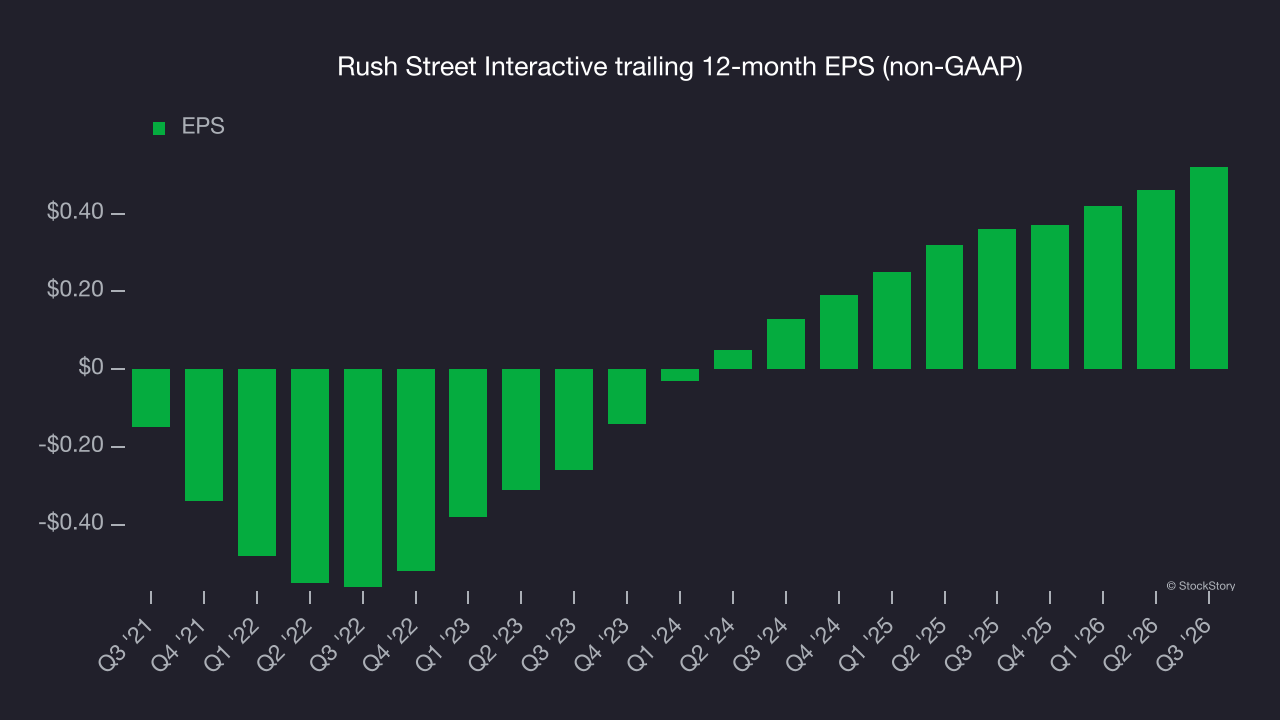
In Q3, Rush Street Interactive reported adjusted EPS of $0.15, up from $0.09 in the same quarter last year. This result easily cleared analysts’ consensus estimates, a positive outcome for shareholders. Over the next 12 months, Wall Street expects Rush Street Interactive’s full-year EPS to grow 50.4% from $0.52 to $0.78, according to S&P.
Key takeaways from Rush Street Interactive’s Q3 results
Rush Street Interactive’s Q3 results had some key positives, with EBITDA and EPS beating analysts’ consensus estimates. Revenue, however, came in slightly below expectations, leaving a mixed quarter. Shares rose 3.8% to $15.72 immediately after the report.
To assess Rush Street Interactive as an investment, consider the bigger picture of valuation, business quality and the latest earnings. For more on these factors, read our full research report here (it’s free).