

Semiconductor testing company Teradyne (NASDAQ: TER) announced better-than-expected revenue in Q3 2026, with revenue up 69.8% year on year to $1.31 billion. Guidance for next quarter’s revenue was better than expected at $1.3 billion at the midpoint, 1.8% above analysts’ consensus estimates. Its non-GAAP profit of $2.29 per share was 11.2% above analysts’ consensus estimates.
For more on Teradyne, read our free full research report.
Teradyne (TER) Q3 2026 highlights:
- Revenue $1.31 billion vs S&P analysts’ consensus estimates of $1.27 billion (69.8% year-on-year growth, 3% beat)
- Adjusted EPS $2.29 vs S&P analysts’ consensus estimates of $2.06 (11.2% beat)
- Adjusted operating income $412.9 million vs analysts’ consensus estimates of $372.1 million (31.6% margin, 11% beat)
- Revenue guidance $1.3 billion at the midpoint for Q4 2026, above analysts’ consensus estimates of $1.28 billion
- Adjusted EPS guidance $2.10 at the midpoint for Q4 2026, above analysts’ consensus estimates of $2.03
- Operating margin 30.8%, up from 18.9% in the same quarter last year
- Free cash flow margin 17.4%, up from 0.3% in the same quarter last year
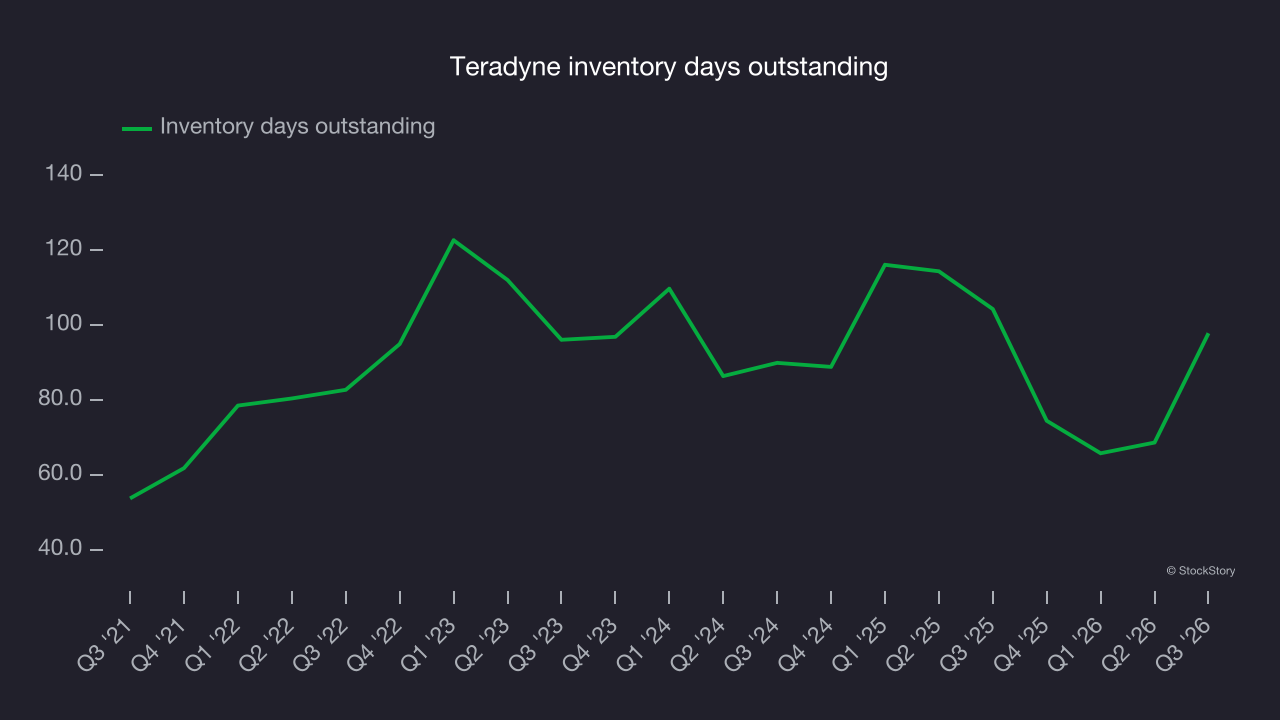
- Inventory days outstanding 98, up from 69 in the previous quarter
- Market capitalization $48.31 billion
"Our wafer to data center strategy and the breadth of our portfolio sustained positive momentum in Q3," said CEO Greg Smith. “Demand extended across the AI value chain, from memory and hard disk drive test to high-speed interconnect and robotics, driving results above the high end of our guidance. With multiple growth engines across test and robotics, we approach 2027 with a more diversified business and an expanding set of opportunities.”
Revenue growth
Reviewing a company’s long-term revenue performance reveals insights into its quality. Any business can report a good quarter or two, but many enduring ones grow for years. Over the last five years, Teradyne grew its revenue at a decent 6.9% compounded annual growth rate. Its growth was slightly above the average semiconductor company and shows its offerings resonate with customers. Semiconductors are a cyclical industry, and long-term investors should be prepared for periods of high growth followed by periods of revenue contractions.
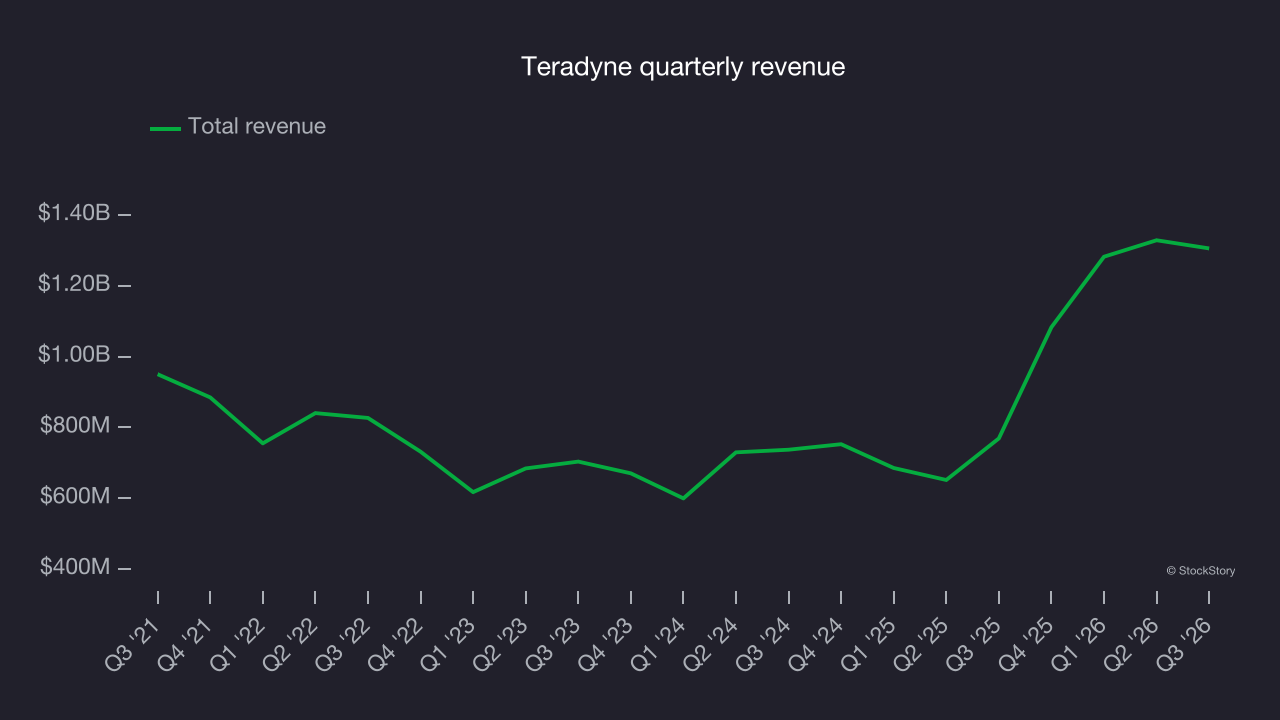
Long-term growth is the most important, but short-term results matter for semiconductors because the rapid pace of technological innovation (Moore’s Law) could make yesterday’s hit product obsolete today. Teradyne’s annualized revenue growth of 35.2% over the last two years is above its five-year trend, suggesting its demand recently accelerated. 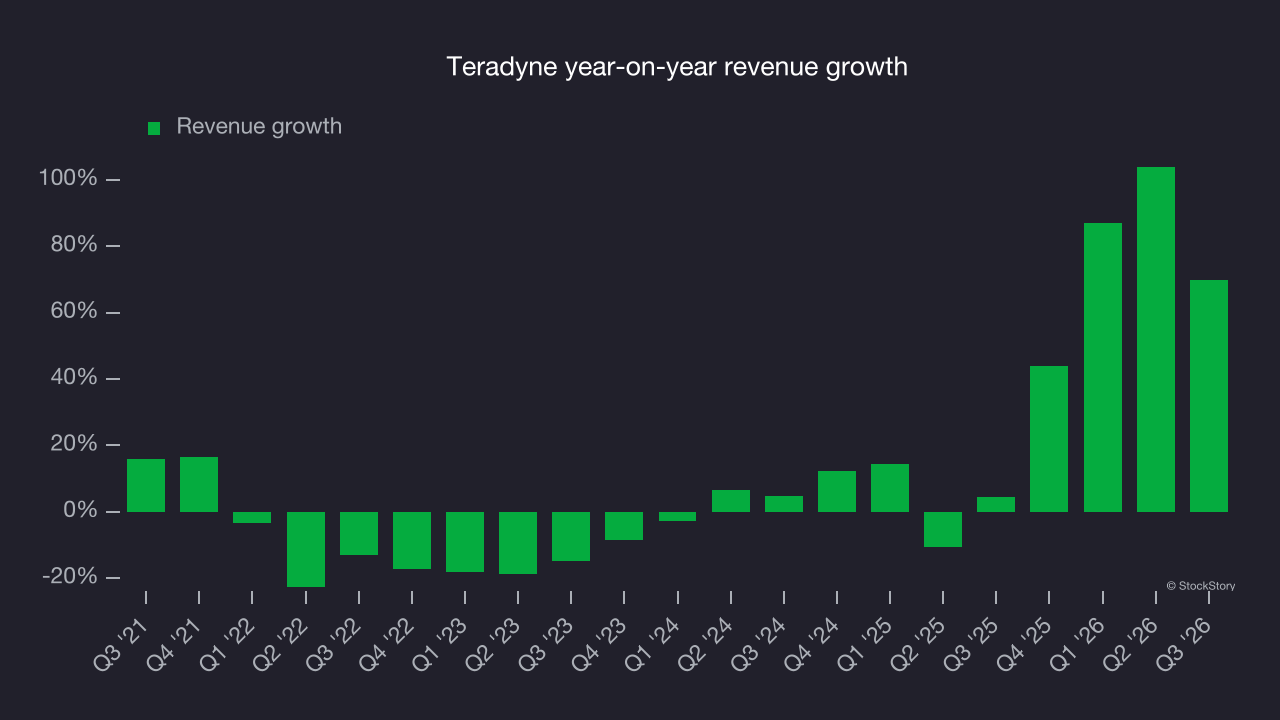
This quarter, Teradyne reported strong year-on-year revenue growth of 69.8%, and its $1.31 billion of revenue beat Wall Street’s consensus estimates by 3%. Beyond the beat, this marks 5 consecutive quarters of growth, implying that Teradyne is in the middle of its cycle – a typical upcycle generally lasts 8-10 quarters. Company management is currently guiding for a 20% year-on-year increase in revenue next quarter.
Looking further ahead, sell-side analysts expect revenue to grow 18.8% over the next 12 months, according to S&P, a deceleration versus the last two years. This projection is underwhelming and suggests its products and services will face some demand challenges.
Product demand & outstanding inventory
Days Inventory Outstanding (DIO) is an important metric for chipmakers, as it reflects a business’s capital intensity and the cyclical nature of semiconductor supply and demand. In a tight supply environment, inventories tend to be stable, allowing chipmakers to exert pricing power. Steadily increasing DIO can be a warning sign that demand is weak, and if inventories continue to rise, the company may have to downsize production.
This quarter, Teradyne’s DIO came in at 98, which is 6 days above its five-year average, suggesting that the company’s inventory has risen above historical levels.
Key takeaways from Teradyne’s Q3 results
Teradyne’s EPS beat analysts’ consensus estimates, and operating income topped Wall Street’s consensus by a wide margin. Those beats made for a decent quarter overall, but inventory levels rose materially. Investors were likely hoping for more, as shares tumbled 6.6% to $303.92 immediately after the release.
The latest quarter matters when deciding whether to invest in the stock, but longer-term business quality and valuation matter more. For more on the stock, read the full research report here (it’s free).