

Property and casualty insurer Selective Insurance Group (NASDAQ: SIGI) fell short of the market’s revenue expectations in Q3 2026, with sales falling 2.5% year on year to $1.33 billion. Its non-GAAP profit of $2.37 per share was 22.9% above analysts’ consensus estimates.
Is now the time to buy Selective Insurance Group? Find out by accessing our full research report, it’s free.
Selective Insurance Group (SIGI) Q3 2026 highlights:
- Net Premiums Earned: $1.18 billion vs analyst estimates of $1.19 billion (2% year-on-year decline, 0.9% miss)
- Revenue: $1.33 billion vs analyst estimates of $1.35 billion (2.5% year-on-year decline, 1.8% miss)
- Combined Ratio: 96.8% vs analyst estimates of 97.3% (54 basis point beat)
- Adjusted EPS: $2.37 vs analyst estimates of $1.93 (22.9% beat)
- Book Value per Share: $55.02 vs analyst estimates of $62.78 (1% year-on-year growth, 12.4% miss)
- Market Capitalization: $5.43 billion
“Operating ROE was 16.9% in the quarter, with excellent investment income and improved underwriting performance, led by a lower loss ratio. These results reflect our disciplined underwriting approach and continued progress to improve profitability,” said John J. Marchioni, Chairman, President and Chief Executive Officer.
Company overview
Founded in 1926 during the early days of automobile insurance, Selective Insurance Group (NASDAQ: SIGI) is a property and casualty insurance company that sells commercial, personal, and excess and surplus lines insurance products through independent agents.
Revenue growth
Insurance companies generate revenue three ways. The first is the core insurance business itself, represented in the income statement as premiums earned. The second source is investment income from investing the “float” (premiums collected but not yet paid out as claims) in assets such as fixed-income assets and equities. The third is fees from policy administration, annuities, and other value-added services. Luckily, Selective Insurance Group’s revenue grew at a solid 10.5% compounded annual growth rate over the last five years. Its growth beat the average insurance company and shows its offerings resonate with customers.
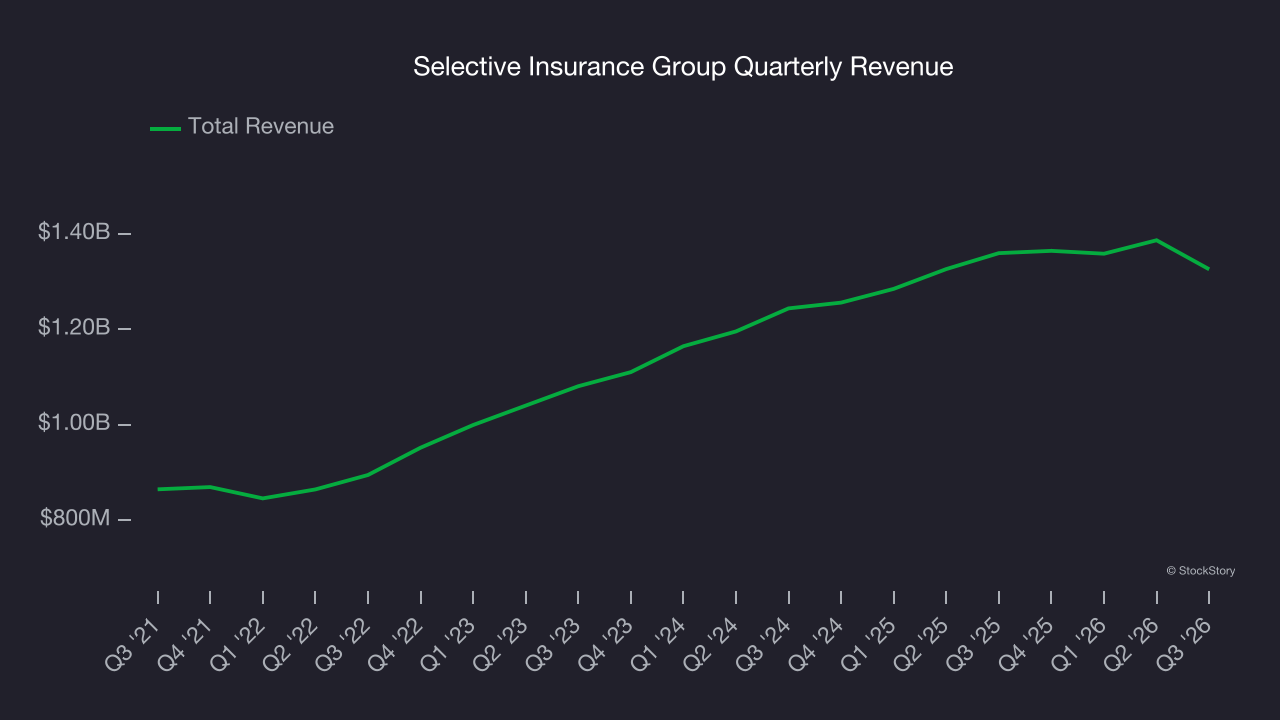
We at StockStory place the most emphasis on long-term growth, but within financials, a half-decade historical view may miss recent interest rate changes, market returns, and industry trends. Selective Insurance Group’s recent performance shows its demand has slowed as its annualized revenue growth of 7.4% over the last two years was below its five-year trend. We’re wary when companies in the sector see decelerations in revenue growth, as it could signal changing consumer tastes aided by low switching costs. 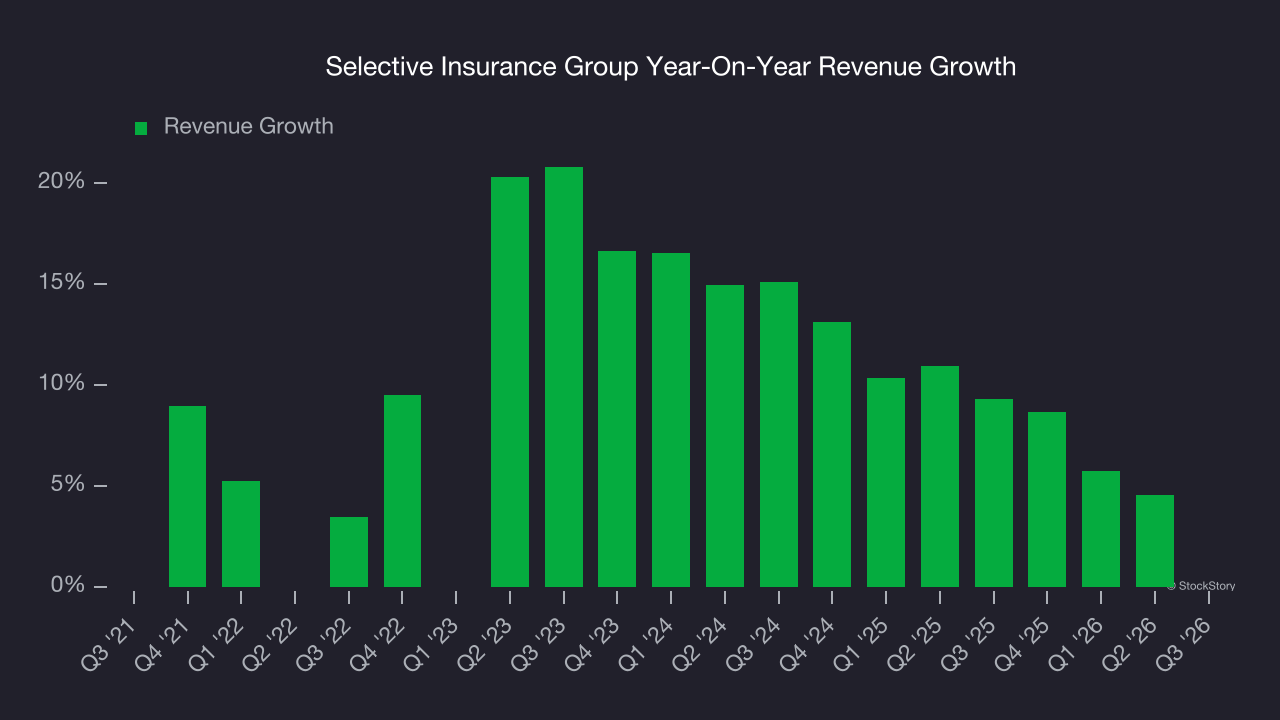 Note: Quarters not shown were determined to be outliers because they were impacted by outsized investment gains/losses that are not indicative of the recurring fundamentals of the business.
This quarter, Selective Insurance Group missed Wall Street’s estimates and reported a rather uninspiring 2.5% year-on-year revenue decline, generating $1.33 billion of revenue.
Net premiums earned made up 90.5% of the company’s total revenue during the last five years, meaning Selective Insurance Group lives and dies by its underwriting activities because non-insurance operations barely move the needle.
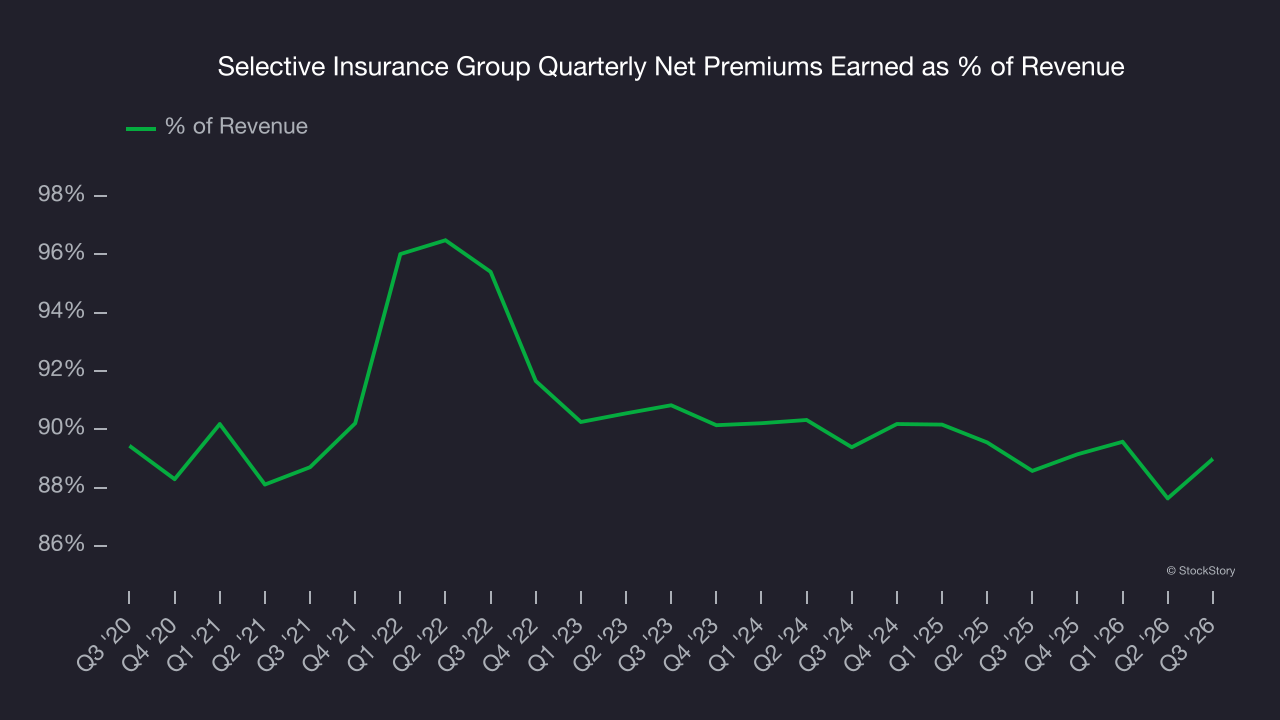
Markets consistently prioritize net premiums earned growth over investment and fee income, recognizing its superior quality as a core indicator of the company’s underwriting success and market penetration.
ALSO WORTH WATCHING: Nvidia’s Quiet Partner. Nvidia’s chips cost a hundred grand. The connectors that make them work cost even more. One company makes them all.
Every AI server needs specialized infrastructure the chip companies don’t make. High-speed cables. Power connectors. Thermal sensors. This 90-year-old company built a monopoly on it. The AI boom just started. This stock is still flying under the radar. Claim The Stock Ticker Here for FREE.
Book value per share (BVPS)
Insurance companies are balance sheet businesses, collecting premiums upfront and paying out claims over time. The float (premiums collected but not yet paid out) is invested, creating an asset base supported by a liability structure. Book value per share (BVPS) captures this dynamic by measuring these assets (investment portfolio, cash, reinsurance recoverables) less liabilities (claim reserves, debt, future policy benefits). BVPS is essentially the residual value for shareholders.
We therefore consider BVPS very important to track for insurers and a metric that sheds light on business quality. While other (and more commonly known) per-share metrics like EPS can sometimes be lumpy due to reserve releases or one-time items and can be managed or skewed while still following accounting rules, BVPS reflects long-term capital growth and is harder to manipulate.
Selective Insurance Group’s BVPS grew at a sluggish 4% annual clip over the last five years. However, BVPS growth has accelerated recently, growing by 6.2% annually over the last two years from $48.82 to $55.02 per share.
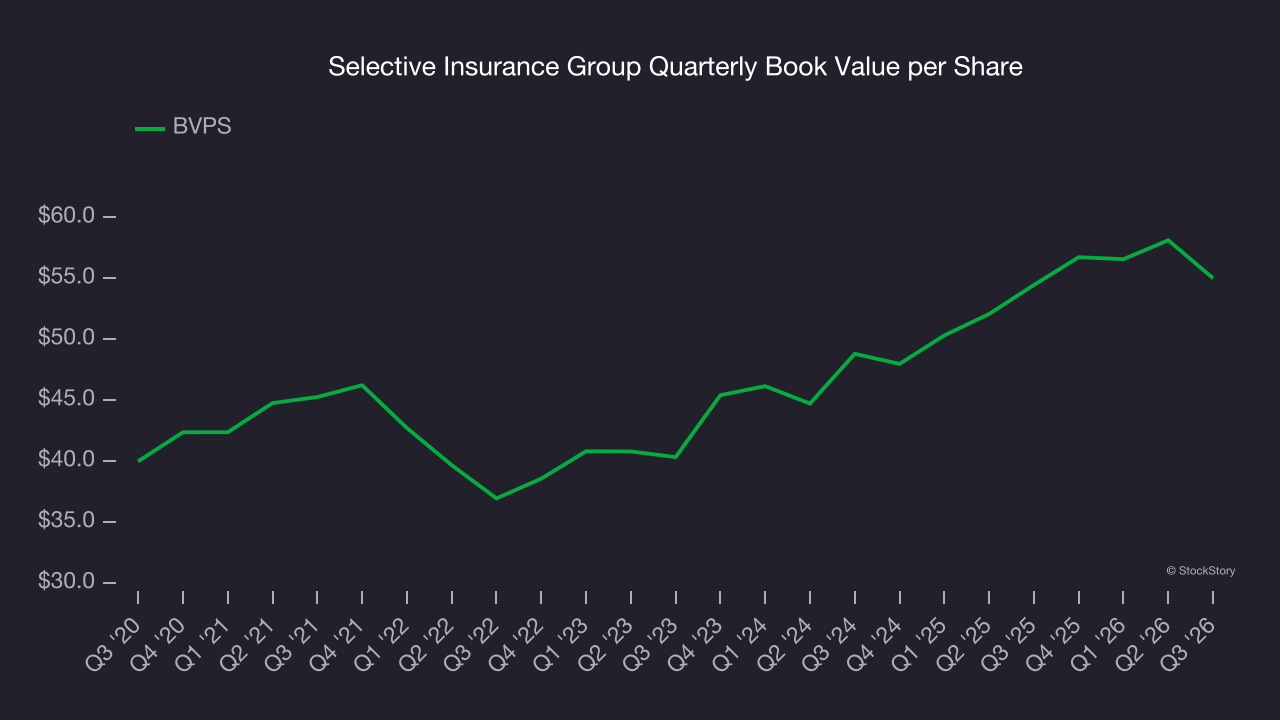
Over the next 12 months, Consensus estimates call for Selective Insurance Group’s BVPS to grow by 25% to $62.78, elite growth rate.
Key takeaways from Selective Insurance Group’s Q3 results
It was good to see Selective Insurance Group beat analysts’ EPS expectations this quarter. On the other hand, its book value per share missed and its revenue fell short of Wall Street’s estimates. Overall, this was a weaker quarter. The stock remained flat at $91.75 immediately following the results.
Is Selective Insurance Group an attractive investment opportunity at the current price? We think that the latest quarter is only one piece of the longer-term business quality puzzle. Quality, when combined with valuation, can help determine if the stock is a buy. We cover that in our actionable full research report which you can read here (it’s free).