
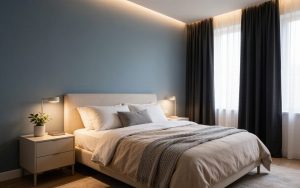
We spend roughly a third of our lives in one room, yet the bedroom is often the space we think about least when it comes to design. We carefully plan our living rooms for entertaining, our kitchens for cooking, and our home offices for productivity — but the bedroom tends to accumulate whatever furniture and decor happens to be left over. That is a missed opportunity, because the bedroom is arguably the room that most directly affects your health, your mood, and your daily energy levels.
The science is clear: your sleep environment matters. Light levels, color choices, clutter, and furniture arrangement all influence how quickly you fall asleep and how deeply you rest. A bedroom that is cluttered, overly bright, or arranged awkwardly works against you every single night, even if you never consciously notice it. The good news is that creating a better sleep environment no longer requires hiring an interior designer or spending a fortune. Technology has made professional-quality bedroom design accessible to everyone — and the most useful tool in this space is a bedroom maker powered by artificial intelligence. You upload a photo of your current bedroom, choose a style that appeals to you, and the AI generates multiple photorealistic redesigns in seconds. Because it is bedroom-specific, the tool is optimized for sleep: it analyzes bed placement for optimal rest, considers window position for light control, and suggests color palettes scientifically associated with relaxation and sleep quality.
The Science of a Restful Bedroom
What makes a bedroom design “sleep-optimized” is not arbitrary aesthetics — it is grounded in what researchers know about how environment affects sleep. Cooler, muted colors are generally associated with better relaxation than bright, stimulating ones. Soft, warm lighting in the evening helps signal to your brain that it is time to wind down. A clutter-free environment reduces the low-grade stress that can keep your mind active at night. And the position of your bed — ideally against a solid wall with a clear view of the door, away from direct window light — has a measurable effect on how secure and comfortable you feel while sleeping.
Most people have never thought about any of this when arranging their bedroom. They put the bed where it fits, add whatever furniture they already own, and call it done. An AI bedroom design tool changes that by bringing sleep-focused design principles to bear automatically. It does not just make the room look nicer; it suggests arrangements and palettes that are specifically chosen to support better rest.
See It Before You Buy It
The single most valuable thing an AI design tool offers is the ability to see changes before you commit to them. Buying a new bed, repainting your walls, or rearranging your furniture are all decisions that are hard to reverse once you have made them. When you can see multiple complete renderings of your own bedroom — each with different colors, layouts, and furniture — you can make those decisions with confidence instead of guesswork.
What makes a bedroom-specific tool more useful than a generic room designer is the depth of its focus. It does not just make the room look nice — it applies sleep science to the design. The AI analyzes bed placement for optimal rest, evaluates nightstand functionality and storage, and considers window position so it can manage natural light properly. It generates coordinated bedding sets, suggests lighting scenarios suited to winding down in the evening, and builds color palettes around calming psychology — soothing blues, soft greens, and warm earth tones that have been associated with relaxation rather than stimulation. For anyone who has struggled to fall asleep in a room that simply does not feel restful, these are not cosmetic details; they are the difference between a room you sleep in and a room that helps you sleep.
This is especially helpful for small bedrooms, where every square foot matters. A design that looks great in a spacious master suite might feel cramped and overwhelming in a compact room. An AI tool that analyzes your actual space and works within its real dimensions helps you find arrangements that maximize both comfort and functionality, rather than imposing a one-size-fits-all aesthetic.
Simple, Affordable Bedroom Upgrades Worth Trying
You do not need a complete renovation to improve your sleep environment. Some of the most effective changes are also the most affordable, and seeing them visualized first makes them easy to commit to. Decluttering is the obvious starting point — a bedroom that is free of visual noise is simply more restful, and it costs nothing. Beyond that, consider your lighting. Replacing harsh, cool-toned bulbs with warm, dimmable ones makes a noticeable difference in how quickly your body winds down in the evening, and adding blackout curtains or blinds addresses the morning light that disrupts sleep.
Color is another low-cost lever. Cool blues, soft greens, and warm neutrals are consistently associated with relaxation, and repainting an accent wall or updating your bedding to match a calming palette can shift the entire mood of the room without a major investment. Bed placement matters too — if your bed currently faces a window or sits directly under an overhead light, moving it to a solid wall with a clear sight line to the door can improve both comfort and the feeling of security that supports deep sleep. An AI design tool lets you preview all of these changes together, so you can prioritize the ones that will make the biggest difference in your particular space.
Beyond the Bedroom
Once you have designed a bedroom you love, the same approach applies to the rest of your home. A broader Ai home design platform can help you carry that momentum into your living room, kitchen, bathroom, and even your outdoor spaces. The workflow is the same — upload a photo, choose a style, review the AI-generated options — but the result is a home that feels cohesive and intentional, rather than a collection of rooms that were each decorated in isolation.
The platform covers all three areas of a property — interiors, exteriors, and gardens — and supports more than twenty design styles across eight interior room types, so you are never limited to a single aesthetic. Whether you want a Scandinavian living room, a Japandi bedroom, a mid-century modern kitchen, or a cottage-style garden, the same tool can render each one from a photo or a text description. You can even generate up to four variations at a time and compare them side by side, which makes it easy to settle on a direction that feels right before you spend anything. That coherence, applied room by room, is what turns a house into a home that genuinely reflects the people living in it.
The takeaway is simple: you do not need to be an interior designer, and you do not need a big budget, to create a home that supports your wellbeing. The bedroom is the perfect place to start, because the payoff — better sleep, more energy, a calmer mind — is immediate and meaningful. If you have been living with a bedroom that does not quite work, take a few minutes to upload a photo and see what AI can do. You might be surprised at how close a better night’s sleep really is.
Company Details
Company Name: ZingFront HongKong Limited
Contact Person: Freya
Email: freya250104@gmail.com
Phone: +39 3491174852
Address: Room 704, 7/F., Tower A, New Mandarin Plaza, 14 Science Museum Road, TST East, Kowloon, Hong Kong, China
Website: https://home-design.ai/