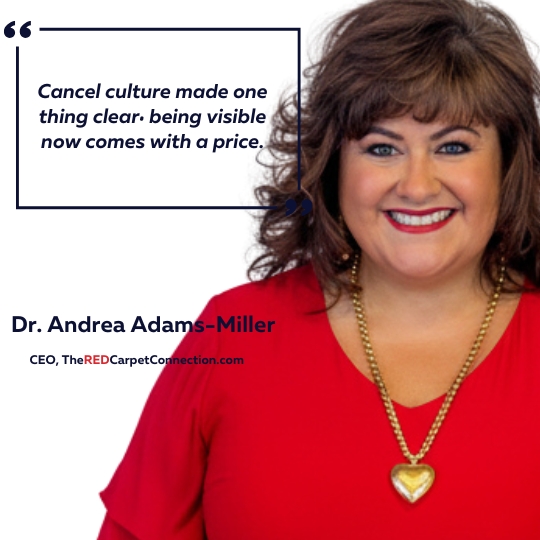
When a celebrity, politician, or brand is suddenly canceled, most people see it as entertainment. Business leaders see something very different. They see a warning. According to applied neuroscientist and executive advisor Dr. Andrea Adams-Miller, CEO, TheREDCarpetConnection.com, LLC, the rise of public cancellations is changing how CEOs, founders, and executives think, speak, and lead, even when they have done nothing wrong. Leaders observe what happens to others and adjust their behavior long before they face any direct risk themselves.
High-profile examples have reinforced that signal. Music artist Nicki Minaj has faced repeated public backlash tied to personal opinions and associations, prompting widespread debate, brand hesitation, and corporate distancing. Actress Kristin Chenoweth, widely recognized for her role in *Wicked*, has also faced waves of public criticism for her statements and affiliations, despite a decades-long career. In both cases, the speed and scale of reaction sent a clear message to others operating in the public eye.
Business media have noted this shift. Leadership contributor Yogesh Shah stated, “Cancel culture isn’t going anywhere… Social media often fuels the outrage, which can quickly damage reputations and opportunities. Share an opinion and risk backlash. Stay silent and risk irrelevance” (Entrepreneur, July 25, 2025).
From a brain-health perspective, this reaction follows a well-documented pattern. Research from UCLA has shown that social rejection and public shaming activate the same neural regions involved in physical pain, including the anterior cingulate cortex (Eisenberger, Lieberman, and Williams, *Science*, 2003).
Additional studies in Nature Reviews Neuroscience have demonstrated that perceived social threat activates the amygdala and stress-response systems, narrowing attention and increasing avoidance behavior (Phelps and LeDoux, 2005).
“The brain does not distinguish well between physical danger and reputational danger,” Adams-Miller explained. “Public backlash is processed as a survival threat.”
These neurological responses help explain why business leaders are becoming quieter and more cautious. Many are doing fewer interviews, delaying announcements, and relying more heavily on legal and communications review. Some are stepping away from the spotlight entirely. This shift reflects biological self-protection rather than legal strategy alone.
“Leaders are learning from what they observe,” Adams-Miller said. “When someone’s reputation collapses quickly and publicly, the brain treats that as a threat and responds by pulling back.”
The same pattern has appeared in corporate settings. Following consumer backlash stemming from brand messaging, Bud Light experienced rapid market reactions, leadership changes, and long-term shifts in brand strategy in 2023. Regardless of public opinion, executives across unrelated industries took notice and adjusted their own visibility and communication strategies.
Business analysts have warned of broader consequences. A Forbes Councils analysis observed that “Cancel culture can foment a climate of fear… and that dynamic can have real consequences for leaders and brands” (February 27, 2023).
As this climate takes hold, decision-making slows and creativity declines. Employees notice when leadership communication becomes limited or delayed. Teams hesitate, innovation slows, and uncertainty rises.
Boards and investors are responding by favoring leaders perceived as low-risk and low-profile. While this may reduce short-term exposure, it can weaken long-term trust and momentum. Leadership presence acts as a stabilizing signal within organizations, and its absence increases internal stress.
“Leadership regulates the nervous system of an organization,” Dr. Adams-Miller said. “When leaders withdraw, uncertainty fills the gap.”
Dr. Adams-Miller’s observations are based on a combination of established neuroscience research and her advisory work with executives, founders, and high-visibility professionals navigating media scrutiny, brand risk, and leadership pressure. She emphasizes that the solution is not silence, but informed regulation.
“Cancel culture created a shock to the system,” she said. “The leaders who thrive are the ones who understand how to stay present without triggering unnecessary risk.”
Cancel culture is often framed as a social or political issue. Its impact on business leadership is quieter, biological, and measurable. Executives are changing how they lead in response to what they observe happening to others. Once this pattern is understood, it becomes manageable.
“Leaders are responding to what they watched happen,” Dr. Adams-Miller expressed. “Understanding that response is what allows leadership to remain steady and effective.”
About Dr. Andrea Adams-Miller
Dr. Andrea Adams-Miller is an applied neuroscientist and executive advisor who works with business leaders and public figures to improve decision-making, communication, and performance under pressure by understanding how neurological responses to stress and scrutiny influence performance.
About The RED Carpet Connection
The RED Carpet Connection is a publicity and strategic advisory firm founded by Dr. Andrea Adams-Miller that helps leaders navigate visibility, reputation, and influence through neuroscience-informed communication and earned media strategy. The company is an umbrella that includes TheSubConsciousConnection.com, a mind mastery training organization.
###
For more information about TheREDCarpetConnection.com, LLC, contact the company here:
The RED Carpet Connection, Consulting, Publicity, Publishing, & Talent Agency, LLC
Dr. Andrea Adams-Miller
1-419-722-6931
AndreaAdamsMiller@TheREDCarpetConnection.com
8155 Township Road 89, Findlay, OH 45840