As of January 21, 2026, the financial landscape has undergone a seismic shift. While traditional equity analysts still pore over balance sheets, a new breed of institutional and retail traders is looking elsewhere for an informational edge: prediction markets. Once dismissed as a niche interest for political junkies, platforms like Polymarket and Kalshi have evolved into high-volume "truth engines" where billion-dollar corporations are the primary subjects of speculation.
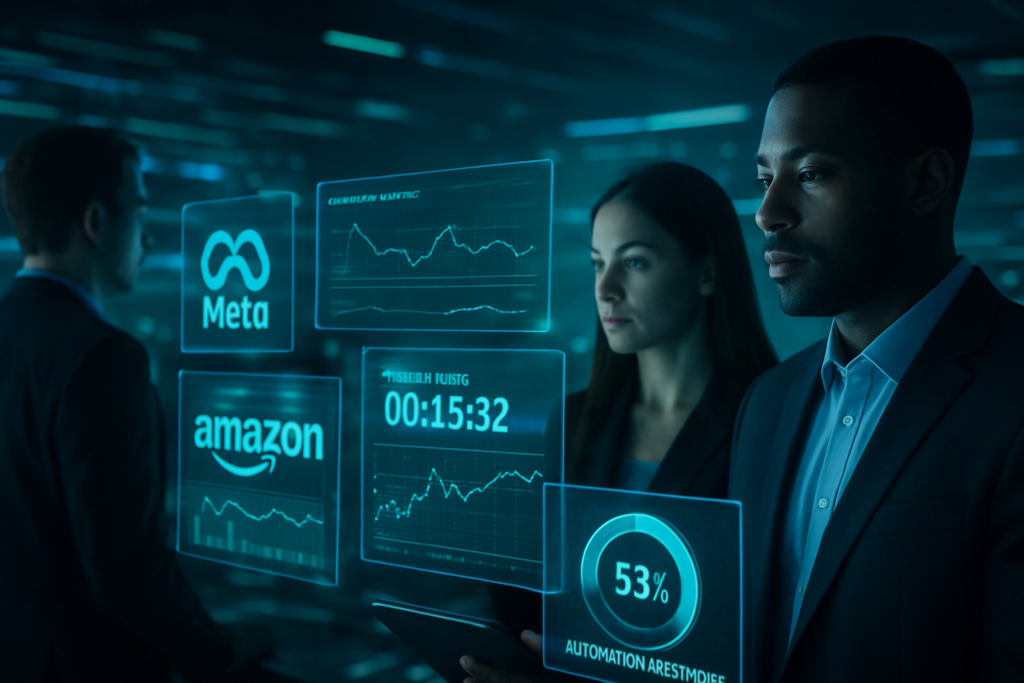
The market has reached a fever pitch this week, with daily turnover hitting a record $814 million. Traders are no longer just betting on who will win the next election; they are wagering on the internal mechanics of Silicon Valley and the strategic pivots of Fortune 500 giants. From the release date of Meta Platforms, Inc. (NASDAQ: META) next AI model to the exact number of pink slips at Amazon.com, Inc. (NASDAQ: AMZN), the "wisdom of the crowd" is now being priced in real-time, often moving ahead of official press releases.
The Market: What's Being Predicted
The current landscape of corporate prediction markets is dominated by two giants: the decentralized powerhouse Polymarket and the CFTC-regulated Kalshi. Polymarket, recently buoyed by a landmark $2 billion investment from the Intercontinental Exchange, Inc. (NYSE: ICE), has become the go-to for speculative tech releases. Currently, the market for "Meta releases Llama 5 in 2025?" has seen substantial volume, while a specialized contract for the Meta "Mango" model is trading at a staggering 88% probability for a June 30 release.
Meanwhile, Kalshi has leveraged its integration with Robinhood Markets, Inc. (NASDAQ: HOOD) to bring "Event Contracts" to over 10 million retail users. These markets are granular; for instance, traders are currently betting on whether Starbucks Corporation (NASDAQ: SBUX) CEO Brian Niccol will use the phrase "Smart Queue" in the next earnings call (65% probability) or if the company will announce a major international acquisition by the end of Q2.
The volume in these specific corporate markets has skyrocketed, with combined trading volumes exceeding $37 billion in 2025. This liquidity has turned prediction markets into a viable alternative to traditional derivatives, with some contracts resolving in hours while others track long-term metrics like Amazon's robot-to-human ratio in its fulfillment centers.
Why Traders Are Betting
The primary driver behind this surge is the search for "alpha"—the excess return on an investment. Institutional desks at firms like The Goldman Sachs Group, Inc. (NYSE: GS) and Susquehanna International Group are increasingly using these markets to identify what analysts call the "Certainty Gap." This occurs when prediction markets price an event with high confidence while traditional futures or options markets remain sluggish.
For example, early in 2026, prediction markets showed a 96% certainty of a Federal Reserve pause, while traditional interest-rate futures were only pricing in a 16% chance. Traders who followed the prediction market signal were able to front-run moves in interest-rate-sensitive stocks. In the corporate sector, "information leakage" is a significant factor. On Polymarket, large "whale" positions often appear hours before major corporate news breaks, leading many to believe that insiders are using the platforms to monetize their knowledge anonymously.
Furthermore, these markets provide a hedge against corporate PR. While a company like Amazon.com, Inc. (NASDAQ: AMZN) might emphasize "workforce optimization," a prediction market contract for "15,000+ additional layoffs by May 2026" provides a cold, hard probability that tells a different story. Traders are betting because the price of a contract is often a more accurate reflection of reality than a sanitized corporate statement.
Broader Context and Implications
The rise of these markets marks the institutionalization of collective intelligence. The Digital Asset Market CLARITY Act of 2025 was a turning point, reclassifying many event contracts as commodity swaps and providing a stable regulatory framework in the U.S. This was further bolstered by the CFTC’s "Future-Proof" initiative in early 2026, which officially recognized prediction markets as valid tools for "price discovery" rather than mere gambling.
However, the implications are not purely financial. These markets serve as a public sentiment gauge that can impact a company's reputation and its stock price. When a market for a Starbucks Corporation (NASDAQ: SBUX) operational failure gains traction, it can force leadership to respond before the issue even hits the mainstream press. This creates a feedback loop where the market doesn't just predict the future—it potentially influences it.
Despite the progress, the sector faces a "patchwork" of legal challenges. While federal regulators have softened their stance, several U.S. states, including Nevada and Massachusetts, have issued cease-and-desist orders against platforms offering sports-adjacent or "socially detrimental" contracts. These legal battles are expected to reach the Supreme Court later this year, which could determine the ultimate ceiling for the industry.
What to Watch Next
As we move further into 2026, the upcoming Q1 earnings season will be the next major catalyst. Watch for a flurry of activity in "keyword" markets—contracts that pay out based on specific phrases used by CEOs during earnings calls. These are often seen as proxies for internal confidence in new initiatives, such as Meta's AGI (Artificial General Intelligence) timeline or Starbucks' turnaround strategy.
Additionally, keep an eye on the resolution of the Amazon "Automation Blueprint" contracts. As the company pushes toward its goal of replacing 600,000 roles with autonomous models like Proteus by 2033, the prediction markets tracking the deployment of these robots are becoming essential reading for labor analysts and tech investors alike.
Finally, the potential for a "Black Swan" event—like the sudden geopolitical shift seen earlier this month with the capture of Nicolás Maduro—could trigger massive volatility in these markets. Such events test the liquidity and resilience of decentralized platforms like Polymarket, proving whether they can handle the volume of a true global crisis.
Bottom Line
The evolution of corporate prediction markets on platforms like Polymarket and Kalshi represents a fundamental change in how information is valued and traded. No longer are "insider" insights or deep-dive research the sole province of elite hedge funds; the price of a contract now offers a democratized, real-time probability of everything from tech launches to mass layoffs.
As a tool, these markets are proving to be remarkably accurate, often outperforming traditional forecasting models by cutting through the noise of corporate communications. For companies like Meta, Starbucks, and Amazon, the existence of these markets means they are being watched more closely than ever before—not just by regulators or journalists, but by a global network of traders putting their money where their conviction is.
Whether you are a retail trader on Robinhood or a portfolio manager at a major bank, the message is clear: the most valuable data point for the future of a company might no longer be in its SEC filings, but on a prediction market dashboard.
This article is for informational purposes only and does not constitute financial or betting advice. Prediction market participation may be subject to legal restrictions in your jurisdiction.
PredictStreet focuses on covering the latest developments in prediction markets.
Visit the PredictStreet website at https://www.predictstreet.ai/.