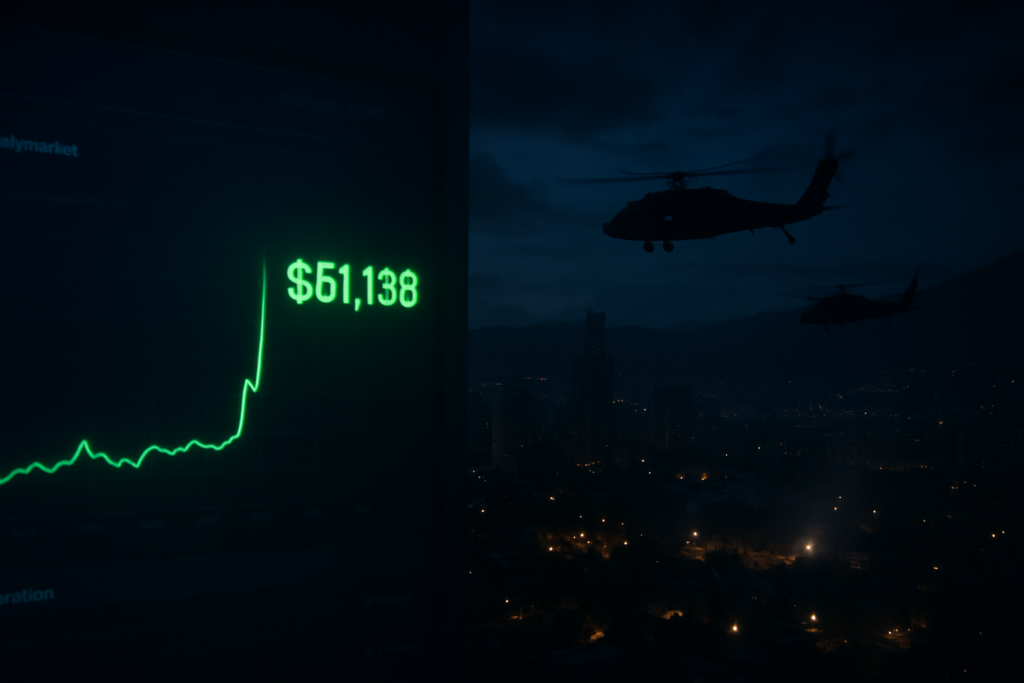
In the hyper-volatile world of decentralized prediction markets, "alpha"—the industry term for an information edge—is everything. But on the evening of January 2, 2026, a single trader on Polymarket appeared to possess an edge so sharp it cut through the fog of international diplomacy. Just hours before U.S. Special Forces descended on Caracas in a daring mission codenamed "Operation Absolute Resolve," an anonymous account turned a $32,537 bet into a staggering $436,000 windfall.
The wager, now infamously known as the "Maduro Bet," has sent shockwaves through the financial world and the U.S. intelligence community. By betting that Venezuelan President Nicolás Maduro would be out of power by the end of January—at a time when the market gave the outcome a mere 7% probability—the trader known as "Burdensome-Mix" didn't just win a bet; they ignited a national debate over the legality of betting on state secrets and the potential for prediction markets to serve as a back door for high-level insider trading.
The Market: What's Being Predicted
The focal point of the controversy was a contract on Polymarket titled "Will Nicolás Maduro be out of power by January 31, 2026?". Polymarket, a decentralized platform that uses the Polygon blockchain, allows users to buy and sell "shares" in the outcome of real-world events. Each share pays out $1.00 if the prediction comes true and $0.00 if it does not.
For much of late 2025, the "Yes" shares for Maduro’s removal were trading in the "basement," hovering around $0.06 to $0.07. Geopolitical analysts largely agreed that while tensions were high, Maduro’s control over the Venezuelan military remained firm. However, the volume surged on January 2, 2026. Within a four-hour window, liquidity poured into the "Yes" side, briefly moving the needle to $0.15 before the market was flooded by the "Burdensome-Mix" account.
The resolution criteria were crystalline: Maduro had to be physically removed from the presidency, resign, or be captured by a foreign power. When news broke at 4:30 AM ET on January 3 that U.S. Special Forces had successfully extracted Maduro from the Fort Tiuna military complex, the market instantly spiked to $0.98. By the time Maduro was arraigned in a New York courtroom on January 5, the market settled, and the anonymous trader walked away with a 1,242% return on investment.
Why Traders Are Betting
The "Maduro Bet" stands out not because of its size—whales often move millions on Polymarket—but because of its surgical timing. While retail traders were busy betting on the NFL playoffs or the price of Bitcoin, "Burdensome-Mix" placed their final, largest buy order at 9:58 PM ET on January 2. This was approximately four hours before the first U.S. aircraft entered Venezuelan airspace.
The community’s initial reaction was one of awe, but it quickly soured into suspicion. Unlike traditional forecasting methods—which relied on satellite imagery showing increased naval activity from Chevron (NYSE: CVX) tankers or regional troop movements—this trade showed no signs of hedging. It was an "all-in" move on a low-probability event.
Evidence of a leak became undeniable when the White House announced on January 16 that federal authorities had arrested Aurelio Perez-Lugones, a Navy veteran and government contractor. Perez-Lugones allegedly used his Top Secret clearance to access tactical databases and pass the timing of "Operation Absolute Resolve" to an associate linked to the "Burdensome-Mix" account. This "insider edge" allowed the trader to front-run a geopolitical earthquake that would eventually send shares of defense giants like Lockheed Martin (NYSE: LMT) and RTX Corporation (NYSE: RTX) to record highs.
Broader Context and Implications
The Maduro Bet has forced a reckoning for the prediction market industry. Proponents, such as those at the Mercatus Center, argue that these markets are "truth machines" that successfully aggregated hidden information to provide a public warning of the impending raid. They point out that the price spike on January 2 was a leading indicator that something major was about to happen—information that could have been used by civilians or businesses to prepare for the fallout.
However, regulators view it differently. The Commodity Futures Trading Commission (CFTC) has ramped up its scrutiny of Polymarket, questioning whether the platform’s lack of "Know Your Customer" (KYC) rigor for certain tiers of users makes it a haven for illicit gains. The incident has already sparked legislative action: Representative Ritchie Torres introduced the "Public Integrity in Financial Prediction Markets Act of 2026." The bill proposes a total ban on federal employees and contractors wagering on outcomes related to their official duties.
Furthermore, the event has highlighted the intersection of "Info-War" and finance. Media conglomerates like Fox Corp (NASDAQ: FOX) and Warner Bros. Discovery (NASDAQ: WBD) saw record viewership during the weekend of the raid, but prediction markets provided the only venue where that information was being priced into a tradable asset in real-time.
What to Watch Next
As Maduro remains in federal custody at the Metropolitan Detention Center in Brooklyn, the prediction market community has shifted its focus to his trial. Markets are already forming around the likelihood of a conviction versus a plea deal that would see him exiled to a third country.
Key dates to monitor include:
- February 12, 2026: The first evidentiary hearing for Aurelio Perez-Lugones, which may reveal more about the "Burdensome-Mix" trader’s identity.
- March 2026: The expected floor vote for the Torres Bill, which could fundamentally change how prediction markets operate in the United States.
- Infrastructure Tenders: Watch for movement in Palantir Technologies (NYSE: PLTR) and Exxon Mobil (NYSE: XOM), as markets begin to bet on which U.S. firms will be awarded the lion's share of contracts for Venezuela’s reconstruction.
Bottom Line
The "Maduro Bet" is a watershed moment for the 2020s. It demonstrated that prediction markets are no longer just a niche playground for "crypto-bros" and political junkies; they are a potent, albeit dangerous, tool for surfacing information that traditional intelligence and journalism often miss.
While "Burdensome-Mix" may have successfully cashed out their $436,000, the cost to the industry may be much higher. If prediction markets are perceived as a way for insiders to monetize classified information, they risk a regulatory crackdown that could stifle the very "wisdom of the crowd" they seek to harness. For now, the Maduro Bet remains the ultimate example of a market that knew too much, too soon.
This article is for informational purposes only and does not constitute financial or betting advice. Prediction market participation may be subject to legal restrictions in your jurisdiction.
PredictStreet focuses on covering the latest developments in prediction markets.
Visit the PredictStreet website at https://www.predictstreet.ai/.