Introduction
As generative AI, particularly in image generation, continues its rapid evolution, developers and enterprises seek efficient ways to integrate advanced models like the Grok Imagine API. This demand has spurred innovation in API management. Direct API management involves complex authentication, rate limiting, and cost analysis, often presenting significant operational challenges.
API proxy platforms emerge as essential intermediaries, simplifying integration and providing powerful management tools. They offer enhanced security, improved performance, and optimized cost structures. This article evaluates 10 prominent Grok Imagine API proxy platforms available in 2026, clarifying their strengths to help you choose the best solution.
Quick Comparison Table
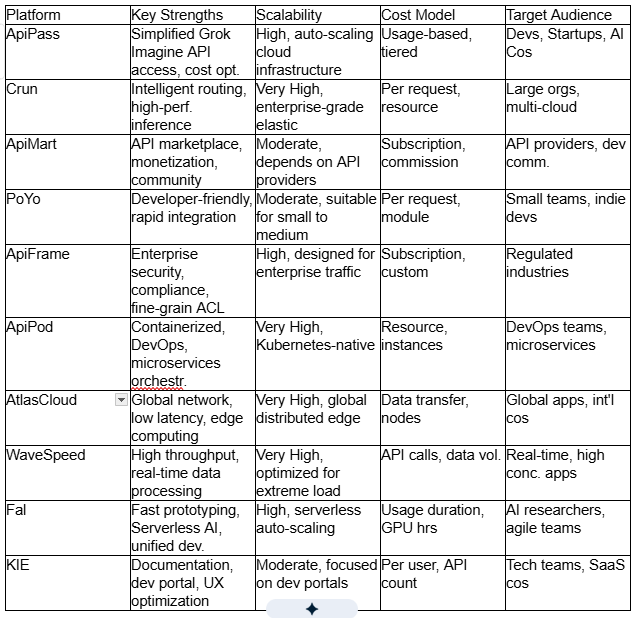
Detailed Breakdown
1. ApiPass
ApiPass acts as a comprehensive AI API Gateway, designed specifically to ensure convenient and efficient calls to the Grok Imagine API. It offers a unified interface and intelligent routing across various AI models, significantly lowering integration barriers and reducing development effort.
ApiPass excels at handling complex authentication, implementing effective rate limiting, and boosting performance through intelligent caching mechanisms, ensuring smooth operations even under heavy load. Critically, its sophisticated cost optimization engine allows for the dynamic selection of model providers based on real-time pricing and performance, guaranteeing the most economical Grok Imagine API invocations possible for users.
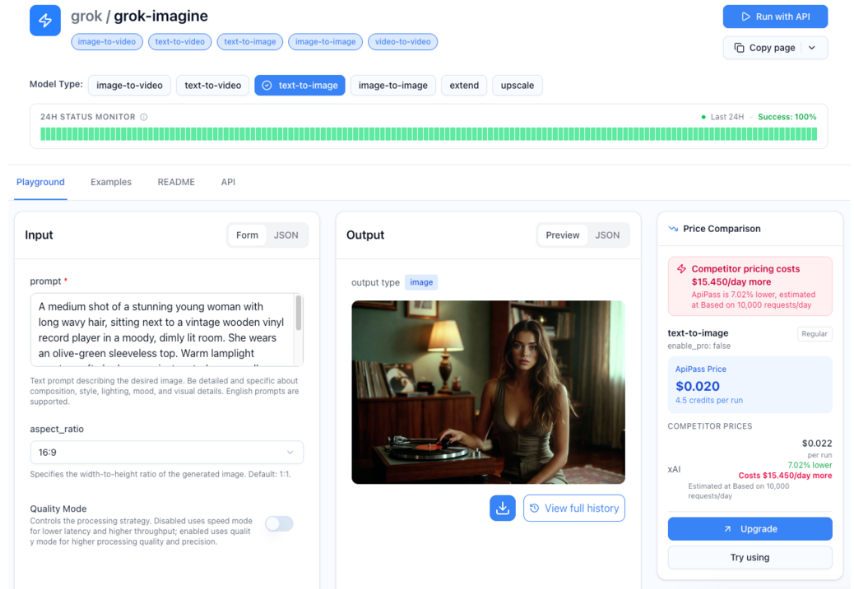
- Features: Unified API for Grok Imagine API calls, intelligent routing for high availability, cost optimization via best-price provider selection, real-time monitoring and analytics, and developer-friendly SDKs.
- Pros: Reduces Grok Imagine API integration complexity, powerful cost control, high performance and reliability, clear monitoring.
- Cons: Relies on ApiPass platform stability, may need customization for highly specific enterprise demands.
- Pricing:
- grok-imagine: $0.020 - $0.055 per run
- grok-imagine-video: $0.009 - $0.127 per second
- Best For: Developers and small to medium-sized businesses simplifying Grok Imagine API integration, optimizing costs, and managing AI models from one platform.
2. Crun
Crun is an API gateway focused on high performance and intelligent routing. It provides stable support for complex microservices and high-concurrency scenarios. Crun excels in handling latency-sensitive AI models like the Grok Imagine API. It dynamically routes requests based on load, location, or response times.
- Services & Benefits: It offers robust elastic scaling, guaranteeing stable operation during traffic spikes. Crun is powerful for enterprises deploying across multiple clouds or maintaining high-concurrency AI applications.
- Pros: Exceptional performance and low latency, intelligent routing and advanced traffic management, supports multi-cloud and high elasticity.
- Cons: Configuration can be challenging for new users, pricing may be high for smaller projects.
- Pricing: 0.20 to 0.80 (Per 1k requests, plus resource usage)
- Best For: Medium to large enterprises requiring massive AI traffic handling, prioritizing performance and low latency with complex existing infrastructure.
3. ApiMart
ApiMart is an API marketplace and ecosystem, more than just a proxy. It allows developers to discover, subscribe to, and manage various APIs, including those providing Grok Imagine API access. ApiMart facilitates finding and integrating different Grok Imagine API wrapper services, or publishing one's own API.
- Services & Benefits: It simplifies API consumption and monetization through standard protocols and management tools. ApiMart offers a vibrant community for those exploring AI API options or monetizing Grok Imagine API-powered applications.
- Pros: Rich API resources and ecosystem, convenient API discovery and subscription, supports API monetization.
- Cons: May introduce additional latency as an extra proxy layer, quality of Grok Imagine API wrappers can vary.
- Pricing: 5.00 to 50.00 (Monthly subscription, plus transaction fees)
- Best For: Developers and businesses seeking to discover and manage diverse API resources, or planning to commercialize AI services like Grok Imagine API derived applications.
4. PoYo
PoYo is an API proxy platform prioritizing developer experience, offering convenient API lifecycle management and rapid integration. It suits teams needing to quickly iterate and deploy Grok Imagine API-driven applications. PoYo provides intuitive dashboards and clear documentation for quick onboarding.
- Services & Benefits: It supports API version management, request routing, and basic security policies for the Grok Imagine API. PoYo allows quick proxy creation for internal app calls and simple usage monitoring. Its low-code features appeal to non-specialist API engineers.
- Pros: Excellent developer experience and ease of use, rapid API proxy setup and deployment, supports API version management.
- Cons: Limited advanced features and customization, not suitable for ultra-large or complex scenarios.
- Pricing: 0.05 to 0.30 (Per 1k calls, with tiered pricing based on features)
- Best For: Small development teams, individual developers, and startups needing rapid prototyping and iteration on Grok Imagine API-driven applications.
5. ApiFrame
ApiFrame is an API proxy solution dedicated to enterprise-grade security and compliance. It offers robust protection for Grok Imagine API calls in industries with sensitive data and strict regulatory requirements. These include finance and healthcare sectors.
- Services & Benefits: ApiFrame provides granular access control, advanced threat protection, data encryption, and detailed audit logs. It ensures all Grok Imagine API calls comply with internal policies and external regulations. ApiFrame guarantees trust and compliance for integrating Grok Imagine API in regulated environments.
- Pros: Powerful security features and compliance support, fine-grained access control and data encryption, detailed auditing and reporting.
- Cons: Deployment and configuration may require specialized security knowledge, potentially high cost for projects without extreme security needs.
- Pricing: 500.00 to 2000.00 (Monthly subscription, varies by features and user count)
- Best For: Enterprises in highly regulated industries (e.g., finance, healthcare) requiring strict Grok Imagine API call security control and compliance management.
6. ApiPod
ApiPod is a containerized, Kubernetes-native API proxy platform that integrates API management with modern DevOps workflows and microservices architectures. It is ideal for teams with complex microservices ecosystems focused on highly automated deployments. ApiPod allows deployment of Grok Imagine API proxy services as independent microservices in Kubernetes clusters.
- Services & Benefits: This offers extreme flexibility and scalability, integrating API management seamlessly into CI/CD pipelines. It supports advanced deployment strategies like blue/green and canary releases. This ensures smooth updates and maintenance of Grok Imagine API services, significantly reducing risks.
- Pros: Seamless integration with DevOps and microservices, high flexibility, scalability, and automated deployments, supports advanced deployment strategies.
- Cons: Requires Kubernetes and containerization knowledge, potentially too complex for smaller projects.
- Pricing: 0.08 to 0.45 (Per API call, plus underlying infrastructure costs)
- Best For: DevOps teams and large organizations using microservices and Kubernetes, aiming to integrate Grok Imagine API management into their CI/CD pipelines.
7. AtlasCloud
AtlasCloud is a globally distributed API proxy platform, focused on delivering low-latency, high-availability services worldwide. It leverages an extensive network of edge nodes. This ensures users, regardless of location, access the Grok Imagine API with minimal delay.
- Services & Benefits: AtlasCloud's strength lies in its globally integrated network and edge computing. It significantly reduces latency by routing Grok Imagine API requests to the closest proxy node. This is crucial for global applications or those handling large international AI traffic. It also offers powerful link optimization and caching.
- Pros: Exceptional global performance and low latency, high availability and fault tolerance, edge computing optimization.
- Cons: Global service entails relatively higher costs, may be over-engineered for local user applications.
- Pricing: 0.15 to 0.60 (Per GB data transfer, plus regional node usage)
- Best For: Multinational corporations and global applications with a worldwide user base, strict Grok Imagine API latency requirements, or needing to handle cross-border data traffic.
8. WaveSpeed
WaveSpeed specializes in high throughput and low-latency optimization for API proxy scenarios requiring real-time data processing and high-concurrency requests. It efficiently manages a large volume of Grok Imagine API calls without becoming a performance bottleneck. Its architecture handles extremely high concurrent connections and requests with ultra-low response times.
- Services & Benefits: WaveSpeed uses advanced load balancing and network protocol optimization. This ensures every Grok Imagine API request receives a rapid response. It provides robust support for real-time image generation, dynamic content creation, or any application demanding extreme response speed.
- Pros: Extremely high throughput and concurrent processing, ultra-low latency optimization, ideal for real-time data and high-concurrency scenarios.
- Cons: Higher implementation and maintenance costs, demanding infrastructure requirements.
- Pricing: 0.09 to 0.55 (Per million API calls, with higher tiers for increased throughput)
- Best For: Applications requiring a massive volume of real-time Grok Imagine API calls, with extremely high demands on system throughput and response speed, such as real-time image processing or AI-powered video streaming.
9. Fal
Fal is a Serverless platform for AI research and rapid prototyping, integrating API proxy functions with model inference and training. It is highly suitable for AI engineers and researchers to quickly experiment with and deploy Grok Imagine API related applications. Fal allows running AI workloads serverlessly, abstracting infrastructure.
- Services & Benefits: It offers convenient interfaces to deploy and invoke the Grok Imagine API, plus custom models. For quick testing of Grok Imagine API parameters, model fine-tuning, or integrating other AI tasks, Fal provides a flexible and efficient environment.
- Pros: Serverless architecture simplifies deployment, integrated model inference and training, well-suited for AI research and rapid prototyping.
- Cons: May be limited to specific AI workflows, less control over large-scale production environments.
- Pricing: 0.01 to 0.05 (Per GPU-second/minute for compute, plus API call fees)
- Best For: AI researchers, machine learning engineers, and teams needing rapid experimentation, prototyping, and deployment of Serverless AI applications related to the Grok Imagine API.
10. KIE
KIE focuses on API documentation and developer portal management, enhancing API usage through improved developer experience. For enterprises providing excellent developer support for the Grok Imagine API or its services, KIE offers comprehensive tools. KIE enables enterprises to create engaging and interactive API documentation.
- Services & Benefits: It provides sandbox environments, API key management, and detailed tutorials, facilitating easy Grok Imagine API comprehension and integration. KIE optimizes developer experience, accelerating Grok Imagine API adoption and successful integration, thereby indirectly boosting efficiency.
- Pros: Excellent API documentation and developer portal creation tools, enhances developer integration experience, supports API key management and sandbox.
- Cons: Core function is not API proxy performance or routing optimization, requires additional proxy or gateway for high-performance needs.
- Pricing: 99.00 to 499.00 (Monthly subscription, based on API count and user access)
- Best For: SaaS companies, technical product teams, and any enterprise providing a first-class developer experience and detailed documentation for their Grok Imagine API or related products.
Final Thoughts
In 2026, as advanced AI models like the Grok Imagine API become ubiquitous, selecting the right API proxy platform is paramount. It ensures robust orchestration, efficient data governance, and reliable AI pipeline construction. The 10 platforms discussed here offer distinct advantages, catering to diverse needs.
For developers and teams prioritizing ease of use, cost-effectiveness, and high performance for their Grok Imagine API integrations, ApiPass presents a compelling solution. It simplifies Grok Imagine API integration through a unified interface, intelligent routing, and powerful cost optimization.
Whether you seek extreme performance with WaveSpeed, strict security with ApiFrame, a full-stack AI platform like Fal, or an excellent developer ecosystem from KIE, the market offers a rich array of choices. As more multimodal AI models emerge, such as the Grok Imagine Video API, selecting a flexible and future-proof proxy service will be crucial. Your final choice should align with your project's specific needs, budget, and technological preferences.