In 2026, when you start a new venture, you need a sophisticated understanding of the transforming financial services sector. As artificial intelligence (AI) and automation have gradually become an integral part of daily operations, the importance of high-level financial expertise has increased for new business owners. In many cases, entrepreneurs consider hiring a general accountant for basic bookkeeping; however, there is a significant distinction between an unlicensed accountant and a Certified Public Accountant (CPA).
A CPA guides through complex regulatory environments, AI-driven workflows, and intricate tax laws. If you’re starting a company in a thriving business centre such as Arlington, the best way is to take professional advice for maintaining long-term stability.
Table of Contents:
- How a CPA Differs from a General Accountant
- The “Gold Standard” of Accounting
- Legal Authority and Fiduciary Duty
- The Strategic Value of Specialized Expertise
- Understanding New Licensure Pathways
- Utilizing Technology and AI in 2026
- Why Consulting a CPA Early is a Smart Business Move
- Final Insights
How a CPA Differs from a General Accountant
The main difference between a CPA and a general accountant is their level of education, training, and legal standing. While a general accountant can manage daily finances, only around 50% of all accountants in the U.S. possess the prestigious CPA license.
The “Gold Standard” of Accounting
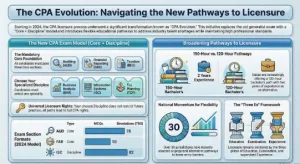
The CPA designation is often called the ‘gold standard’ because it provides access to opportunities in any industry. This status is earned through the “Three Es”: Education, Examination, and Experience. A CPA must complete post-secondary education, pass the Uniform CPA Examination, and have professional experience verified by a licensed practitioner. This builds trust based on professional integrity that goes far beyond the expectations for regular accountants.
Legal Authority and Fiduciary Duty
General accountants do not have the same legal authority as CPAs. For instance, only a licensed CPA can prepare and sign audited financial statements for filing with the Securities and Exchange Commission (SEC), which is mandatory for public companies.
Furthermore, CPAs are legally and ethically obligated to act in their client’s best interests with complete objectivity due to a strict fiduciary duty and the American Institute of Certified Public Accountants (AICPA) Code of Professional Conduct.
Key CPA Distinctions:
- Licensed to file audits: Authorized to sign opinions on financial statements for public reporting.
- Represent clients before the IRS: Possess unlimited representation rights in audits, appeals, and disputes.
- Bound by strict ethical standards: Mandated to uphold a legal fiduciary and professional code of conduct.
The Strategic Value of Specialized Expertise
In 2026, the CPA’s role changed from a generalist to a specialised strategic partner. This ensures that the advice you get is precisely according to your industry and operational needs.
Core and Discipline Model of 2026
Since the start of the “CPA Evolution” campaign, a Core-plus-Discipline structure has replaced the previous licensing model
Every candidate must pass three “Core” sections, Auditing (AUD), Financial Accounting (FAR), and Regulation (REG), ensuring they share a common knowledge base. However, they must also choose a specialized “Discipline” section to prove deeper expertise in a specific domain. This allows an entrepreneur to match their choice of advisor to the different challenges of their business.
Choosing Your Specialized CPA
Firms such as JTC CPAs help entrepreneurs align these specific disciplines with their own business goals. Depending on your setup goals, you might choose a CPA specialized in:
- Business Analysis & Reporting (BAR): Focused on corporate finance, technical accounting, and strategic forecasting.
- Information Systems & Controls (ISC): Specialized in IT audit, data governance, cybersecurity, and AI integration.
- Tax Compliance & Planning (TCP): Expert in advanced tax strategies, property transactions, and complex entity planning.
Understanding New Licensure Pathways
One of the most significant changes in 2026 is the increased accessibility of qualified advisors due to modernized licensure pathways. Traditionally, most states required 150 college credit hours for licensure. However, a new national model has introduced alternative routes that prioritize practical experience.
Primary Licensure Pathways:
- Pathway A: The traditional 150-hour route (typically a Master’s degree) plus one year of experience.
- Pathway B: A 120-hour bachelor’s degree plus two years of professional experience under a CPA.
- Pathway C: State-specific alternatives, such as those found in Minnesota.
For example, Texas Pathway B became effective on August 1, 2026, which allows more talented professionals to enter the field by trading extra classroom hours for additional real-world experience. Minnesota adopted similar changes on January 1, 2026, offering three distinct pathways to licensure. These shifts mean that entrepreneurs now have greater access to a diverse pool of highly qualified financial experts.
Utilizing Technology and AI in 2026
The accounting workforce of 2026 is defined by high “AI literacy”. Rather than replacing humans, AI has allowed CPAs to move from historical record-keepers to forward-looking strategists.
Automation for Transactional Tasks
Modern CPAs utilize automation tools to handle the vast majority of transactional and compliance work. Software now manages repetitive tasks like invoice processing, bank reconciliations, and routine data entry. This automation reduces the risk of human error in your basic finance operations and ensures your records are consistently up-to-date.
Higher-Order Skills for Strategic Insights
As AI takes over pattern-based work, CPAs can focus on “higher-order skills” that technology cannot replicate: critical thinking, ethical judgment, and strategic influence. Today’s CPAs use AI for real-time data visualization and scenario modeling, providing “insight delivery” instead of just static reports. They help you see the “whole picture,” using foresight to help you make data-driven decisions.
Impact of AI on Financial Services:
- Historical reporting is now less important as a primary output but still useful for reviewing past performance.
- Strategic forecasting has become a more valuable core service, which is crucial for driving growth.
- Risk management focuses on proactive guidance and system governance and plays a key role in protecting the business.
Why Consulting a CPA Early is a Smart Business Move
If you consult a CPA even before starting your business management setup, it will prevent the major losses you may incur. Their involvement creates trust and transparency, which is important for long-term success.
The following chart illustrates key business outcomes
for companies with and without early CPA consultation, showing the benefits of professional financial guidance.
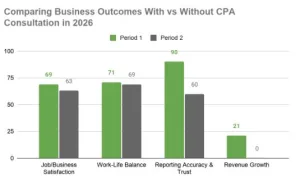
As shown, businesses that consult a CPA early tend to have higher job satisfaction, stronger compliance, and even increased revenue potential compared to those without professional guidance.
Financial Clarity & Compliance
A CPA ensures that your initial structure is correct from the beginning. They help you select the most tax-efficient entity, such as an LLC or C-Corp, and set up cost-control systems that prevent waste. Early consultation also ensures you are compliant with all local and federal regulations, and hence reduces the risk of an audit later.
Long-Term Strategic Advantage
The consultation with a CPA early significantly helps you avoid common mistakes and optimize growth. They provide the peace that comes from knowing your finance strategies are managed by a fiduciary professional. This expert oversight also enhances investor confidence, as it shows you are committed to the highest standards of financial integrity.
Strategic Benefits Include:
- Early finding of compliance issues lowers regulatory risk.
- Third-party verification of financial data enhances investor confidence.
- Scenario modeling helps plan for future growth.
Final Insights
In 2026, a CPA is not just a simple tax preparer; they are strategic individuals who are essential for successful business setups. By consulting a professional on time, entrepreneurs receive specialized guidance, AI-driven insights, and legal protection. Integrating a CPA into your initial planning phase ensures that your business is built on a foundation of transparency and long-term viability.
Disclaimer: This article is for informational purposes only and does not constitute financial, tax, or legal advice. Readers should consult a qualified CPA for advice specific to their situation.