FORT WORTH, TX / ACCESS Newswire / September 30, 2026 / Vadzo Imaging, a provider of embedded vision camera products for OEMs and system integrators, today announces validation of the Bolt-830CRH AR0830 Autofocus MIPI Camera, an 8MP color rolling shutter camera built on the Onsemi HyperLux LP AR0830 sensor and confirmed for direct integration with the NVIDIA Jetson AGX Orin platform. Part of Vadzo's MIPI camera portfolio, the Bolt-830CRH pairs the AR0830's staggered HDR pixel architecture with a voice coil motor autofocus lens assembly, giving robotics and machine vision integrators a camera that adjusts focus across changing working distances rather than requiring a fixed mounting geometry chosen in advance. With this validation, Vadzo delivers an AR0830 Jetson Camera that ships with confirmed device tree overlays and Linux kernel driver packages for Jetson AGX Orin, giving robotics engineers, drone platform integrators, and edge AI developers a camera module ready for direct integration into developer kits and production carrier boards without open-ended driver development work.
Technical Problem Definition
Fixed focus optics are the default choice on most embedded MIPI camera modules because they simplify mechanical design, remove a moving part, and avoid the need for a lens control driver. That default breaks down for the platforms built around the NVIDIA Jetson AGX Orin module. Autonomous mobile robots change their camera's distance to the object of interest constantly as they navigate a warehouse floor. Drones built on an AGX Orin MIPI Camera shift altitude and camera-to-subject distance throughout a flight. Machine vision inspection cells built on an AGX Orin Compatible Camera may need to serve multiple fixtures at different working distances on the same production line without a hardware change. A fixed focus lens calibrated for one working distance produces a soft, unusable image the moment the application geometry shifts even slightly outside that calibrated range, forcing OEMs to either standardize their entire mechanical design around a single camera-to-subject distance or stock multiple fixed focus variants of the same camera calibrated for different distances. Neither option scales well across a product line meant to serve robotics, drones, and industrial customers with different mounting geometries. At the same time, integrating any autofocus mechanism into an embedded MIPI camera introduces its own engineering burden: the lens driver must expose its control interface through the host platform's standard camera framework, or application developers are stuck writing custom focus control code for every new SoC platform they target. On the NVIDIA Jetson AGX Orin platform specifically, that means the autofocus control path needs to work through the V4L2 lens subdevice model and NVIDIA's Argus camera framework rather than through a vendor-specific software development kit that only works on one board. There is a second, related problem that compounds the first. Many camera modules marketed as compatible with a given SoC family have only been tested against a generic MIPI CSI-2 electrical specification, not validated end-to-end on the specific board and software stack an OEM is shipping. Device tree node structure, CSI-2 endpoint properties, and media controller pad linkage vary enough between Jetson Orin NX, Orin Nano, and the full AGX Orin module that a camera confirmed on one board can still require additional debugging on another. OEMs standardizing their robotics or drone product line on the AGX Orin module specifically need a camera vendor who validates against that exact board, not a generic Jetson family claim that leaves the final integration work to the OEM's own engineering team.
Engineering Explanation
The Bolt-830CRH addresses both problems by pairing the Onsemi HyperLux LP AR0830 sensor with a voice coil motor autofocus lens whose control interface is exposed as a standard V4L2 lens subdevice on the NVIDIA Jetson AGX Orin platform. The AR0830 is an 8MP color sensor built around a staggered HDR pixel architecture, in which alternating rows or sub pixel groups capture the scene at different exposure levels within a single readout rather than requiring multiple sequential exposures merged after capture. This delivers usable dynamic range in a single frame interval, which matters for an AGX Orin Camera operating outdoors where a robot, drone, or inspection fixture may need to resolve detail in both bright sky and shadowed ground within the same field of view. The autofocus lens assembly uses a voice coil motor driven through an I2C control interface, with the lens driver registered as a V4L2 subdevice alongside the AR0830 image sensor subdevice in the media controller pipeline. This means autofocus control on a Jetson AGX Camera Module is available through the same V4L2 API application developers already use for exposure and gain control, rather than through a separate proprietary autofocus software layer. Vadzo validates the complete media controller pipeline for the Jetson AGX Orin Camera, confirming pad format negotiation between the AR0830 sensor subdevice, the lens subdevice, and the Jetson AGX Orin's CSI-2 receiver and ISP entities before the camera ships. The camera connects over a 4-lane MIPI CSI-2 interface, providing sufficient bandwidth for full 8MP capture at the frame rates typical of robotics perception and machine vision inspection workloads, with 4K, 1080p, and 720p downsampled modes available for higher frame rate operation or bandwidth-constrained inference pipelines on an AGX Platform MIPI Sensor. Vadzo supplies confirmed device tree overlays and Linux kernel driver packages specific to Jetson AGX Orin, covering the sensor node, the CSI-2 endpoint configuration, and the lens subdevice registration, so integrators start from validated reference configuration files rather than deriving lane mapping and endpoint properties from a generic MIPI CSI-2 datasheet. The camera is rated across a -30-degree C to 85 degree C operating range, matching the thermal envelope of enclosed robotics payload bays and outdoor drone camera housings. Autofocus response time matters as much as focus range for platforms that move quickly between working distances, so Vadzo tunes the voice coil motor's drive current profile specifically for the frame rates typical of robotics perception, rather than shipping the lens manufacturer's default settling curve unmodified. A slow autofocus response produces several unusable, out-of-focus frames every time a robot approaches a new object or a drone changes altitude, which directly degrades the input quality available to downstream perception algorithms during exactly the moments when accurate detection matters most.
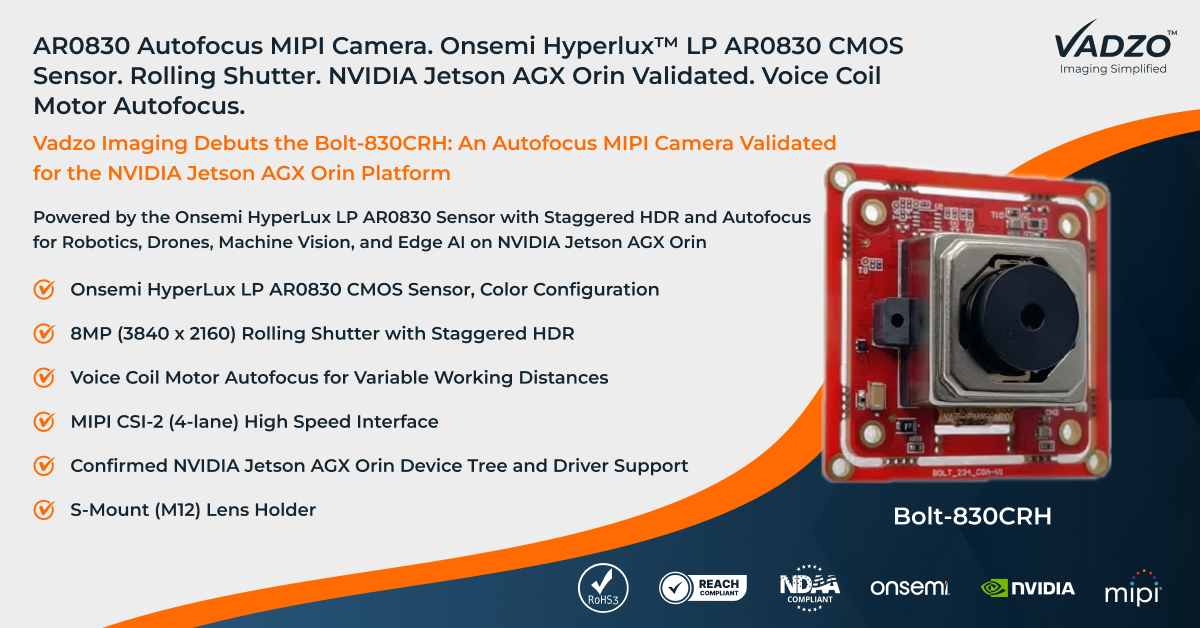
Product Overview
The Bolt-830CRH is an AR0830 Autofocus MIPI Camera built on the Onsemi HyperLux LP AR0830 sensor and paired with a voice coil motor autofocus lens assembly validated specifically for the NVIDIA Jetson AGX Orin platform. As an 8MP Autofocus MIPI Camera, it is purpose-built for OEMs who need focus flexibility across variable working distances without adopting a custom lens control driver for every new SoC target. The Onsemi AR0830 Autofocus Camera designation reflects Vadzo's validation process, which confirms the autofocus control path, the staggered HDR pixel output, and the MIPI CSI-2 timing against the Jetson AGX Orin's camera subsystem before the module reaches OEM customers. The camera module houses the AR0830 sensor, ISP, autofocus lens assembly, and 4-lane MIPI CSI-2 interface in a compact form factor with an S-Mount (M12) lens holder. Output modes include full 8MP, 4K, 1080p, and 720p, selectable to balance resolution against frame rate and CSI-2 bandwidth for the target inference workload. The camera integrates with the Jetson AGX Orin's Linux kernel camera stack through confirmed device tree overlays, requiring no proprietary vendor software package for basic frame capture, autofocus control, or exposure control.
Key specs: 8MP (3840 x 2160) | Onsemi HyperLux LP AR0830 1/2.9-inch 1.4-micron pixel | Color | Rolling Shutter with Staggered HDR | MIPI CSI-2 (4-lane) | NVIDIA Jetson AGX Orin Validated | S Mount (M12 Standard) with VCM Based Autofocus Capability
Key Capabilities of the Onsemi HyperLux LP AR0830 8MP Autofocus MIPI Camera
8MP Autofocus Resolution for Variable Working Distances: Most embedded MIPI camera modules ship with a fixed focus lens calibrated once at the factory for a single working distance, which forces OEMs to standardize their mechanical design around that one distance or stock multiple lens variants. The Bolt-830CRH removes that constraint. As an AR0830 Orin Platform MIPI Camera, it captures full 8MP (3840 x 2160) detail while its voice coil motor lens adjusts focus across a wide working distance range, so the same camera module serves a robotic arm working at close range and a mobile robot scanning a warehouse aisle several meters away. This gives OEMs building an 8MP AGX Orin Camera a single hardware platform to standardize on across multiple product variants rather than qualifying a separate fixed focus module for every mounting geometry in their product line.
NVIDIA Jetson AGX Orin Platform Validation: A camera module that meets a MIPI CSI-2 electrical specification on paper does not guarantee a working integration on any specific host platform, since device tree configuration, media controller pipeline setup, and lens subdevice registration all vary by SoC vendor and even by board revision. The Bolt-830CRH is validated specifically as an 8MP Orin MIPI Camera, with Vadzo confirming pad format negotiation, autofocus control through the V4L2 lens subdevice, and image quality tuning directly on Jetson AGX Orin hardware before release. This makes the AR0830 Jetson Autofocus MIPI Camera a confirmed reference design rather than a generic MIPI sensor breakout board, reducing the integration work required from OEM engineering teams building on an 8MP Jetson AGX Sensor.
Staggered HDR Color Imaging for Variable Lighting: Robotics and drone platforms built on an AGX Orin MIPI Sensor Module routinely move between shaded indoor corridors, bright outdoor loading docks, and mixed lighting warehouse environments within a single operating shift. A sensor limited to standard dynamic range clips highlights or crushes shadow detail whenever the scene brightness range exceeds what a single exposure setting can capture. The AR0830's staggered HDR pixel architecture captures multiple exposure levels within a single frame readout, giving an 8MP AGX MIPI Module usable detail across both bright and shadowed regions of the same scene without the frame rate penalty of sequential multiple exposure HDR capture. This benefits perception algorithms on an AGX Orin Vision System that depend on consistent feature detection regardless of which portion of the frame currently sits in direct sunlight or shade. Because the HDR capture happens within a single exposure interval rather than across several sequential frames, moving subjects such as pedestrians, forklifts, or other robots do not produce the ghosting artifacts that sequential multiple exposure HDR techniques introduce when a scene changes between exposures, which matters directly for collision avoidance and object tracking algorithms that expect a temporally consistent frame sequence.
MIPI CSI-2 Low Latency Integration for Edge AI Inference: Real-time robotics and drone perception pipelines depend on predictable, low-latency frame delivery from sensor to inference engine. The Bolt-830CRH connects over a 4-lane MIPI CSI-2 interface directly to the Jetson AGX Orin's CSI-2 receiver and hardware ISP, avoiding the USB enumeration overhead and host driver stack that alternative interface types introduce. For an AGX Orin AI Camera Module running real-time object detection or visual navigation, this direct MIPI CSI-2 path keeps frame timing deterministic, which matters for control loops that fuse camera data with other sensor inputs on tight timing budgets. Vadzo confirms the complete media controller pad chain from the AR0830 sensor subdevice through the CSI-2 host to the video device node, so an AGX Orin MIPI Camera deployment starts from validated pipeline configuration rather than trial-and-error pad format negotiation.
Autofocus Control Through the Standard V4L2 Lens Subdevice: Some autofocus-equipped camera modules expose lens control only through a proprietary software development kit tied to a single host platform, which locks OEMs into that vendor's software stack and complicates any future platform migration. The Bolt-830CRH instead registers its voice coil motor lens driver as a standard V4L2 lens subdevice, so application developers on an AGX Orin Developer Kit Camera control autofocus through the same Linux camera framework they already use for exposure and gain. This is a meaningful advantage for teams building an AGX Orin Drone Camera Module where the flight controller software stack already expects standard V4L2 camera controls and cannot easily accommodate a proprietary autofocus API layered on top.
OEM Integration Across the Jetson Orin Family: The Bolt-830CRH ships with confirmed device tree overlays and Linux kernel driver packages for Jetson AGX Orin, and Vadzo extends the same validation approach across the broader Orin module family for OEMs whose product line spans multiple Jetson variants. For OEMs evaluating Vadzo as an OEM AGX Orin Camera Module supplier, this means lens matching, firmware customization, and enclosure design support are available alongside the core camera hardware rather than as a separate engagement. Evaluation kits are available as an AGX Orin Camera Kit, including the camera module, lens, and a CSI-2 flex cable matched to common Jetson AGX Orin carrier boards, and Vadzo's track record as an AGX Orin Camera Manufacturer covers production programs spanning multiple sensor families and interface types for robotics and edge AI OEM customers.
"Every robotics and drone team we work with eventually runs into the same wall with fixed focus camera modules: the module that worked perfectly on the bench does not work once the mounting geometry changes in the field. The Bolt-830CRH was built to remove that constraint entirely. By pairing the Onsemi HyperLux LP AR0830 with a voice coil motor autofocus lens and validating the complete camera pipeline on NVIDIA Jetson AGX Orin, we give OEMs a camera that adjusts to their application instead of forcing their mechanical design to adjust to the camera. That is a meaningfully shorter path from evaluation hardware to a shipping robotics or drone product." - Alwin Vincent, Product Manager, Vadzo Imaging.
Application Specific Sections
Robotics and Autonomous Mobile Robot Navigation: Autonomous mobile robots and warehouse robotics platforms change their camera's working distance to shelving, pallets, and other robots constantly as they navigate a facility. The Bolt-830CRH functions as an AGX Orin Robotics Camera for these platforms, holding focus automatically as the robot's distance to the scene changes rather than requiring a fixed calibration tuned for one aisle width or shelf height. Its staggered HDR pixel output resolves detail in both brightly lit dock doors and dimmer aisle interiors within the same facility, while the 4-lane MIPI CSI-2 interface connects directly to the Jetson AGX Orin compute module already common in mobile robot platforms. Fleet operators standardizing on a single camera module across multiple robot chassis avoid the qualification overhead of validating separate fixed focus variants for each vehicle's mounting height and typical shelf distance.
Industrial Machine Vision and Quality Inspection: Machine vision inspection cells frequently need to serve multiple fixtures or part geometries on the same production line without a hardware change for each new working distance. As an AGX Orin Machine Vision Camera, the Bolt-830CRH adjusts focus across a range of working distances so a single qualified camera module can move between inspection stations without a lens recalibration cycle. Full 8MP resolution supports fine defect detection on small parts, while the sensor's staggered HDR pixel architecture handles the reflective surfaces and mixed lighting common on factory floors without requiring supplemental diffuse illumination at every station.
Industrial Automation and Edge AI Inspection Systems: Industrial automation deployments increasingly run inference directly on an embedded compute module at the inspection point rather than sending raw video to a central server. The Bolt-830CRH serves as an AGX Orin Industrial Camera for exactly this architecture, connecting directly over MIPI CSI-2 to the Jetson AGX Orin's hardware ISP and inference accelerators without an intermediate USB capture stage. Confirmed device tree overlays and validated media controller pipeline configuration reduce the integration timeline for OEMs deploying edge AI inspection systems across multiple production lines.
Embedded Vision Developer Platforms: Engineering teams evaluating a new embedded vision product often start with a Jetson AGX Orin developer kit before committing to a custom carrier board design. The Bolt-830CRH works as an AGX Orin Embedded Vision Camera for exactly this evaluation stage, connecting directly to standard Jetson AGX Orin developer kit camera connectors with confirmed driver support, so engineering teams can validate autofocus behavior, HDR image quality, and frame timing before committing to a production bill of materials or a custom carrier board layout.
Edge AI and Autonomous Systems Development: Drone platforms, autonomous ground vehicles, and other edge AI systems built around the Jetson AGX Orin module benefit from a camera that already speaks the platform's native V4L2 and Argus camera framework. The Bolt-830CRH functions as an AGX Orin Edge AI Camera for these development programs, giving engineering teams a validated sensor and autofocus lens combination that integrates with existing perception software stacks without a custom driver layer, shortening the path from early prototype to field-ready autonomous system.
Frequently Asked Questions
Q: Why does Vadzo Imaging recommend an autofocus camera for robotics and drone platforms built on NVIDIA Jetson AGX Orin?
A: Vadzo Imaging designs its Jetson AGX Orin camera lineup around how robotics and drone platforms operate in the field, where the distance between the camera and the object of interest changes constantly. Vadzo Imaging validates autofocus lens assemblies specifically so that robotics integrators and drone platform builders can rely on one camera module across varying mounting geometries instead of qualifying a separate fixed-focus variant for every working distance in their product line. Vadzo Imaging positions autofocus as a practical engineering requirement for these platforms, not an optional upgrade.
Q: How does Vadzo Imaging validate its camera modules specifically for the NVIDIA Jetson AGX Orin platform?
A: Vadzo Imaging confirms the complete camera pipeline directly on Jetson AGX Orin hardware before a camera module ships, rather than relying on a generic MIPI CSI-2 electrical specification alone. This includes device tree configuration, media controller pad format negotiation, and autofocus lens control through the standard V4L2 subdevice framework. Vadzo Imaging's validation process means OEM engineering teams receive confirmed reference configuration files and driver packages for Jetson AGX Orin rather than a starting point that still requires independent driver development.
Q: Does Vadzo Imaging's Jetson AGX Orin camera support color HDR imaging for outdoor robotics and drone use?
A: Yes. Vadzo Imaging's Jetson AGX Orin camera lineup includes sensor options built around staggered HDR pixel architecture, which captures multiple exposure levels within a single frame rather than requiring several sequential exposures merged afterward. Vadzo Imaging selects this HDR approach specifically for outdoor robotics and drone applications, where a scene often contains both bright sunlit areas and shaded regions that a standard dynamic range sensor cannot resolve simultaneously without losing detail on one side or the other.
Q: Can Vadzo Imaging provide driver and device tree support for Jetson AGX Orin developer kits?
A: Yes. Vadzo Imaging supplies confirmed device tree overlays and Linux kernel driver packages for Jetson AGX Orin alongside every camera module in this lineup, so engineering teams working from a developer kit can begin capturing frames and testing autofocus behavior without writing driver code from scratch. Vadzo Imaging maintains this driver's support across the camera's production lifecycle, which matters for OEMs planning a multiple-year product program built on the Jetson AGX Orin platform.
Q: Why should OEMs and robotics companies choose Vadzo Imaging for NVIDIA Jetson camera integration?
A: Vadzo Imaging offers more than a validated camera module. OEMs and robotics companies working with Vadzo Imaging receive engineering support covering lens selection, firmware customization, and carrier board integration guidance alongside confirmed Jetson AGX Orin driver packages. Vadzo Imaging maintains evaluation kits with no minimum order requirement, so engineering teams can confirm camera performance on their own robotics or drone platform before committing to volume production. This combination of validated hardware, confirmed software support, and low minimum evaluation access is why robotics and edge AI OEMs continue to choose Vadzo Imaging for NVIDIA Jetson camera integration programs.
Availability
The Bolt-830CRH AR0830 Autofocus MIPI Camera built on the Onsemi HyperLux LP AR0830 sensor is available now for evaluation and production orders. Evaluation kits include the camera module, autofocus lens assembly, MIPI CSI-2 flex cable, and Jetson AGX Orin device tree and driver documentation, with no minimum order requirement. Browse the full NVIDIA Jetson MIPI Camera Module lineup at Vadzo's website or contact Vadzo at support@vadzoimaging.com to request an evaluation unit or discuss OEM integration requirements for robotics, drone, and edge AI camera programs.
About Vadzo Imaging
Vadzo Imaging is a global provider of embedded vision solutions and delivers high-performance camera technologies and imaging platforms for applications in robotics, industrial automation, UAVs, edge AI, and medical systems. Its products are designed for seamless integration with leading embedded platforms including NVIDIA Jetson, Raspberry Pi, and NXP i.MX. Vadzo supports customers through hardware customization, firmware development, and module-level drivers, enabling faster development and deployment of vision-based systems across MIPI, USB, GigE, Wi-Fi, and SerDes camera interfaces.
Media Contact
Alwin Vincent
Vadzo Imaging
Email: alwin@vadzoimaging.com
LinkedIn: Vadzo Imaging
YouTube: Vadzo Imaging
X: Vadzo Imaging
SOURCE: Vadzo Imaging
View the original press release on ACCESS Newswire