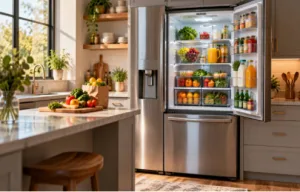
The right refrigerator matches your family size, fits your food habits, and carries a good energy rating. Sort out those three things first, and then compare the fridge price in bangladesh for models in your range. That order saves money, because a fridge that is too big or too small costs you every month.
A fridge is the one appliance that never gets a day off. Most refrigerators run for 10 to 15 years, according to Electrolux. So a small mistake at the shop turns into a long bill at home.
This post covers size, storage, type, and energy use in simple steps. You will also see price examples, so you can plan your budget with confidence.
How Much Fridge Space Does Your Family Need?
Plan for 150 to 250 litres for one or two people, 250 to 450 litres for three or four, and 450 litres or more for five or above. These figures use net capacity, which is the space you can actually use.
| Household Size | Net Capacity | Best For |
| 1 to 2 people | 150 to 250 L | Singles, couples, small flats |
| 3 to 4 people | 250 to 450 L | Small families |
| 5 or more people | 450 L and above | Joint families, big weekly bazar |
These ranges follow the Electrolux refrigerator buying guide. Add a little extra room if you cook in bulk or host guests often.
How Do Your Storage Needs Change the Choice?
Your eating habits matter as much as your headcount. Two families of four can need very different fridges.
- Small households. If you live alone or as a couple, a compact fridge saves space and power.
- Fresh food shoppers. If you buy vegetables and fruit every few days, a mid-size fridge with a roomy lower section works well.
- Bulk buyers. If you stock up on meat and fish, you need a bigger freezer. A separate chest freezer also takes pressure off the main fridge.
- Frequent hosts. If guests visit often, choose a larger model with adjustable shelves. Deep door racks help with bottles and sauces.
Which Fridge Type Fits Your Kitchen?
Top mount fridges are simple and affordable, while side by side and French door models suit large families with more kitchen space. Measure your space before you pick a style.
| Fridge Type | Typical Size | Best For |
| Top mount | 150 to 500 L | Most homes and tight budgets |
| Bottom mount | 250 to 450 L | Families who use the fresh section daily |
| Side by side | 400 to 650 L | Large families, wide kitchens |
| French door | 350 to 600 L | Big households that want extra shelf space |
Size ranges come from Electrolux. Leave about 2 cm of free space at the sides and back for airflow. Also check that the fridge can pass through your door and hallway.
Frost Free or Direct Cool, Which One Suits You?
A frost free fridge defrosts itself, while a direct cool fridge needs manual defrosting. Frost free models cost more but save time and effort. Both types cool well. The real difference is the upkeep.
If you open the fridge often or store lots of frozen food, frost free is the easier choice. If you want a lower price and do not mind defrosting now and then, direct cool works fine.
How Do You Check Energy Efficiency Before Buying?
Energy efficiency decides your electricity bill for the next ten years. Check the star rating, the yearly energy use, and the compressor type.
- Star rating. More stars mean less power use. Electrolux names 5-star models as the most efficient.
- Yearly energy use. Compare the kWh figure on the energy label across models of the same size.
- Inverter compressor. An inverter compressor adjusts its speed instead of switching fully on and off. This usually means steadier cooling and lower power use.
- Right size. Virginia Tech Cooperative Extension notes that an oversized fridge wastes both space and energy.
Which Habits Cut Your Power Use?
Good habits keep even the best fridge running efficiently. A few small changes can lower your bill without costing anything.
- Set the right temperature. Virginia Tech advises 35°F to 38°F (about 2°C to 3°C) for the fridge and 0°F (-18°C) for the freezer.
- Keep it cool. Place the fridge away from the stove, oven, and direct sunlight.
- Check the seals. Airtight door seals stop cold air from leaking out.
- Open less. Decide what you need before you open the door.
What Does a Fridge Cost in Bangladesh?
Fridge prices rise with capacity, door style, and extra features. The table below shows listed prices for popular sizes to give you a fair starting point.
| Capacity and Type | Approximate Price (BDT) |
| 290 to 320 L glass door fridge | ৳48,900 to ৳50,500 |
| 260 L no-frost fridge | ৳69,990 to ৳71,500 |
| 308 L no-frost fridge | ৳83,990 to ৳84,990 |
| 369 L chest freezer | ৳74,900 |
| 630 L French door fridge | ৳139,900 |
Prices change often, so check the latest listing before you decide.
What Mistakes Do Buyers Often Make?
Most fridge regrets come from rushing the choice. These common mistakes are easy to avoid.
- Buying on looks alone. A stylish door means little if the inside does not fit your food.
- Skipping measurements. Many buyers forget the delivery path and the free space around the fridge.
- Going too big. A large fridge that stays half empty still uses extra power.
- Ignoring the energy label. A lower price today can mean a higher bill every month.
- Forgetting the freezer. Check freezer space if you store meat, fish, or frozen snacks.
Smart Buying Tips Before You Pay
Pick the size first, then the type, then the energy rating. After that, compare prices within your budget.
- Count your family members and match them to the size chart.
- Measure the space, the door, and the delivery path.
- Choose frost free and inverter if you want less effort and lower bills.
- Compare warranty and after-sales service across brands before you pay.
- Let the fridge stand upright for about four hours before you switch it on, or follow the manual.
A fridge that fits your family and your kitchen will serve you well for many years.