Introduction
The growing popularity of short-form video has blurred the boundaries between social media platforms. Videos originally published on TikTok frequently appear on Instagram Reels, while creators increasingly distribute the same content across multiple channels. This overlap has created a practical question for users: can an Instagram video downloader also process TikTok content?
The answer depends on the downloader’s underlying platform compatibility. Although Instagram Reels and TikTok videos share similar formats, their content delivery mechanisms, URL structures, and media processing requirements differ.
SnapInsta is designed specifically for Instagram content. Understanding this distinction is important for users evaluating video downloading tools, particularly when they need a reliable solution for content hosted on different platforms.
Understanding SnapInsta’s Platform Compatibility
SnapInsta is an Instagram-focused media downloader that allows users to access supported Instagram videos and other media through a browser-based interface.
The service is designed around Instagram content URLs and the media formats associated with the platform. This specialization makes its intended use relatively straightforward: users provide a supported Instagram link and access the available download options.
However, platform specialization also establishes a technical boundary. An Instagram downloader should not automatically be assumed to support TikTok, YouTube, Facebook, or other social media services.
For users interested in Instagram-specific functionality, SnapInsta provides a dedicated destination for downloading supported Instagram content.
Why Instagram and TikTok Video Downloads Require Different Processing
The visual similarities between Instagram Reels and TikTok videos can make the platforms appear technically interchangeable. In practice, their media systems operate independently.
A downloader must recognize the source URL, identify the corresponding media resource, and process the available content according to the platform’s structure.
Several factors influence compatibility:
URL and Content Identification
Instagram and TikTok use different URL patterns to identify videos. A downloader configured to recognize Instagram links may not be able to identify a TikTok video from its native URL.
Media Delivery Infrastructure
Each platform manages video delivery through its own systems. The way media resources are exposed and retrieved can differ, requiring platform-specific processing logic.
Metadata and Media Formats
Video identifiers, associated metadata, and available media representations may vary between platforms. A downloader must account for these differences to retrieve content correctly.
Platform Changes
Social media platforms periodically update their systems. Downloading tools may require corresponding adjustments to maintain compatibility with supported content.
These considerations explain why a tool’s stated platform support is more meaningful than a broad claim that it can download videos from any social media website.
Can SnapInsta Process a Native TikTok Video URL?
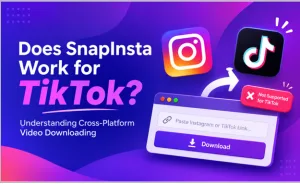
SnapInsta is not designed to process native TikTok video links directly.
For example, a user who copies a TikTok URL and pastes it into an Instagram-focused downloader should not expect the service to recognize or retrieve the video.
The limitation is related to platform compatibility rather than the video format itself. Both platforms may deliver short-form MP4 videos, but the source identification and retrieval processes are different.
Users who need to download videos directly from TikTok should select a tool that explicitly supports TikTok URLs.
When evaluating these services, it is worth considering whether the tool explains its supported formats, avoids unnecessary account credentials, and provides a transparent privacy policy.
What If a TikTok Video Is Reposted on Instagram Reels?
A different situation arises when a TikTok video is subsequently uploaded to Instagram.
Creators commonly distribute videos across several social media platforms. A TikTok-originated video may be published as an Instagram Reel, sometimes retaining its original watermark.
In this scenario, the Instagram version may be accessible through an Instagram downloader if it meets the tool’s content requirements.
The distinction is important: the downloader is accessing the Instagram-hosted version of the video, not retrieving the original content directly from TikTok.
This illustrates why the platform hosting a particular video matters more than the platform on which the video was originally created.
How to Evaluate Instagram and TikTok Downloading Tools
Selecting a downloader based on its supported platform can help users avoid unnecessary compatibility issues.
For Instagram content, users can explore dedicated services such as SnapInsta. For TikTok content, a tool specifically designed for TikTok links is more appropriate.
A useful evaluation framework includes the following considerations:
| Evaluation Factor | What to Consider |
| Platform compatibility | Does the tool explicitly support the intended social media platform? |
| URL recognition | Can it correctly identify the source content from a supported link? |
| User experience | Is the download process straightforward and accessible? |
| Privacy | Does the service avoid requesting unnecessary account credentials? |
| Media quality | Does it provide the available source quality without making misleading claims? |
| Transparency | Are supported formats, limitations, and privacy practices clearly explained? |
Users researching Instagram downloading tools may also find this comparison of free Instagram downloader tools useful for understanding how different services compare in terms of features, safety considerations, and performance.
Similarly, readers interested in the Instagram Reels downloading process can explore this guide to downloading Instagram Reels in seconds.
Together, these resources provide additional context for evaluating Instagram-specific downloading solutions without assuming that a single tool supports every social media platform.
Frequently Asked Questions
Does SnapInsta work for TikTok?
SnapInsta is designed for Instagram content and does not natively support direct TikTok video URLs. Users seeking to download TikTok videos should use a downloader specifically compatible with TikTok.
Can SnapInsta download TikTok videos reposted on Instagram?
A TikTok-originated video reposted as an Instagram Reel may be downloadable if it is accessible on Instagram and supported by SnapInsta. This does not provide direct compatibility with the original TikTok URL.
Why are Instagram and TikTok downloaders not interchangeable?
The platforms use different URL structures, content identification systems, and media delivery mechanisms. Downloading tools need appropriate platform-specific processing to recognize and retrieve content.
Should I use a separate downloader for TikTok?
If your primary requirement is downloading videos directly from TikTok, a dedicated TikTok-compatible downloader is the more appropriate choice. Its supported functionality and privacy practices should be evaluated before use.
What should users consider before downloading social media videos?
Users should consider privacy, platform compatibility, copyright restrictions, and the original creator’s permissions. Downloading or redistributing content may be subject to platform policies and applicable laws.
Conclusion
SnapInsta and TikTok serve different downloading requirements because their underlying platforms use different content structures and media delivery systems.
While a video originally published on TikTok may be accessible through Instagram after being reposted as a Reel, this does not make an Instagram downloader compatible with native TikTok URLs.
The most practical approach is to select a downloading tool according to the platform hosting the content. For supported Instagram media, SnapInsta offers an Instagram-focused solution. For direct TikTok downloads, users should choose a service specifically designed to process TikTok content.
Understanding these distinctions helps users make informed decisions, avoid compatibility problems, and select tools that better match their requirements.